Wednesday, May 29, 11:00 AM-1:00 PM in SS 2127 (note irregular location).
Syntax Group
Julianne Doner (Ph.D.) on what happens when null subjects are lost; Andrew Peters (Ph.D.): on Mongolian converbs.

University of Toronto Department of Linguistics Blog
May 28, 2019

May 27, 2019
Public lecture: Monika Molnar (University of Toronto)
Monika Molnar (faculty) of the Department of Speech-Language Pathology is giving a free public lecture on Thursday, May 30, from 6:30 PM to 7:30 PM in room 132 of the Rehabilitation Sciences Building (500 University Avenue) as part of the May Month events aiming to draw attention to speech and hearing awareness: "Childhood bilingualism from the perspectives of research and clinical practice."
Many children across Canada and the globe grow up learning more than one language in their homes. Parents and educators often wonder whether bilingual children follow typical developmental patterns. Speech-language pathologists also struggle to identify language disorders in this group of children because the assessment tools aren’t specifically designed for multi-language settings. In this talk, we will share recent research findings on bilingual language acquisition and how it is informing caregivers and speech-language pathology practice today.
Many children across Canada and the globe grow up learning more than one language in their homes. Parents and educators often wonder whether bilingual children follow typical developmental patterns. Speech-language pathologists also struggle to identify language disorders in this group of children because the assessment tools aren’t specifically designed for multi-language settings. In this talk, we will share recent research findings on bilingual language acquisition and how it is informing caregivers and speech-language pathology practice today.
May 26, 2019
Report from NACIL 2
The Second North American Conference on Iranian Languages took place at the University of Arizona from April 19 to 21. Unfortunately, the American border is currently closed to those who have only an Iranian passport, so some of those taking part (including two members of our department) had to join in via Skype. Given the situation, Noam Chomsky (University of Arizona/Massachusetts Institute of Technology) addressed the attendees twice: once on syntax and once on current U.S.-Iranian relations.
Arsalan Kahnemuyipour (faculty) presented a keynote speech: "The CP-vP parallelism: Evidence from (some) Iranian languages." Note that a recording of Arsalan's talk can be found here. Thanks to the NACIL2 photographers for taking and sharing this image!

Also notably, Breanna Pratley (BA) presented "The importance of methodological choices in the typology of uncommon phenomena: A Gilaki case study."

Well done to the organisers and to everyone who participated – whether on-site or from a distance.
May 25, 2019
Guest speaker: Paul Kerswill (University of York)

The Department of Language Studies at the Mississauga campus is pleased to welcome Paul Kerswill (University of York), a sociolinguist whose research has centered on dialect contact. His talk, "Demography in the formation of Multicultural London English: The Jamaican component", will be taking place at 11:00 AM on Wednesday, May 29, in room 3180 of the New North Building. Note this updated location.
May 24, 2019
Congratulations, Julie!
Congratulations to Julie Goncharov (Ph.D. 2015, currently at the University of Göttingen), who has been awarded a three-year postdoc at the University of Tromsø! Wonderful news, Julie, and a fantastically well-earned opportunity.
May 23, 2019
ACAL 50
The fiftieth Annual Conference on African Linguistics (ACAL 50) is taking place from May 23 through 25 at the University of British Columbia. We have several alumni taking part:
Monica Irimia (Ph.D. 2012, now at the University of Modena and Reggio Emilia) and colleague Patricia Schneider-Zioga (California State University, Fullerton):
"Differential object marking in Kinande."
Sharon Rose (BA 1990, now at the University of California, San Diego), and University of California, San Diego colleagues Michael Obiri-Yeboah and Sarah Creel:
"Perception of ATR vowel contrasts by Akan speakers."
Keffyalew Gebregziabher (former postdoc, now at the University of Calgary):
"Clitics and agreement affixes: A view from Tigrinya possessive, modal necessity, and copular constructions."
May 22, 2019
Research Groups: Week of May 20-24
Note that there is no meeting of the Syntax Group this week.
Friday, May 24, 10:00 AM-11:30 AM, in SS 4043
Psycholinguistics Group
Shir Givoni (Tel-Aviv University): "Marking ambiguity."
Language is ambiguous but, contra received wisdom, ambiguity need not always be resolved in order to arrive at a single intended meaning. In fact, interlocuters may mark ambiguous utterances when more than one meaning is called for. Consider the following example (ambiguous utterance underlined and marking in bold for convenience):
"Octopus Garden was conceived in 2005 as a sacred space for intentional relationships and transformation through yoga, meditation and complementary therapies. This month we are bending over backwards (pun intended) to make the diverse practices of yoga more accessible than ever before" (Octopus Garden newsletter, May 9, 2019).
This talk presents the Low-Salience Marking Hypothesis (Givoni, Giora, and Bergerbest 2013), according to which marking ambiguity boosts awareness of less-salient meanings (i.e., less frequent, less familiar, less conventional, and less prototypical meanings) and facilitates their activation. Couched in the Graded Salience Framework (Giora 1997, 2003) this hypothesis is the first to address the phenomenon of ambiguity marking and its implications with regard to processing of ambiguity. Results from offline questionnaires, a lexical decision task, and an online reading task, all conducted in Hebrew, support the Low-Salience Marking Hypothesis. Results are discussed with respect to alternative lexical access models.
May 21, 2019
AFLA 26
The 26th meeting of the Austronesian Formal Linguistics Association is taking place from May 24 through 26 at the University of Western Ontario.
One of the invited speakers is Becky Tollan (Ph.D.):
"Effects of case and transitivity in anaphora resolution in Niuean."
"What moves, why and how: The contribution of Austronesian."
Yining Nie (MA 2015, now at New York University):
"Raising applicatives in Tagalog."
"Raising applicatives in Tagalog."
Maayan Abenina-Adar (BA 2013, now at the University of California, Los Angeles), with James Collins (Univeristy of Hawai’i at Manoa):
"How modal and non-modal implications of Tagalog free relatives emerge."
May 20, 2019
REP course in Brazil

Octavia Andrade-Dixon (BA), Greg Antono (BA), Guilherme Teruya (BA), Rildo Dias (faculty, Universidade Estadual de Roraima), Suzi Lima (faculty), Carlos Borges (faculty, Universidade Estadual de Roraima), and Isabella Coutinho (faculty, Universidade Estadual de Roraima)
Suzi Lima (faculty) is currently leading a REP (Research Excursion Program) course, 'Brazilian Indigenous Languages: Documentation, Language Maintenance, and Revitalization', in Boa Vista, Roraima, Brazil. The enrolled undergraduate students are receiving hands-on training in language documentation (working on indigenous languages of Roraima) and collaborative research under the direction of Suzi and colleagues at the Universidade Estadual de Roraima (UERR). Check out their blog to learn more about their adventures!
May 19, 2019
27th Manchester Phonology Meeting
The 27th Manchester Phonology Meeting is taking place at the University of Manchester, England, from May 23 through 25. Current department members and alumni presenting are:
Elan Dresher (faculty) and Iryna Osadcha (Ph.D. 2018):
"Mobile lexical parentheses in metrical grids."
Aleksei Nazarov (faculty):
"Formalizing the connection between opaque and exceptionful generalizations."
Heather Yawney (Ph.D.):
"Derived environment effect of the velar and uvular voicing restriction in Kazakh."
Nicholas Rolle (MA 2010, now at Princeton University):
"The scope of dominant grammatical tone in Izon."
Shay Hucklebridge (MA 2016, now at the University of Massachusetts, Amherst):
"Slave coalescence as gradual coda reduction."
There is also an associated pedagogy workshop, 'Teaching Phonology: The State of the Art', taking place on the 22nd. Christina Bjorndahl (MA 2008, now at Carnegie Mellon University) and colleague Mark Gibson (Universidad de Navarra, Pamplona) are presenting "Laboratory phonology in the classroom."
May 18, 2019
Congratulations, Barend!
Congratulations to Barend Beekhuizen (faculty), who is the recipient of a Connaught New Researcher Award for 2019-2020 from the U of T's Connaught Fund!
May 17, 2019
SCULC 10
The tenth annual Southern California Undergraduate Linguistics Conference (SCULC 10) is taking place at the University of California, Los Angeles, on May 18. Several of our undergraduates will be presenting!
Kristen Wing Yan Wong (BA):
"Sound symbolism of gender in Cantonese first names."
Andrea Michelle Leung (BA):
"The effect of visual integration of pitch contour in Mandarin tone perception."
Stephanie Deschamps (BA) and Shanthos Thirunavukkarasu (BA):
"Cross-modal noise compensation in audiovisual words."
"Sound symbolism of gender in Cantonese first names."
Andrea Michelle Leung (BA):
"The effect of visual integration of pitch contour in Mandarin tone perception."
Stephanie Deschamps (BA) and Shanthos Thirunavukkarasu (BA):
"Cross-modal noise compensation in audiovisual words."
May 16, 2019
Parameters Workshop in Honour of Lisa Travis
The Department of Linguistics at McGill University is holding a workshop on May 17 and 18 on the theme of syntactic parameters in order to celebrate faculty member Lisa Travis, who is retiring at the end of this academic year.
Julianne Doner (Ph.D.) is presenting:
"How to organize parameters: Accounting for alternations in EPP type
Yining Nie (MA 2015, now at New York University) is also presenting:
"Applicatives and the parameters of promotion."
Julianne Doner (Ph.D.) is presenting:
"How to organize parameters: Accounting for alternations in EPP type
Yining Nie (MA 2015, now at New York University) is also presenting:
"Applicatives and the parameters of promotion."
May 15, 2019
Chicago Linguistic Society 2019
The 55th annual meeting of the Chicago Linguistics Society is meeting at the University of Chicago from May 16 through 18.
Aleksei Nazarov (faculty) and Shay Hucklebridge (MA 2016, now at the University of Massachusetts, Amherst) are both part of a large group project with their University of Massachusetts, Amherst colleagues Brandon Prickett, Kaden Holladay, Rajesh Bhatt, Gaja Jarosz, Kyle Johnson, and Joe Pater: "Learning syntactic parameters gradually and without triggers."
Aleksei Nazarov (faculty) and Shay Hucklebridge (MA 2016, now at the University of Massachusetts, Amherst) are both part of a large group project with their University of Massachusetts, Amherst colleagues Brandon Prickett, Kaden Holladay, Rajesh Bhatt, Gaja Jarosz, Kyle Johnson, and Joe Pater: "Learning syntactic parameters gradually and without triggers."
May 14, 2019
Research Groups: Week of May 13-17
Wednesday, May 15, 11:00 AM-1:00 PM in SS 560A
Syntax Group
1. Julianne Doner (Ph.D.): "How to organize parameters: Accounting for alternations in EPP type."
2. Arsalan Kahnemuyipour (faculty) and Sahar Taghipour (Ph.D.): "Hybrid alignment in Laki agreement."
Syntax Group
1. Julianne Doner (Ph.D.): "How to organize parameters: Accounting for alternations in EPP type."
2. Arsalan Kahnemuyipour (faculty) and Sahar Taghipour (Ph.D.): "Hybrid alignment in Laki agreement."
May 10, 2019
ABRALIN 50
The 50th meeting of the Associação Brasileira de Linguística (ABRALIN 50) took place from May 2 through 9 in Maceió, Brazil. Suzi Lima (faculty) gave a talk: "Oficinas de linguística em comunidades indígenas e pesquisa colaborativa" at the special session 'Languages and peoples threatened: Political impacts of linguistic work' organized by Bruna Franchetto (UFRJ/Museu Nacional). She also co-organized the session 'Complex structures in Brazilian languages' along with Tonjes Veenstra (Zentrum für Allgemeine Sprachwissenschaft). (Photos, video, and captions courtesy of Suzi.)

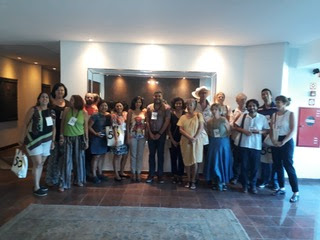


Participants in the symposium 'Complex structures in Brazilian languages'.
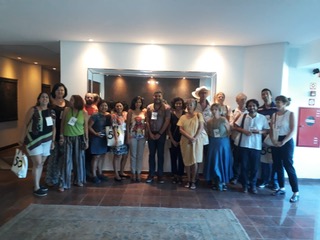
Participants in the symposium 'Languages and peoples threatened: Political impacts of linguistic work'.

Brazilian languages specialists: Kris Stenzel (UFRJ), Ana Vilacy Galucio (Museu Paraense Emílio Goeldi), Suzi Lima (faculty), Mara Santos (UNIFAP), Bruna Franchetto (UFRJ/Museu Nacional), Denny Moore (Museu Paraense Emílio Goeldi), and Luciana Storto (USP).
Suzi celebrated her birthday with her colleagues in Brazil and reports that she had a fabulous time!
May 9, 2019
WSCLA 24
The 24th Workshop on the Structure and Constituency of the Languages of the Americas is taking place from May 9 through 11 at the University of Maryland. We are represented by presentations by one faculty member and a number of alumni, all on different indigenous languages of North and South America.
Guillaume Thomas (faculty):
"Switch-reference and discourse anaphora."
Will Oxford (Ph.D. 2014, now at the University of Manitoba)
"The Algonquian inverse: What’s voice got to do with it?"
Michael Barrie (Ph.D. 2006, now at Sogang University)
"Cayuga and Contiguity Theory: The role of default agreement."
Shay Hucklebridge (MA 2016, now at the University of Massachusetts, Amherst):
"Associative plural in two Northern Dene languages."
Michelle Yuan (MA 2013, now at the University of Chicago):
"The morphosyntax of participle-incorporating existentials in Inuktitut."
May 8, 2019
U of T Science Rendezvous 2019

May 7, 2019
GLOW 42
Generative Linguistics in the Old World (GLOW) 42 is taking place from May 7 through 11 at the University of Oslo in Norway. Several current and previous graduate students are presenting posters:
Jessica Denniss (Ph.D.):
"Ngarinyman resultatives."
Paulina Lyskawa (MA 2015, now at the University of Maryland) and colleague Rodrigo Ranero (University of Maryland):
"A Mayan diagnostic for the unergative vs. unaccusative distinction."
Monica Irimia (Ph.D. 2011, now at the University of Modena and Reggio Emilia):
"Varieties of structural objects and multiple licensing."
Monica and colleague Patricia Schneider-Zioga (CSU Fullerton):
"Partitive case and abstract licensing: Sociative causation in Kinande."
May 6, 2019
Research Groups: Week of May 6-10
Wednesday, May 8, 11:00 AM-1:00 PM in SS 560A
Syntax Group
Sahar Taghipour (Ph.D.): "Definiteness in Laki: Its contributions to DP structure."
Syntax Group
Sahar Taghipour (Ph.D.): "Definiteness in Laki: Its contributions to DP structure."
Subscribe to:
Posts (Atom)