Showing posts with label Research project. Show all posts

December 2, 2024

Professor Naomi Nagy's Book Launch at the Canadian Language Museum

Image of books laid out on table at canadian language museum


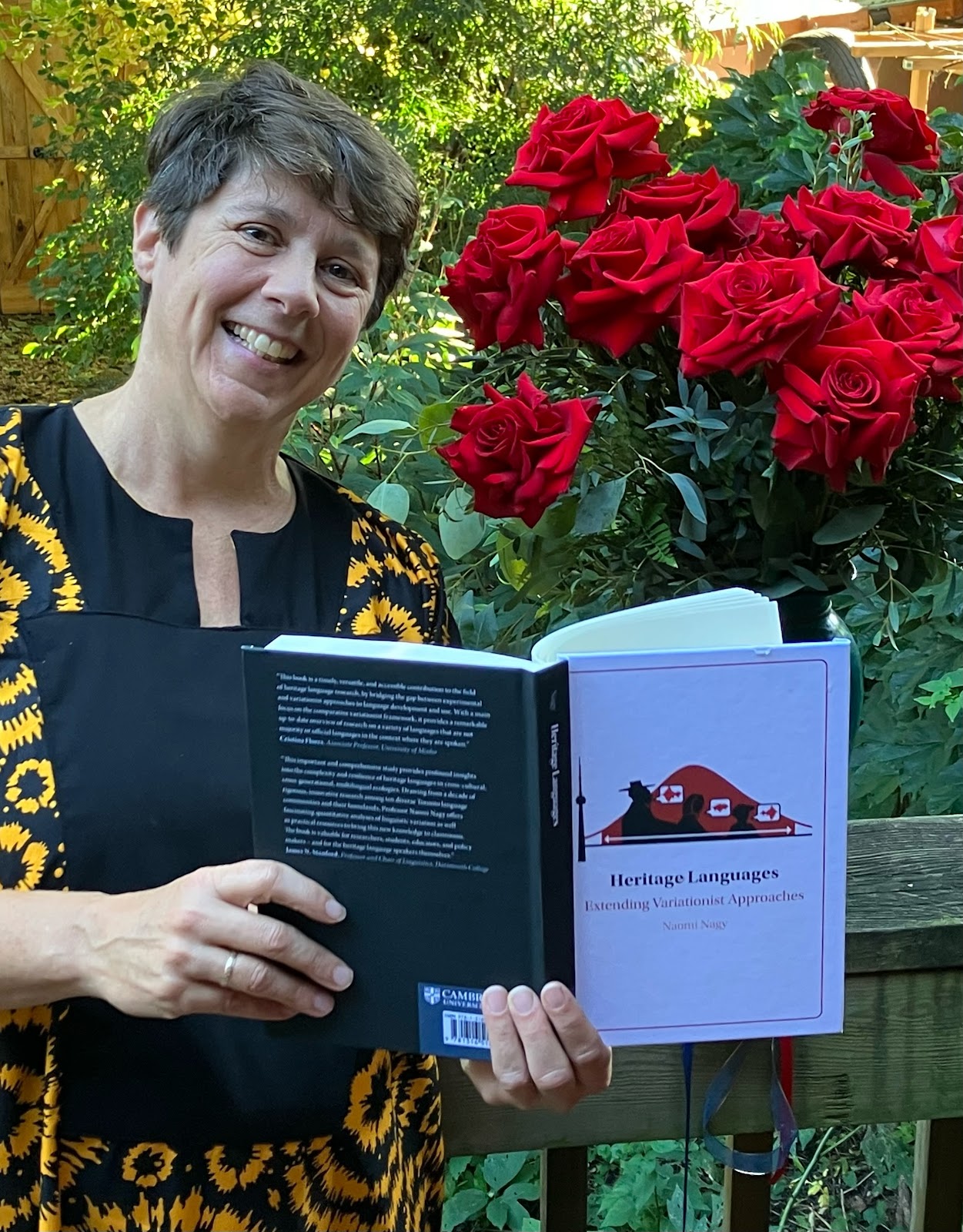
Professor Naomi Nagy (department chair) introduced her new work, Heritage Languages: Extending Variationist Approaches, earlier this semester at the Canadian Language Museum at Glendon College. 

This book is a part of the larger Heritage Language Variation and Change in Toronto project (HLVC), and an accumulation of hard work of linguists at the UofT, and heritage language speakers across the city. 


Professor Nagy at the Book Launch

Read the publication at this link, accessible through University of Toronto libraries.

Congratulations Professor Nagy on your publication and launch! 

Canadian Language Museum
Picture credits: Craig Diegel

July 23, 2024

Naomi Nagy, Linguistics Chair, Publishes Book about Heritage Language Variation and Change!

book cover
On June 27th, 2024, Department of Linguistics Chair, Naomi Nagy, published her book, Heritage Languages: Extending variationist approaches. [Click link to purchase :-) or get it from UofT's library]. 

In Canada, the term, "heritage language" refers to a language learned in the home by children, if that language is not one of Canada's official languages (French, English). Half the people in Toronto are heritage-language speakers!

This book seeks to dispel stigma surrounding the use of one's heritage language by investigating cross-generational variation and change in conversations with 400+ speakers, in 8 different heritage languages, in Toronto. The findings reveal many similarities between heritage and homeland varieties.

"Introduc[ing] new methodology to help readers understand and apply variationist sociolinguistic approaches to quantitatively analyze spontaneous speech," this novel approach to heritage language research showcases how change in grammar of heritage languages resembles change patterns seen hegemonic, majority languages, contradicting findings of "simplification/attrition patterns in experimental heritage language studies." [quoted from the publicity blurbs]

Comparing patterns not only across languages, but across generations, this research quotes heritage speakers to give voice and pride to the use of their languages. 

Nagy presented some of this research at BAM's Language Research Day, as her talk on Heritage Language Variation and Change (HLVC), which we covered on the blog earlier in July. Other findings are on the project's webpage.

This book promises to be a veritable toolbox for those interested in learning about or researching heritage languages, dedicated to language revitalization.

Currently, the Department Chair is in Italy conducting research also relevant to this pursuit - about the variation in Franco-Provencal language varieties over time and space, and how to connect speakers of different varieties via social media.


The author reports that this book was much more fun to write than her dissertation!

July 15, 2024

Arcadian Greek vs. Standard Greek: Dr. Photini Coutsougera Publishes A Dictionary with the Answers


From Dr. Coutsougera: 

"""
Dr. Photini Coutsougera of Mississauga Campus' Language Studies Department has recently published a new book, A Dictionary of Northeastern Arcadian Greek [in Greek] with Patakis Publications, Athens, Greece (2024)/ 320 pages. 

A Look Inside: Letter Αα, p. 66

The Dictionary of Northeastern Arcadian Greek comprises 4.200 entries and 5.120 senses. These entries were primarily collected during field work, over a period of approximately thirteen years, and from existing written sources. 

Subsequently, they were verified one by one  by a group of native speakers of the dialect, aged 80 and over. Each entry contains semantic, phonological, morphological, syntactic and stylistic information. It also contains a plethora of authentic examples in use, synonyms, antonyms, idioms and idiomatic phrases, proverbs, sayings, and verses from local folk poetry. Finally, a 28-page Prologue includes a compact grammar of the dialect, lays out the research methodology employed in the data collection, and defines Arcadian Greek on the basis of linguistic criteria which systematically differentiate it from Standard Greek. 

This book aspires to bring the Peloponnesian varieties of Greek to the fore as they have been conspicuously absent from the literature.

                                                                 """


July 11, 2024

Language Research Day - BAM!

On Monday, June 3rd, the University of Toronto hosted Language Research Day (LRD), a student-led academic conference designed to facilitate interaction and learning among graduate students in the field of language research. 

Spanning campuses, languages, and levels of inquiry, this hybrid conference hosted over 100 in-person and virtual attendees.

Professor and Linguistics Department Chair Naomi Nagy gave the opening keynote, (Heritage) Russian case-marking: Variation and paths of change.

Dr. Craig Chambers, a joint PhD in Cognitive Science and Linguistics, gave the closing keynote, Where and how does nonlinguistic cognition fit into language abilities? This presentation was drawn from a cross-sectional study on real-time language processing, and aids in the complete understanding of the "mental architecture supporting language abilities across the human lifespan."

One other Linguistics Dept member presented: PhD student Nick Haggarty, who was featured in June's spotlight on Queer Linguistics.

Other University of Toronto departments in attendance included Speech Language Pathology, Psychology, and Near & Middle Eastern Civilizations, making up a participation as diverse as the languages discussed at the conference. 

The Linguistics Department, in part responsible for funding the event, was also represented by Pedro Mateo Pedro, as well as Angelika Kiss, who helped organize, and recently defended her PhD thesis (to be covered on the blog soon)!

To see more information, check out BAM's Instagram page or the #LRD2024.

We look forward to seeing the development of this exciting event in 2025!


April 3, 2024

Congrats Karina!

Congrats to Karina Cheung! 

She presented her research at TULCON and then at Vic's Research Day. For the second, she won the Student Choice Research Award (Voted on by UofT Community) for her paper, "The effects of Heavy-NP Shift on Tagalog Word Order Preferences,"  based on work supervised by Dr. Ivan Bondoc.

October 22, 2021

SLUGS Academic Seminar!

 Professor Alexei Kochetov is presenting at the SLUGS academic seminar on Monday, October 25th! He will be presenting his work on Kalasha laterals; Phonetic Realizations and Change in Progress! 

For the full abstract please see the SLUGS website! Zoom link and password are also available on the website. 

Hope to see you all there!! 


April 16, 2021

Research Groups: Friday, April 16

10:00 AM - 11:30 AM: Language Variation and Change Group
Michael Friesner
(faculty, Department of French) and Laura Kastronic (faculty, Department of French): "Developing sociolinguistic competence in French through the flipped classroom model."

​The flipped classroom approach (cf. Bergmann and Sams 2012), in which class time is largely devoted to collaborative activities, has recently been extended to the second-language classroom. Nonetheless, despite incorporating communicative methods, predominant pedagogical practices, focusing on prescriptive norms and traditional textbook explanations of linguistic phenomena (Mougeon et al. 2010), impart minimal sociolinguistic competence, leaving most second language learners ill-equipped to replicate native-like patterns of variation (cf. Dewaele 2004). Learners therefore overuse hyperstandard, hyperformal, or register-inappropriate forms. We believe that the flipped classroom model is well suited to addressing these challenges for FSL teaching. We therefore draw on variationist sociolinguistic research to foster a deeper understanding of three well-studied phenomena (cf. Mougeon et al. 2010) - negation, expression of future time, and first-person plural address - for which traditional pedagogical explanations diverge considerably from L1 community behaviour. We argue that time outside of the classroom is well spent building sociolinguistic awareness through evidence-driven description, corpus-based realia, and analytical commentary on sociolinguistic implications of variant choice, providing scaffolding for communicative in-class comprehension and production exercises. Additionally, we address questions of the appropriate point of intervention based on perceptions of casual or nonstandard linguistic behaviour by L1 speakers of varying geographic origins. 

1:00 PM - 2:30 PM: Fieldwork Group
Shabri Kapoor
(Ph.D.): "The mass/count distinction in Cusco Quechua."

The mass/count distinction is often described as the difference between nouns that represent countable entities (dog/dogs), and uncountable entities such as substances or 'stuff' (water/*waters). Languages that have this distinction often show differences in the features that distinguish count from mass nouns. One such feature is the use of a container classifier when combining numerals with mass nouns (three cups of water). My research explores how the mass/count distinction applies to the Cusco variety of Quechua, and specifically, how container classifiers that combine numerals with mass nouns in Cusco Quechua differ morphologically, depending on classifier type.

January 4, 2021

New paper: Béjar, Massam, Pérez-Leroux, and Roberge (2020)

Susana Béjar (faculty), Diane Massam (faculty), Ana-Teresa Pérez-Leroux (faculty), and Yves Roberge (faculty) have a chapter, "Rethinking complexity" in an edited volume, Syntactic architecture and its consequences I, edited by András Bárány, Theresa Biberauer, Jamie Douglas, and Sten Vikner.

This paper addresses the nature of complexity of recursion. We consider four asymmetries involving caps on recursion observed in previous experimental acquisition studies, which argue that complexity cannot be characterized exclusively in terms of the number of iterations of Merge. While recursion is essentially syntactic and allowed for by the minimalist toolkit via Merge, selection, and labeling or projection, the complexity of recursive outputs arises at the interface.

November 29, 2020

Congratulations, Daphna!

We are delighted to have learned that Daphna Heller (faculty) has been awarded a six-month Chancellor Jackman Faculty Research Fellowship in the Humanities by the Jackman Humanities Institute, in support of her project 'Sources of information and linguistic meaning: From typology to cognition'. Congratulations, Daphna!

September 16, 2020

Talk by Nathan, Lex, and Pocholo for Arts and Science

For the 'Teaching and Learning Community of Practice' series hosted by Arts and Science, Nathan Sanders (faculty), Lex Konnelly (Ph.D.), and Pocholo Umbal (Ph.D.) are giving an online presentation on Tuesday, September 22, from 2 PM to 3:15 PM, based on the ongoing LEAF-funded project in our department: "Building equity, diversity, and inclusion in courses: A case study in linguistics." There will also be ample time for discussion. To register to attend, visit the link.

In linguistics courses, language-related biases can surface in many forms, affecting the choice of course material (especially linguistic data), how that material is presented, and how instructors interact with students. We began a three-year project in September 2019 to address some of these biases in the linguistics classroom, with the ultimate goal of generalizing the methods and materials to other fields.

In this session, we present some preliminary results of this project from the first year in various linguistics courses, including new course content on the relationship of phonetics to gender, race and sign languages; new problem sets featuring data from under-represented languages; and workshops on inclusive classroom practices. We will also discuss paths forward for creating more affirming classrooms beyond linguistics, especially in fields where issues of language can play a central role (English, psychology, etc.).

June 1, 2020

Applications now open for LIN398 in 2020-21

Suzi Lima (faculty) is leading a year-long Research Opportunity Program course (LIN398) over the course of the 2020-21 academic year on the topic of 'Internationalized learning at home: Investigating African languages spoken in Toronto':

Statistics Canada (2019) reports that the Black population is steadily growing in Canada. In Toronto, this population has doubled in the last 20 years. In this population, 56% are first-generation (born outside Canada) and 35% are second-generation (born in Canada but at least one parent was born abroad). Statistics Canada (2019) also reports that the number of immigrants from Africa has increased significantly, making up about 65% of the population of Black immigrants (as opposed to 27.3% of immigrants from the Caribbean and Bermuda). At the University of Toronto the population of undergraduate students from Africa corresponded (in 2017) to 2.6% (415 students) of the international student population (Liang 2017). The official records of the University of Toronto (Liang 2017) also report that Nigeria is the 9th most common country of origin for international students. In this project, our goal is to describe some semantic aspects of African languages while engaging the first- and second-generation communities of speakers of these languages. The goals of this project will advance the description of African languages spoken in Toronto and promote the visibility of these languages and communities of speakers on campus.

Application instructions can be found here. Note that interested undergraduate students are highly encouraged to submit by Friday, June 12, as review of applications will begin very shortly thereafter.

May 25, 2020

Symposium on Jackman Scholars-in-Residence project

For this year's Jackman Scholars-in-Residence program, Barend Beekhuizen (faculty) has guided a group of outstanding undergraduates - Mah Noor Amir, Maya Blumenthal, Li Jiang, Anna Pyrtchenkov, and Jana Savevska - on an intense 4-week computational project examining cross-linguistic variation in the translations of words such as true, real, actual, and right in a sample of languages (Urdu, Hindi, Hebrew, German, Mandarin, Greek, Russian, Spanish, Macedonian, and Bulgarian). At the conclusion of the project, the students will be presenting their findings on Thursday, May 28, at 11 AM to 12 PM, online. See the email for the Zoom link and come hear about what this powerhouse team of emerging researchers has been up to!

March 3, 2020

Newcomers for March 2020

We've had two more people join us recently:

Jeremy Needle (postdoc) comes to us following a postdoc at the University of Canterbury in New Zealand and a Ph.D. (2018) at Northwestern University. He's here working with Sali A. Tagliamonte on dialectology and change over time.

Annika Rossmanith (University of Groningen) an MA student originally from Germany, now studying in the Netherlands. She is here to work with Naomi Nagy on the Heritage Language Variation and Change project, as her current research is on heritage speakers of Russian.

Welcome!

February 26, 2020

Applications now open for LIN398

As with last year, Suzi Lima (faculty) is leading a Research Excursion Program (LIN398) course to Brazil to do intensive collaborative fieldwork on multiple endangered indigenous languages of the Amazon region. She and several undergraduates will be travelling to Boa Vista from May 3rd through 15th. If you are an undergraduate student in Arts & Science at the St. George campus and you have an intermediate number of credits, you are eligible. Applications for the course are due on Monday, March 10. For more details, see below or email Suzi.


January 31, 2020

Naomi and undergrad RAs in Arts and Science News

Naomi Nagy (faculty), Kate Cheung (BA), Mira Chow (BA), and Jonathan Ng (BA) are featured in the Arts and Science News this week in the form of an article on variation and change in heritage Cantonese as spoken by several generations of Toronto residents - one of 10 languages of Naomi's ongoing Heritage Language Variation and Change project.

September 23, 2019

Guest speaker: Amy Rose Deal (University of California, Berkeley)

As part of the Non-Canonical Relatives project, our department is very pleased to welcome Amy Rose Deal, who is an Associate Professor at the University of California, Berkeley. She works on syntax and semantics, particularly from a typological point of view, and will be giving two talks to our department on Friday the 27th.

The first, "Uncentered attitude reports", will be at the meeting of our Syntax Group (11:30 AM-1 PM in SS560A).

One of the major discoveries in attitude semantics over the last thirty years has been the fact that certain types of attitude reports require interpretation de se. This finding has prompted a move among semanticists to treat attitude verbs as uniformly quantifying over centered worlds (typically modeled as triples of worlds, individuals, and times), rather than merely over possible worlds, and likewise a move to treat attitude complements as uniformly denoting sets of centered worlds, rather than mere sets of possible worlds. Thus "A believes P" is true iff P holds of all triples such that A believes that she might be x in w at t. Proponents of a Uniformity Thesis of this type include Schlenker (1999), Ogihara (1999), von Stechow (2003), Anand (2006), Pearson (2015), and Grønn and von Stechow (2010). In this talk I present evidence against the Uniformity Thesis, drawing from my fieldwork on Nez Perce (Sahaptian). I show that dedicated de se devices (shifty 1st person indexicals, relative tenses) are possible in one type of attitude report in Nez Perce, but not in another type, and argue that the difference between the two types of attitude report crucially reflects the semantics of the attitude verb and its complement. I argue in particular that some attitude verbs quantify over centered tuples, making it possible to include dedicated de se devices, whereas others quantify merely over possible worlds, ruling such devices out.

The second, "Interaction, satisfaction, and the PCC", will be taking place from 3 PM to 4:30 PM, also in SS560A.

Person-case constraint (PCC) phenomena involve restrictions on the relative person of the two objects of a ditransitive. In this talk, I present an account of four types of PCC patterns within the Interaction/Satisfaction theory of Agree (Deal 2015), and demonstrate some advantages of this view over various competitors. Advantages include the ability to account for both strong and weak PCC effects without invoking multiple types of Agree, and the ability to capture the rather complex relationship between PCC effects and morphological marking of Agree (i.e. in some languages PCC holds only when IO and DO clitics are combined, whereas in others PCC effects hold even though IO and DO clitics are not combined, and in still others IO and DO clitics combine without triggering PCC effects). I will also discuss the extent to which the theory can capture the role of number in PCC effects.

September 18, 2019

Guest speaker: Ur Shlonsky (University of Geneva)

In conjunction with the Syntax of Nominal Linkers and the Agreement in Copular Clauses projects, we are very pleased to welcome Ur Shlonsky, a syntactician from the University of Geneva who has worked extensively on the structure of Semitic and Romance languages as well as typological issues; he is a leader in the Cartography framework. He will be spending Thursday the 19th at our Mississauga campus and the 20th downtown, and will be giving talks at each one. The first, "Cartography and selection", is taking place from 1-3 PM in Maanjiwe nendamowinan 4107. It is meant to be conducive to a lively discussion.

On the assumption that a head syntactically selects the head of its sister phrase, the following question arises: How is selection satisfied in a left periphery with a rich functional sequence (Rizzi 1997, etc.)? In many languages, left-dislocated topics can precede wh-words in indirect questions: "You asked me this book to whom I should give" (okay in Hebrew, Italian, Spanish and some people's English). If the Topic sits in Spec/Top, how can the interrogative-selecting V 'ask' "see" the wh-word?

Then, his second talk will be at 3 PM in SS 560A, incorporating collaborative work with Luigi Rizzi (University of Geneva) and Isabelle Roy (Centre national de la recherche scientifique): "Copular sentences and their subjects."

Hebrew copular sentences in the present tense look like small clauses, leading one to think that the structure of (i) is equivalent to the reduced structure attributed to the bracketed part of (ii). 

(i) Daniela balʃanit mecuyenet.
Daniel linguist excellent
'Daniela is an excellent linguist.'
(ii) Bill considers [Daniela an excellent linguist].

I believe this is a false analogy. I try to demonstrate that the copula-less sentences in (i) contain a (perhaps surprisingly) rich functional structure and incorporate (at least) two distinct subject positions. The presentation starts out with a discussion of copular sentences in French, where the evidence for two subject positions is overt, and proceeds to a presentation and analysis of Hebrew.

June 29, 2019

Sali in the U of T Magazine

Sali A. Tagliamonte (faculty) has been interviewed for the University of Toronto Magazine about the task of adding more Canadian words to the Oxford English Dictionary.

June 26, 2019

Sociolinguists in Marmora

Faculty member Sali A. Tagliamonte's Ontario Dialects Project has spent the past 17 years documenting and analysing the dialects of English found in this province. Nearly every summer, Sali takes a team of students (graduate and/or undergraduate) out to a select location to conduct a large number of sociolinguistic interviews with the locals. This year's expedition, in late May, was to the town of Marmora, located northeast of Peterborough and northwest of Belleville. Sali, along with graduate students Ilia Nicoll (Ph.D.) and Lauren Bigelow (MA), spent a week interviewing residents, going on local adventures, and singing Bob Dylan songs with quite a crowd! (Photos courtesy of Sali.)

Lauren and Ilia in Marmora.

Ilia discovers some local educational materials!

Playing music and singing with the locals!

April 5, 2019

New paper: Nodari, Celata, and Nagy (2019)

Naomi Nagy (faculty) and colleagues Rosalba Nodari (Schuola Normale Superiore) and Chiara Celata (Schuola Normale Superiore) have a paper out in the Journal of Phonetics, 73: "Socio-indexical phonetic features in the heritage language context: Voiceless stop aspiration in the Calabrian community in Toronto."

This study examines cross-generational transmission of a sociophonetic variable in a heritage language context. Voiceless stop aspiration is a sociophonetic variable in Calabrian Italian, indexing socio-cultural values about the speaker’s social and geographical origin. We investigate the production of voiceless stops by three generations of Calabrian Italians (immigrants and the next two generations) in Toronto, via acoustic and auditory analysis of nearly 5000 tokens from conversational speech in Calabrian Italian. Both Italian and English use long-lag VOT, but they differ in its phonological distribution: long-lag VOT is preferentially associated with pre-tonic, word-initial stops in English and with post-tonic, post-sonorant or geminate stops in Calabrian Italian. We show that, in heritage Calabrian Italian in Toronto, both phonetic implementation (cued by VOT duration) and phonological distribution of aspiration (as cued by perceived aspiration rate across phonological contexts) change cross-generationally, but some changes are non-linear, as third generation speakers appear to reproduce some patterns attested in the speech of first generation speakers. External variables such as the sex of the speakers modulate the cross-generational effects, with males producing more aspirated stops and exhibiting a more conservative behavior in certain phonetic contexts.