Showing posts with label Graduate students. Show all posts

December 24, 2024

Grad Writing Day

Group smiles for a job well done (or well on the way)

On Friday, Dec 13, 2024, graduate students rallied in silence in the Lounge for a "Writing Day" retreat. 
Term papers, GPs, and data analyses received a long-due, disciplined treatment! 

Satisfied writers Rhoda and Claudia

With a lot of enthusiastic feedback on the experience, the Department hopes to host a more regular writing accountability group in the future.

Thanks, Claudia, for organizing!

November 18, 2024

Will Williams successfully defends Thesis Proposal!

On November 15, 2024, Will Williams (now PhD Candidate) presented his thesis proposal, "Presuppositions, entailments, and other inferences: The case of factive-implicatives". 

His supervisory committee consists of Guillaume Thomas (senior supervisor; faculty), Michela Ippolito (faculty), and Keir Moulton (faculty).

Congrats Will on a successful thesis proposal presentation!  

November 8, 2024

Grad Convocation 2024

On October 28 and November 1, we celebrated the conferral of our graduate students' MA and PhD degrees. This marks the culmination of hard work, dedication, and perseverance. Your achievements are a testament to your determination––we are incredibly proud of each and every one of you!

Our newly minted PhDs:

  • Angelika Kiss
  • Emilia Melara
  • Virgilio Partida Penalva
  • Maida Percival

We even had our own hooding ceremony! Angelika was hooded by her supervisor, Michela Ippolito (faculty).


Our new MAs:
  • Louis Careri
  • Laura Escobar
  • Siyi Fan
  • Fredrik Gao
  • Olanrewaju Samuel
  • Mechelle Wu
  • Aliya Zhaksybek

Kelly, Dave, Naomi, Keir, Michela, Nathan, Angelika, Pocholo, and Emily


Guillaume Thomas (Graduate Coordinator) giving a toast

Naomi Nagy (Department Chair) congratulating our grads


Thank you to everyone (colleagues, friends, and family) who celebrated with us! And once again, a huge congratulations to our grads!


October 21, 2024

Song Jiang successfully defends Thesis Proposal!


On September 27, 2024, Song Jiang (now PhD candidate) presented his thesis proposal, "Articulatory variability in the articulation and coarticulation of Mandarin rhotic vowels"

His supervisory committee consists of Alexei Kochetov (Supervisor; faculty), Peter Jurgec (faculty), and Tim Bressmann (faculty, SLP).

Congratulations Song on a successful thesis proposal presentation!

October 1, 2024

The Department of Linguistics celebrates the start of the 2024-25 academic year!

On Friday, September 13, 2024, UofT linguists participated in an all-day event celebrating the start of the new academic year and, more importantly, welcoming new members to the department!


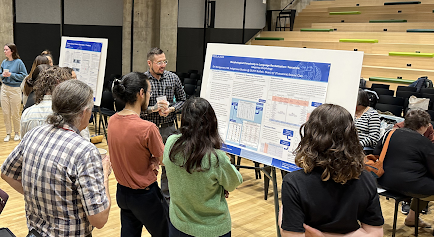
The day began with breakfast in the department lounge. Folks mingled around and numerous faculty members and students showcased their research posters. 


Keir Moulton (Graduate Chair) and Naomi Nagy (Department Chair) gave their welcome remarks. Keir reminded us that we also work on Fridays: we participate in research groups and learn new things; and we catch-up with colleagues as part of community building. Naomi then introduced the new cohort of MA and PhD students as well as our post-doctoral fellows.


Outside the lounge, students and faculty teamed up to play bowling! Congratulations to Derek Denis (faculty) and Nick Haggarty (PhD student), the winning team! 


The day progressed with a series of lightning talks in various research groups and labs. We got to hear about recent and on-going work in the (H)LVC, CSoL, Syntax, Semantics, PHON, and LDDR groups. We also got to see the Phonetics Lab, Experimental Syntax-Semantics Lab, the TLC lab, and the newly renovated grad space! After lunch, we got to hear from some faculty members about their research interests and works-in-progress.

We capped off our second-annual Kick-off Day with a welcome party at The Pilot! Department members enjoyed an afternoon filled with food, drinks, and laughter. 


Thank you to everyone (especially our administrative staff) for making this day a success!

September 2, 2024

Linguistics Coffeehouse Recap!

During March of 2024, Jack Mahlmann, Claudia Raihert, and Mechelle Wu, graduate students of our department, organized a coffeehouse fundraising event. 

Raising over $1400 for Onkwawenna Kentyohkwa, Mahlmann, Raihert, and Wu wanted to bring this event to the attention of the wider UofT Linguistics community to surpass that amount next year. 

A community organization on the territory of the Six Nations of the Grand River, Onkwawenna Kentyohkwa works as a school to support the vitality of Kanien'kéha, a Mohawk language. Earlier in May, this blog covered WSCLA, at which several speakers gave presentation concerning the revitalization of this language. 

For all those interested in supporting the goal of revitalizing the Mohawk language at Grand River, feel free to visit their Donate page, or look out for more events such as these next year. 

Congratulations to this trio and all those who donated!

August 2, 2024

UofT Linguists Impress at the 2024 CLA Conference


From June 17-19, 2024, UofT Linguists trekked to Carleton University to attend the 2024 Canadian Linguistics Association (CLA) Conference

Will Williams, PhD student, shared this list of talks and posters by UofT people. Bolded names indicate University of Toronto affiliation.

Looking forward to CLA 2025, and the presentation of more incredible presentations such as the ones below!

Posters

Thales Buzan, Cristina Name & Laura Colantoni (Faculty)

Native English Speakers’ Perception of Questions Produced by L1 Brazilian Portuguese and L1 English Speakers

Caroline Mekhaeil (PhD student, UTM)

Could Individual Language Dominance Explain the Transfer to L3 French?

Caroline Mekhaeil presents poster


Samuel Akinbo (Faculty), Tongpan Fwangwar & Michael Bulkaam

Morphophonological Polarity in West Chadic Languages

Rim Dabbous, Marjorie Leduc (MA Alumna), David Ta-Chun Shen & Charles Reiss

Locality in phonology is epiphenomenal

Radu Craioveanu (Alum)

Long and short diphthongs in North Saami

Radu Craioveanu presents poster

Liam McFadden (Undergrad), Avery Ozburn (Faculty) & Samuel Akinbo (Faculty) - Best Poster!

Language mapping for linguists

Liam McFadden presents poster

Talks

Ash Asudeh, Bronwyn Bjorkman, Neil Myler, Daniel Siddiqi & Lisa Sullivan (Alum)

Metasyncretism and secondary exponence in LRFG

Samantha Jackson (incoming Faculty, ex-postdoc) & Derek Denis (Faculty)

Speaking of immigrants: Commentary on the aural employability of (non-)Canadian English

Samira Ghanbarnejadnaeini (MA Alum)

“Woman, Life, Freedom:” A Feminist Critical Discourse Analysis of Gender and Political Activism

Laurestine Bradford (MA Alum)

A Source of Conativity in Tlingit Pluractional Verbs

Angelika Kiss (PhD student), Jianing ZhouJustin Leung (PhD student)

Declarative questions in Shanghainese and Cantonese

Yawovi Godo, Lydia Mei, Andreea Cristina Nicolae & Lyn Tieu (Faculty)

Étude expérimentale des propriétés d’exhaustivité de la disjonction en français : L’interaction de l’exclusivité, du libre choix, et des implicatures ad hoc

Lisa Sullivan (Alum) & Nicole Rosen (Alum)

/e/-/i/ overlap in Manitoba English

Calvin Quick (PhD Student)

Agreement with nominal antecedents in Welsh

Simone Diana Zamarlik (Alumni)

Preposition stranding in a non-preposition-stranding language: The puzzle of optional preposition omission under sluicing in Polish

Crystal Chen (PhD Student), Lyn Tieu (Faculty) & Ana Teresa Pérez-Leroux (Faculty)

Investigating the role of gaze and the semantics of demonstratives in referent identification

Samuel Jambrović (PhD Student), Awarded "Honorable Mention"

Defending predicativism: Lessons from Barbie

Nadia Takhtaganova (PhD Student) & Barend Beekhuizen (Faculty)

Variation in the Morphosemantics of Postnominal Prepositions: The Case of Romance A

Arsalan Kahnemuyipour (Faculty) & Sahar Taghipour (Alumni)

Ezafe in the context of PPs

Justin R. Leung (PhD Student)

I’m like, “Like is not a complementizer, it seems like”

Dionatan Cardozo (Visiting student)

Quantified Phrases in Brazilian Portuguese: Preliminary Experimental Results

Christiana Moser (PhD Student), Bahar Tarakcı, Ercenur Ünal & Myrto Grigoroglou (Faculty)

Multimodal recipient mentions in possession-transfer event descriptions: language-specificity outweighs conceptual peripherality

Patrick Kinchsular (Undergrad)

External Possession in Kinyarwanda: A Tale of Two Applicatives

Annie Chong, Avery Ozburn (Faculty) & Tamam Youssouf

Phonologically-conditioned allomorphy in Oromo plurals

Ana Teresa Pérez-Leroux (Faculty), Laura Colantoni (Faculty), Danielle Thomas (alum) & Crystal Chen (PhD Student)

Gender in Toronto Heritage Spanish

Anissa Baird (PhD Student) & Emily Atkinson (Faculty)

Five- & Eight-Year-Olds’ Interpretation of Ambiguous They

July 30, 2024

Song Jiang and Alexei Kochetov Publish on Mandarin rhotics!

Attendees of the 13th International Seminar on Speech Production, ISSP.

Song Jiang (left), PhD candidate at the Uoft Phonetics Lab, and Alexei Kochetov, Professor of Linguistics (right), recently published their work, Variability in the articulation of Beijing Mandarin rhotic vowels


Rhotic vowels are modified by the consonant /r/ - think "heard" and "bird".

Noticing that the "contextual and/or inter-speaker variability" of North American English rhotic vowels such as /ɹ/ and [Éš] was widely documented, and that that of the Mandarin rhotic vowels, such as [Éš, u˞], was less so, they set out to conduct an "extensive ultrasound investigation" of these rhotic vowels in Beijing Mandarin.

In fact, they were able to indicate a "greater than previously reported variability in the articulation of Beijing Mandarin rhotic vowels" by examining variation in tongue configuration, (retroflex or bunched) vocalic contexts, and reported greater similarity between rhotic vowels to rhotic vowels, than in rhotic and non-rhotic vowels.

This publication was presented as a poster on Wednesday, May 15th at the 13th International Seminar on Speech Production, (ISSP 2024) held this year in Autrans, France.

We are so proud of this momentous accomplishment, and congratulate them on their hard work. 

(All quotes from the paper's abstract, found in the link above.)

July 21, 2024

Greg Antono Successfully Defends Thesis Proposal!


In the early hours of Monday, July 15th, 2024, Greg Antono presented his thesis proposal - Topics in Mandarin referring expressions - to a committee consisting of Michela Ippolito, Craig Chambers, and his supervisor, Daphna Heller.

Seeing an impressive attendance of UofT linguistics, and a successful defense, this presentation was a huge accomplishment for Antono.

The Department of Linguistics congratulates him, and looks forward to celebrating a successful thesis defense soon!


July 19, 2024

PhD Candidate Angelika Kiss Successfully Completes Thesis Defense - Congratulations, Doctor!

On Thursday, June 20th, 2024, Angelika Kiss of the Department of Linguistics completed her last step toward officially becoming Dr. Kiss! Congratulations!

Completing her thesis defense of Form-meaning relations in non-canonical questions, Dr. Kiss impressed her committee consisting of Professors Guillaume Thomas, Laura Colantoni, and Keir Moulton, as well as her supervisor, Professor Michela Ippolito. Also in attendance at the defense was Fatima Hamlaoui, who performed internal/external reviews.

Dr. Kiss' Thesis Defense Reception, featuring Guillaume Thomas, Fatima Hamlaoui, Michela Ippolito, Angelika Kiss, Hans-Martin Gaertner, Keir Moulton (L-R)

Dr. Michela Ippolito and Dr. Angelika Kiss

The Department of Linguistics congratulate her on the successful completion of her dissertation, and are excited to see her future works.


July 17, 2024

Our Newest Alumni: Linguistics PhDs at Convocation

Announcing the newest PhDs from the Department of Linguistics! They were conferred their degrees at convocation on June 5th.

Sahar Taghipour: Case and Phi-agreement in Laki: Parametrizing split-ergativity in Kurdish

Sahar with her supervisor, Professor Arsalan Kahnemuyipour.

Andrei Munteanu: Probabilistic Evaluation of Comparative Reconstructions 


Kiranpreet Nara: An acoustic study of Punjabi tones and an investigation of ongoing tonal changes


The Graduate Office congratulates and welcomes their newest alumni into this exciting next chapter of their journeys. 

July 11, 2024

Language Research Day - BAM!

On Monday, June 3rd, the University of Toronto hosted Language Research Day (LRD), a student-led academic conference designed to facilitate interaction and learning among graduate students in the field of language research. 

Spanning campuses, languages, and levels of inquiry, this hybrid conference hosted over 100 in-person and virtual attendees.

Professor and Linguistics Department Chair Naomi Nagy gave the opening keynote, (Heritage) Russian case-marking: Variation and paths of change.

Dr. Craig Chambers, a joint PhD in Cognitive Science and Linguistics, gave the closing keynote, Where and how does nonlinguistic cognition fit into language abilities? This presentation was drawn from a cross-sectional study on real-time language processing, and aids in the complete understanding of the "mental architecture supporting language abilities across the human lifespan."

One other Linguistics Dept member presented: PhD student Nick Haggarty, who was featured in June's spotlight on Queer Linguistics.

Other University of Toronto departments in attendance included Speech Language Pathology, Psychology, and Near & Middle Eastern Civilizations, making up a participation as diverse as the languages discussed at the conference. 

The Linguistics Department, in part responsible for funding the event, was also represented by Pedro Mateo Pedro, as well as Angelika Kiss, who helped organize, and recently defended her PhD thesis (to be covered on the blog soon)!

To see more information, check out BAM's Instagram page or the #LRD2024.

We look forward to seeing the development of this exciting event in 2025!


July 4, 2024

2023-2024 Cowper and Dresher Prizes - Congratulations Calvin and Yanfei!


Named after two emeriti professors in Linguistics Department, Elizabeth Cowper and Elan Dresher, the Cowper and Dresher Prizes are distinguished awards for graduate students of Linguistics. 

The 2023-2024 winners were announced earlier in June 2024.

Calvin Quick, a PhD student interested in Mediaeval Welsh poetry, won the Cowper Prize for his papers “Tense and finiteness in embedded bod-clauses” and “Problematizing Linear Approaches to Modifier-Head Adjacency Restrictions.”

For her paper, “An OT Analysis of Stress Patterns of Oneida (Iroquoian)” Yanfei Lu was awarded the Dresher Prize, a recognition within the LIN department for outstanding graduate student work in Phonology.

Yanfei Lu, winner of the
Dresher Prize.

We are so proud of both the students, congratulations!

July 2, 2024

Tri-Agency Confirms Increased Funding for CIHR, NSERC, and SSHRC Awards!

Earlier in June, Tri-Agency confirmed that, effective September 1st, 2024, the Government of Canada will be increasing award values for students and postgraduate researchers, including new and current award holders.

Advocating for "fairness for every generation," and a commitment to researchers of the future, this increase in budget is funded by Canada’s federal granting agencies, including CIHR, (Canadian Institutes of Health Research) NSERC, (Natural Sciences and Engineering Research Council of Canada) and SSHRC (Social Sciences and Humanities Research Council of Canada).

The value of master's scholarships will be increased to $27,000/year, while those for doctoral students will jump to $40,000/year. Current and new postdoctoral fellowships will increase to $70,000.

Students holding an SSHRC Doctoral Fellowship are also included in this increase, totaling $40,000/year. 

Programs not affected by this increase include Vanier and Banting, worth $50,000 and $70,000 respectively.

More goals expected to be met by this budget increase can be found on the Budget Canada website.

To apply for any of these incredibly exciting awards, see the list below:

  • CIHR Health Research Training Award Programs
  • NSERC Students and Fellows
  • Social Sciences and Humanities Research Council

  • At the Linguistics Department blog, we strongly encourage any and all interested and qualifying parties to apply for these awards, especially after these recent increases, and we look forward to writing many posts documenting your success.

    June 17, 2024

    UofT at the 37th Annual Human Sentence Processing Conference

    The University of Michigan’s Linguistics Department hosted the 37th Annual Conference on Human Sentence Processing, held at Ann Arbor May 16th-18th. A full list of UofT participants can be found below.

    UofT Linguistics presenters gave talks at this exciting conference, including Tiana Simovic of the Department of Psychology, her supervisor Dr. Craig Chambers, focusing on Psycholinguistics and Cognitive Science, and Wesley Orth, a Postdoctoral Fellow who completed his PhD at Northwestern University.

    That presentation by Simovic and Chambers looked at how pragmatics (mental state reasoning) is involved in pronoun resolution, a relatively unexplored field.

    At HSP 2023, they explored "how reasoning is involved in language processing." 

    Orth's talk at the conference was a collaborative effort in relative clauses in Hungarian, a relatively understudied language. Unique properties of its structure allowed Orth and co. to test new hypotheses, testing variants which read to different reading behaviours, offering insights into the role of memory and prediction in processing. Their work will have an impact on tools for investigating such understudied languages.

    Some posters from our UofT linguists included Dave Kush's poster on Active expectation in the processing of Urdu and Hindi correlative structures, in collaboration with Urwa Ali, Sanvi Dubey, Ishita Kumar, and Hayah Siddiqui. 

    Their work developed a variant of the "violated expectation paradigm," used in work on expectations and prediction. Hypothesizing surprise if readers were presented with something other than a demonstrative pronoun at the start of a sentence after seeing a correlative, they measured reading time to gauge "surprise" in readers presented with a name at the start of a second sentence instead of a pronoun. Indeed, they found this surprise value. 

    Future work will clarify whether these results show prediction of a pronoun as a subject of the next clause, or the pronoun as the first thing in the sentence - a challenging task due to Urdu and Hindi's flexible word order. 

    Other posters included Ivan Bondoc’s on the subject relative clause advantage in Tagalog; Negative disjunctive sentences in child and adult Romanian: A preference for strong interpretations, co-authored by Lyn Tieu, assistant Professor in the French Department; and a poster on children’s interpretation of the hotly-debated ambiguous singular “they” by Anissa Baird, Nicole Hupalo, Mahnoor Khurram, and Emily Atkinson.

    Notable alums presenting at the conference include Ailís Cournane, who earned her Master of Arts and PhD in Linguistics from the University of Toronto, and who now leads the Child Language Lab at New York University.

    The Linguistics Department was proud to see so many of our own linguists forging new paths in their fields, and can't wait for HSP Conference #38!


    Presentations and talks by UofT Linguists:

    Talks:

    Tiana Simovic and Craig Chambers: Pronoun Interpretation Highlights the Robustness of Social Perspective Reasoning

    Sonny Wang and Craig ChambersThe Trait-Like Nature of Bridging and Instrument Inferences in Younger and Older Adults: An Individual Differences Study

    Wesley Orth, Dávid Nemeskey, and Eszter Ronai: Hungarian relative clause processing: Diverging Results in L-maze and A-Maze


    Posters by current UofT linguists:

    Urwa Ali, Sanvi Dubey, Ishita Kumar, Hayah Siddiqui, Dave Kush: Active expectations in processing Urdu and Hindi correlative structures

    Adina Camelia Bleotu, Lyn Tieu, Mara Panaitescu, Gabriela Bîlbîie, Anton Benz, Andreea Nicolae: Negative disjunctive sentences in child and adult Romanian: A preference for strong interpretations

    Ivan Bondoc, Dave Kush: Animacy does not modulate the subject relative clause advantage in Tagalog

    Anissa Baird, Nicole Hupalo, Mahnoor Khurram, Emily Atkinson: Children’s Interpretation of Ambiguous Singular "They"


    Presentations by UofT Linguistics Alum: 

    Maxime Tulling, Vishal Arvindam, Ailís Cournane: Maybe now, not later: online processing of possibility and negation in adults and 2-year-olds

    June 14, 2024

    Linguistics Spotlight: Nicholas Haggarty in the Field of Queer Linguistics

    Some French words like, “quatre” (four) and “table,” have over time evolved to sound more like “quat-” or “tabl-,” as speakers “dop” that final segment. 


    Seems minor, right?


    In 17th-century France, popular opinion held that people who pronounced words without that final segment were “peasants,” “uneducated.”


    Sociolinguists often track such idiosyncrasies and their evolving meanings over time to get an understanding of the impact of language on culture. One such individual is Nicholas Haggarty (they/he), who studied historical perceptions of social class of people who spoke French with that particular identifier.


    They made an interesting claim in response: it’s not a social class phenomenon or an indicator of education level, but rather, an identifier of Quebec and Montréal French.


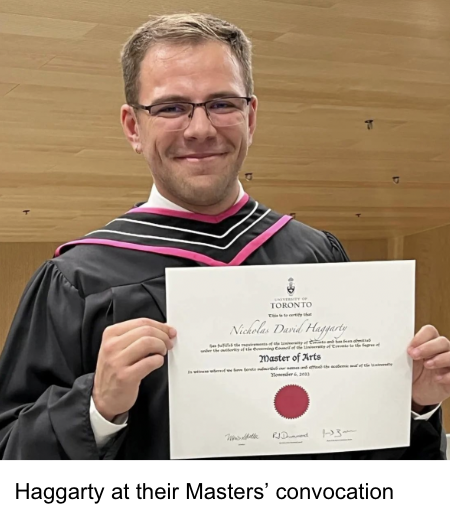
    Haggarty just finished their first year as a PhD student studying Sociolinguistics and Queer Linguistics with a background in both French and English. Having assisted on Professor Yoonjung Kang’s “Speech Rate Effects in French Stop Voicing Production and Perception,” Haggarty looks back on their works as constantly striving for an understanding of why people make the sounds they do, and why those sounds are perceived in the ways they are. 


    Their Master’s thesis studied the stereotypical “gay” voice, and whether there was a science-backed explanation for the phenomenon so commonly referred to in the media. Haggarty examined pitch and tone in a series of archived interviews with queer men of the 80s.


    An inspiring individual who views their research as advocacy rooted in education, Haggarty’s work focuses on the stories we tell through not only our language, but the clues revealed by the linguistic forms we use. 


    What is queer linguistics?

    Haggarty describes queer linguistics as relevant today due to societal interests in staying the hetero-normative course. To them, the field brings the queer community into the linguistics field, identifying elements of queerness and queer performance to define how people use language to root themselves in their identity. 


    An intersecting interest therein, Critical Discourse Analysis investigates parts of speech and what it means when we use them. For example, when we use Internet-slang or community-specific vernacular, are we showing relation or connection to ourselves or our community?


    Haggarty’s magnum opus to date is their PhD, using a corpus of interviews with queer individuals in the Toronto area. He will study their oral histories to get an understanding of language that goes beyond phonetic analysis, including the various ways they perceive authenticity in their identity. 


    The best part about this? The resource will be public. 


    An unprecedented act of agency and advocacy, this database of oral histories of queer people in Canada is a way of teaching people how queerness is perceived in our corner of North America, and whether the lessons they teach us line up with research done in places like the United States. If not, perhaps there is something to be said about breaking down pervasive stereotypes.


    As Haggarty says, “everything we do is a performance,” and their work in the field of queer linguistics seeks to decode its meanings and values. 


    To all those interested in the emerging field of queer linguistics, and to everyone else who values education and understanding above all else, keep an eye out for this exciting development in Haggarty’s work.


    We all have something to learn by listening to each other’s stories and taking them on their own terms. 


    June 12, 2024

    Emilia Melara Successfully Defends their PhD Thesis! Congratulations, Doctor!

    On May 27th, PhD Candidate Emilia Melara became the Linguistic Department's newest PhD! 

    Completing their Final Oral Examination in linguistics, this moment followed years of an extensive research project on syntactic properties of Mauritian Creole. 

    Their supervisor Elizabeth Cowper, along with the rest of the committee (Susana Bejar, Diane Massam, Keir Moulton), are so proud of Melara's work and excited to see what they do next. 

    We didn't find a new picture, but check out the last time Emilia earned a linguistics degree!

    Congratulations, Emilia!

    Nadia Takhtaganova successfully defends her PhD Thesis Proposal!

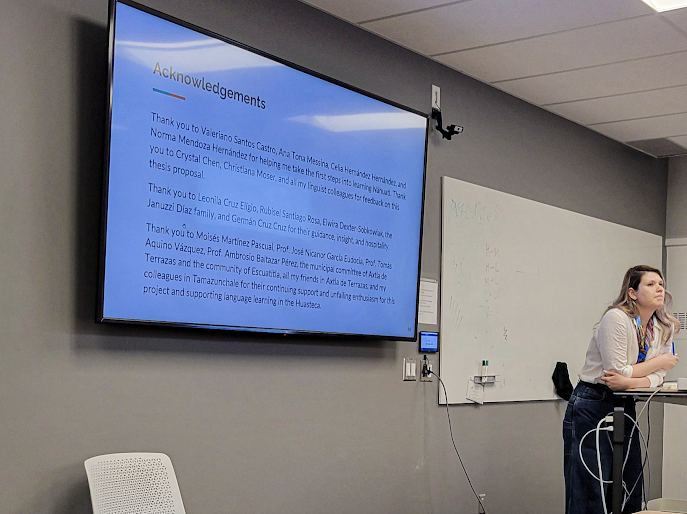
    On May 14th, 2024 PhD student Nadia Takhtaganova successfully defended her thesis proposal, Mapping Spatial Expressions in Huasteca Nahuatl.

    Working on language documentation in Latin America, Takhtaganova is currently studying the interaction of relational nouns and case marking in Nahuatl, an Uto-Aztecan language spoken in Eastern Mexico. Incorporating historical and generative linguistic frameworks with her thesis, she aims to train community members in linguistic research methodology to "raise metalinguistic awareness" and reduce stigmatization of language change.

    We highly recommend speaking to Nadia about this exciting work, a "morphosyntactic snapshot of typological change in spatial expressions in Huasteca Nahuatl."

    Her thesis proposal committee, consisting of Pedro Mateo Pedro and Michelle Troberg, as well as Nadia’s supervisor, María Cristina Cuervo, are excited to see where she goes next, and to see the successful completion and defense of her PhD thesis. 

    We at the Linguistics Department are so proud of Nadia for all her hard work! Congratulations!


    June 4, 2024

    UofT Linguists at the 55th Annual Conference on African Linguistics

    Several members of our UofT community presented talks at the 55th Annual Conference on African Linguistics hosted by McGill University, between May 2nd and May 4th

    A complete list of UofT attendees and presenters can be found below. 

    Liam McFadden, Assistant Professor Samuel Akinbo, PhD Candidate Gregory Antono, Yi-Ting Deng, and Assistant Professor Avery Ozburn presented their work, Mapping African languages

    His first conference outside of UofT, McFadden is an undergraduate student at UofT, who got to combine his knowledge of linguistics and GIS (Geographic Information System) to navigate through the field of language mapping with the goal of engaging the linguistics community in a project of making better maps

    McFadden and the team are excited to see the development of their work in future years, and we at the WHITL are excited to see ACAL 56!

    UofT Linguistics Department Presence: 

    Speakers: 

    Laura Griffin, Alexander Angsongna - An Analysis of Tone Delinking in Future Contexts in Central Dàgáárè

    Liam McFadden, Samuel Akinbo, Gregory Antono, Yi-Ting Deng, Avery Ozburn - Mapping African languages

    Keffyalew Gebregziabher - Polar and Wh-questions in Tigrinya 

    Samuel Akinbo, Tongpan Rabo Fwangwar - Grammatical tones in the Derivation of Verbs from Ideophones in Mwaghavul

    Atiqa Hachimi, Gareth Smail - Stylized performance of “mock Berber” in a Moroccan Stand-Up comedy talent show

    Juvénal Ndayiragije, Patrick Kinchsular - A comparative analysis of transitive expletive constructions in Kirundi and Germanic

    Poster:

    Avery Ozburn, Gregory Antono, Saba Mirabolghasemi - Community- and context-based approaches to African linguistics: the Language Profiles Project

    May 31, 2024

    UofT Hosts WSCLA - The Workshop on Structure and Constituency in Languages of the Americas


    Members of the WSCLA organizing committee at the Saturday dinner. L to R: Martin Renard, Jack Mahlmann, Greg Antono, Pedro Mateo Pedro, Susana Béjar, Yanfei Lu, Laura Griffin. We are missing Keren Rice. 

    Between April 26th and 28th, the University of Toronto’s Linguistics Department and the Centre for Indigenous Studies were proud to host WSCLA - the Workshop on Structure and Constituency in Languages of the Americas.

    Dedicated to the “formal and theoretically-informed linguistic study of the Indigenous languages of North, Central, and South America,” the event included speakers from Montreal, Alberta, Buffalo, Minnesota, and even Copenhagen. Invited speakers from UofT included Oheróhskon Ryan DeCaire, Associate Professor, while panelists saw a presentation from Tahohtharátye Joe Brant, Assistant professor. Looking forward to WSCLA 2025!


    Talks

    The Acquisiton of Ideophones and Split Ergatvity in Chuj
    Pedro Mateo Pedro (Faculty)

    Adult Immersion in Kanien’kéha Revitalizaton 
    Oheróhskon Ryan DeCaire (Wáhta and UofT Faculty)

    Posters

    Low “From” Applicatves in Kanien’kéha
    Martn Renard (PhD)

    Language Contact and the Extended PP Projection: Huasteca Nahuatl Spatial Expressions 
    Nadia Takhtaganova (PhD)

    Language Revitalizaton, is it only Indigenous Speakers’ Responsibility?
    Pedro Mateo Pedro (Faculty), Nathalia Ortz Rios (BA), Daniela Lopez Loncar (BA), Jorge Francisco Mex Tesucun, Otoniel Rosendo Zacal Chayax, and José Alfredo Chayax Tesucun (Comunidad Lingüistca Itzaj)

    Special Session Panel: The Future of Kanien’kéha Revitalization

    Panelists from the Sunday special session on the Future of Kanien'kéha Revitalization: 

    Tahohtharátye Joe Brant (TTO and UofT), Rohahiyo Jordan Brant (Onkwawenna Kentyohkwa), Oheróhskon Ryan DeCaire (Wáhta Mohawks and UofT), Tehota’kerá:ton Jeremy Green (TTO and York University), Konwanonhsiyóhstha’ Callie Hill (Tsi Tyónnheht Onkwawén:na), Owennatekha Brian Maracle (Onkwawenna Kentyohkwa), Karonhiióhstha’ Shea Sky

    (Ionkwahronkha’onhátie and Kanien’kehá:ka Onkwawén:na Raotitióhkwa).


    Other presentations involving UofT alumni:

    Apparent Cross-Clausal Agreement with Obliques in Kalaallisut is Prolepsis
    Line Mikkelsen (Berkeley), Emily Clem (UCSD), Michelle Yuan (MA 2013, now Faculty at UCLA), Ellen Thrane

    (Mis)matches Between Speech and Gesture in Hul’q’umi’num’ Storytelling
    Rosemary Webb (BA 2019; now PhD student at UVic)

    A Source of Conatvity in Tlingit Pluractonal Verbs
    Laurestine Bradford (MA 2021, now PhD student at McGill)

    Voice, Valence, and Hul’q’umi’num’ Salish Switch-Functon Serial Verb Constructons
    Lauren Schneider (SFU) and Rosemary Webb (BA 2019; now PhD student at UVic)


    Elder Eileen Antone giving the opening special session on Sunday, Iwith. 


    Sunday Morning Poster session.


    Mskwaankwad Rice (University of Minnesota) giving the presentation on a Learner-Centered Approach to Linguistic Research, one of 6 invited talks.