Showing posts with label Publication. Show all posts

December 2, 2024

Professor Naomi Nagy's Book Launch at the Canadian Language Museum

Image of books laid out on table at canadian language museum


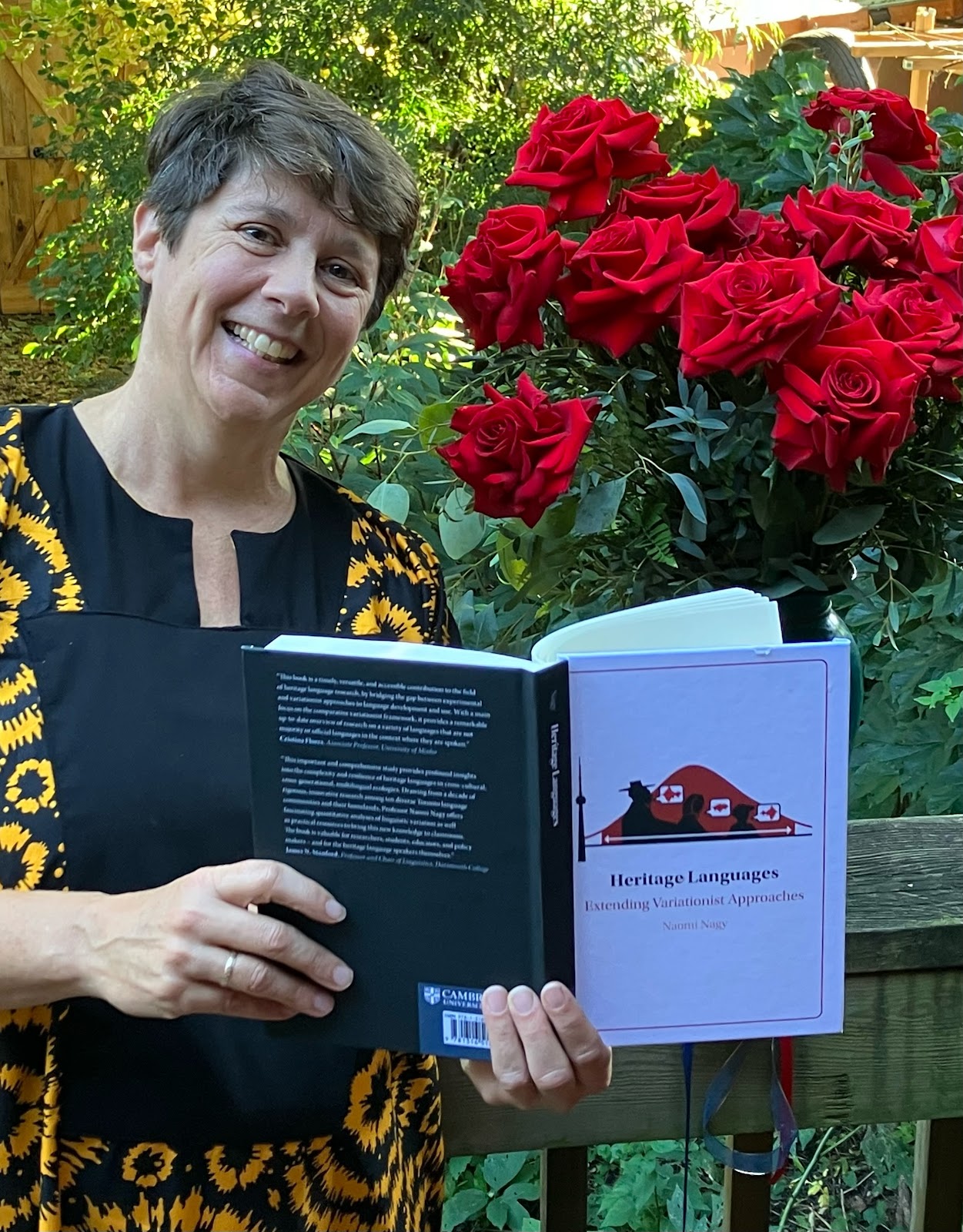
Professor Naomi Nagy (department chair) introduced her new work, Heritage Languages: Extending Variationist Approaches, earlier this semester at the Canadian Language Museum at Glendon College. 

This book is a part of the larger Heritage Language Variation and Change in Toronto project (HLVC), and an accumulation of hard work of linguists at the UofT, and heritage language speakers across the city. 


Professor Nagy at the Book Launch

Read the publication at this link, accessible through University of Toronto libraries.

Congratulations Professor Nagy on your publication and launch! 

Canadian Language Museum
Picture credits: Craig Diegel

November 16, 2024

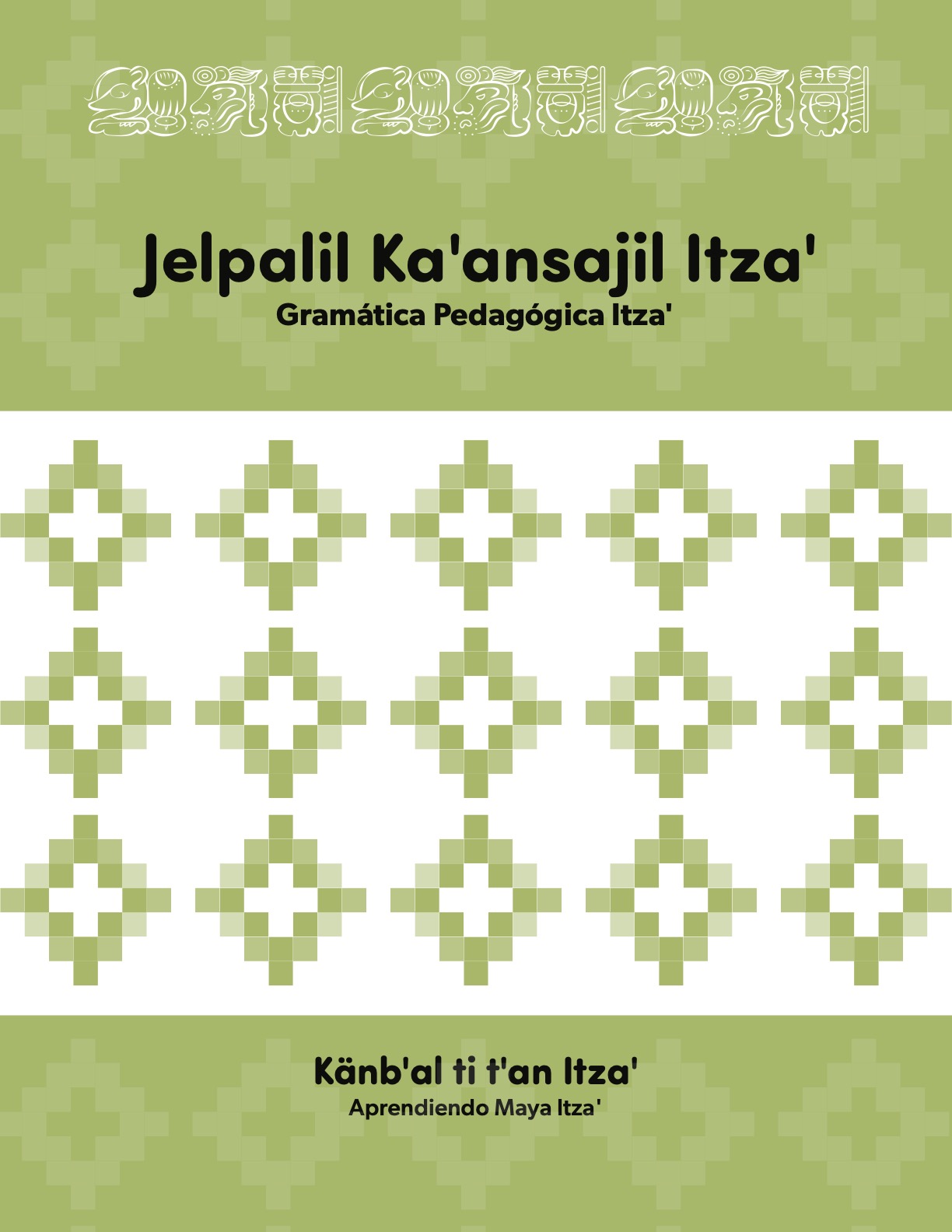
Pedro Mateo Pedro Publishes The Itza' Pedagogical Grammar

The department is pleased to congratulate Pedro Mateo Pedro (faculty) on the publication of the Itza' Pedagogical Grammar, in collaboration with the Comindad Lingüística Itza' of the Academia de las Lenguas Mayas de Guatemala.


Itza’ is an endangered language spoken in Guatemala that belongs to the Yucatecan branch of Mayan languages. 80% of the pedagogical grammar appears only in Itza’, since the aim is to strengthen the understanding and oral expression of the language. The development of the grammar is part of a larger project on the revitalization of Itza’. 

This project was a joint effort with individuals in the language community and at UofT: Jorge Francisco Mex Tesucún (Comunidad Lingüística Itza'), Ana López Sipac (Kaqchikel speaker), Aki Zhang, Sooyoun Im, David Ramsay, Jevan Konyar, and Daniela Lopez Loncar (UofT).  

This is a great step towards revitalization and documentation. Congratulations everyone! 


The book is available here: 

Itza' Pedagogical Grammar

August 28, 2024

AI-Driven Hype in Classrooms: Navigating Ethical Issues - Presented!

During the summer of 2023, Lex Konnelly and Nathan Sanders presented on AI "hype" in classrooms to help instructors address issues bubbling to the surface as ChatGPT's range broadens with each question it is asked by some unsuspecting student. 

Addressing ethical and pedagogical considerations for AI-driven text generation in classrooms, particularly of linguistics, they presented a foray into the ever-changing landscape evolving at a rate "faster than scholars can publish work on them" (Sanders).

Though some faculty members with whom the researchers partnered focused on ways they could Chat-GPT-proof their assessments, others were interested in integrating such tools into their classwork.

Importantly, the researchers' approach is not punitive, but rather, constructive - an approach to merging of AI tools with educational models which will benefit not only morale in the classroom, but student media and technology literacy in a world rapidly going wireless.

Perhaps today's students can benefit from learning how to hack tools such as chatbots to maximize their potential for learning. 

Perhaps future integration of artificial intelligence brings with it the potential of a rapid decline or even total erasure of the capacity to learn hard skills.

Regardless, the researchers' position is that the fields of linguistics and artificial intelligence are necessarily intertwined.

Due to tools' like Chat-GPT's reliance on large language models, students of both linguistics and computer science, or even artificial intelligence engineering, have much to gain by probing the threads linking their interests to each other, potentially by exploring something like the groundbreaking focus on Computational Linguistics offered by UofT. 

Presented by Konnelly at the 2024 Annual Meeting of the Linguistic Society of America in January, this work will be published soon as a proceedings paper

As Sanders and Konnelly will be the first to tell you, by the time this post goes live, this information may be obsolete. 

We at WHITL don't see this as a reason not to comment, but as an opportunity to mark our ideas on an AI-timeline quickly extending into the future, and an exciting chance to engage with all students across UofT. 

AI in the classroom poses all kinds of ethical questions for students and professors, and raises new questions every time it is used. This work gives us some interesting and thought-provoking ways of dealing with technology which passes the Turing Test daily, and (usually) with flying colours at that.

August 2, 2024

UofT Linguists Impress at the 2024 CLA Conference


From June 17-19, 2024, UofT Linguists trekked to Carleton University to attend the 2024 Canadian Linguistics Association (CLA) Conference

Will Williams, PhD student, shared this list of talks and posters by UofT people. Bolded names indicate University of Toronto affiliation.

Looking forward to CLA 2025, and the presentation of more incredible presentations such as the ones below!

Posters

Thales Buzan, Cristina Name & Laura Colantoni (Faculty)

Native English Speakers’ Perception of Questions Produced by L1 Brazilian Portuguese and L1 English Speakers

Caroline Mekhaeil (PhD student, UTM)

Could Individual Language Dominance Explain the Transfer to L3 French?

Caroline Mekhaeil presents poster


Samuel Akinbo (Faculty), Tongpan Fwangwar & Michael Bulkaam

Morphophonological Polarity in West Chadic Languages

Rim Dabbous, Marjorie Leduc (MA Alumna), David Ta-Chun Shen & Charles Reiss

Locality in phonology is epiphenomenal

Radu Craioveanu (Alum)

Long and short diphthongs in North Saami

Radu Craioveanu presents poster

Liam McFadden (Undergrad), Avery Ozburn (Faculty) & Samuel Akinbo (Faculty) - Best Poster!

Language mapping for linguists

Liam McFadden presents poster

Talks

Ash Asudeh, Bronwyn Bjorkman, Neil Myler, Daniel Siddiqi & Lisa Sullivan (Alum)

Metasyncretism and secondary exponence in LRFG

Samantha Jackson (incoming Faculty, ex-postdoc) & Derek Denis (Faculty)

Speaking of immigrants: Commentary on the aural employability of (non-)Canadian English

Samira Ghanbarnejadnaeini (MA Alum)

“Woman, Life, Freedom:” A Feminist Critical Discourse Analysis of Gender and Political Activism

Laurestine Bradford (MA Alum)

A Source of Conativity in Tlingit Pluractional Verbs

Angelika Kiss (PhD student), Jianing ZhouJustin Leung (PhD student)

Declarative questions in Shanghainese and Cantonese

Yawovi Godo, Lydia Mei, Andreea Cristina Nicolae & Lyn Tieu (Faculty)

Étude expérimentale des propriétés d’exhaustivité de la disjonction en français : L’interaction de l’exclusivité, du libre choix, et des implicatures ad hoc

Lisa Sullivan (Alum) & Nicole Rosen (Alum)

/e/-/i/ overlap in Manitoba English

Calvin Quick (PhD Student)

Agreement with nominal antecedents in Welsh

Simone Diana Zamarlik (Alumni)

Preposition stranding in a non-preposition-stranding language: The puzzle of optional preposition omission under sluicing in Polish

Crystal Chen (PhD Student), Lyn Tieu (Faculty) & Ana Teresa Pérez-Leroux (Faculty)

Investigating the role of gaze and the semantics of demonstratives in referent identification

Samuel Jambrović (PhD Student), Awarded "Honorable Mention"

Defending predicativism: Lessons from Barbie

Nadia Takhtaganova (PhD Student) & Barend Beekhuizen (Faculty)

Variation in the Morphosemantics of Postnominal Prepositions: The Case of Romance A

Arsalan Kahnemuyipour (Faculty) & Sahar Taghipour (Alumni)

Ezafe in the context of PPs

Justin R. Leung (PhD Student)

I’m like, “Like is not a complementizer, it seems like”

Dionatan Cardozo (Visiting student)

Quantified Phrases in Brazilian Portuguese: Preliminary Experimental Results

Christiana Moser (PhD Student), Bahar Tarakcı, Ercenur Ünal & Myrto Grigoroglou (Faculty)

Multimodal recipient mentions in possession-transfer event descriptions: language-specificity outweighs conceptual peripherality

Patrick Kinchsular (Undergrad)

External Possession in Kinyarwanda: A Tale of Two Applicatives

Annie Chong, Avery Ozburn (Faculty) & Tamam Youssouf

Phonologically-conditioned allomorphy in Oromo plurals

Ana Teresa Pérez-Leroux (Faculty), Laura Colantoni (Faculty), Danielle Thomas (alum) & Crystal Chen (PhD Student)

Gender in Toronto Heritage Spanish

Anissa Baird (PhD Student) & Emily Atkinson (Faculty)

Five- & Eight-Year-Olds’ Interpretation of Ambiguous They

July 23, 2024

Naomi Nagy, Linguistics Chair, Publishes Book about Heritage Language Variation and Change!

book cover
On June 27th, 2024, Department of Linguistics Chair, Naomi Nagy, published her book, Heritage Languages: Extending variationist approaches. [Click link to purchase :-) or get it from UofT's library]. 

In Canada, the term, "heritage language" refers to a language learned in the home by children, if that language is not one of Canada's official languages (French, English). Half the people in Toronto are heritage-language speakers!

This book seeks to dispel stigma surrounding the use of one's heritage language by investigating cross-generational variation and change in conversations with 400+ speakers, in 8 different heritage languages, in Toronto. The findings reveal many similarities between heritage and homeland varieties.

"Introduc[ing] new methodology to help readers understand and apply variationist sociolinguistic approaches to quantitatively analyze spontaneous speech," this novel approach to heritage language research showcases how change in grammar of heritage languages resembles change patterns seen hegemonic, majority languages, contradicting findings of "simplification/attrition patterns in experimental heritage language studies." [quoted from the publicity blurbs]

Comparing patterns not only across languages, but across generations, this research quotes heritage speakers to give voice and pride to the use of their languages. 

Nagy presented some of this research at BAM's Language Research Day, as her talk on Heritage Language Variation and Change (HLVC), which we covered on the blog earlier in July. Other findings are on the project's webpage.

This book promises to be a veritable toolbox for those interested in learning about or researching heritage languages, dedicated to language revitalization.

Currently, the Department Chair is in Italy conducting research also relevant to this pursuit - about the variation in Franco-Provencal language varieties over time and space, and how to connect speakers of different varieties via social media.


The author reports that this book was much more fun to write than her dissertation!

July 15, 2024

Arcadian Greek vs. Standard Greek: Dr. Photini Coutsougera Publishes A Dictionary with the Answers


From Dr. Coutsougera: 

"""
Dr. Photini Coutsougera of Mississauga Campus' Language Studies Department has recently published a new book, A Dictionary of Northeastern Arcadian Greek [in Greek] with Patakis Publications, Athens, Greece (2024)/ 320 pages. 

A Look Inside: Letter Αα, p. 66

The Dictionary of Northeastern Arcadian Greek comprises 4.200 entries and 5.120 senses. These entries were primarily collected during field work, over a period of approximately thirteen years, and from existing written sources. 

Subsequently, they were verified one by one  by a group of native speakers of the dialect, aged 80 and over. Each entry contains semantic, phonological, morphological, syntactic and stylistic information. It also contains a plethora of authentic examples in use, synonyms, antonyms, idioms and idiomatic phrases, proverbs, sayings, and verses from local folk poetry. Finally, a 28-page Prologue includes a compact grammar of the dialect, lays out the research methodology employed in the data collection, and defines Arcadian Greek on the basis of linguistic criteria which systematically differentiate it from Standard Greek. 

This book aspires to bring the Peloponnesian varieties of Greek to the fore as they have been conspicuously absent from the literature.

                                                                 """


June 25, 2024

Tahohtharátye Joe Brant Completes Dissertation at the University of Victoria

Congratulations Tahohtharátye Joe Brant!

He has earned a PhD from the University of Victoria, completing his dissertation, Tó: nya'teká:yen tsi Entewà:ronke', in Language Revitalization and Change, available at the University of Victoria website

Tahohtharátye is cross-appointed in the Centre for Indigenous Studies, and we are proud to have him on our faculty.

Learn more about him here, and read about his work at WSCLAon the WHITL blog.

Congratulations once more!

June 24, 2024

UTM Faculty Dr. Samantha Jackson and Derek Denis Publish their Research into Accent-Based Biases in the GTA

Postdoctoral Fellow of Language Studies at UTM, Dr. Samantha Jackson, and Associate Professor of Linguistics, Derek Denis, have recently published their work titled What I say, or how I say it? Ethnic accents and hiring evaluations in the Greater Toronto Area.

Jackson’s work, focusing on sociolinguistics, investigates how immigrants to Canada speaking with an identifiably non-Canadian accent are perceived by prospective employers. She investigates strategies to reduce such workplace discrimination and target other societal problems. 


Denis' interests follow variationist sociolinguistics (language change), and how human language faculty allows for variation both within the individual’s grammar and the larger context of the society in which it exists.


During their study, they recorded 12 women giving scripted 6 answers to interview questions, (3 good, 3 bad) and asked Human Resources students at universities and colleges in the GTA to rank the content of responses, as well as the employability of each voice. They were also asked to determine for which, if any, job interview to recommend these individuals. 


Jackson and Denis analyzed the results using conditional inference tree modeling and random forest analysis.


They found that the accent heard by participants affected their ratings of all these scripted responses, viewing Canadian accents as superior to those of non-Canadians – specifically, the most disadvantaged being Chinese, Nigerian, and German accents. These were least likely to be recommended for customer-facing and, importantly, higher-ranking jobs. 


Presented at online conferences in 2021 and 2022, in Germany and in Vancouver, a full thematic analysis of comments from the full study’s sample will be presented in June at the CLA (Canadian Linguistics Association) Conference, held in Ottawa. Watch out for WHITL’s coverage of that event, coming soon. 


As for this publication, major recommendations from the report include (1) adding language to the Ontario Human Rights Commission’s grounds for discrimination, among others, which can be found in their full published work. It will also be available in the June issue of Language


Though linguistic protection is an idea covered in sections 15 (Equality Rights), and 23 (Minority language and educational rights) of the Canadian Charter, Jackson and Denis’ work puts a spotlight on the need for specific and targeted legislation to protect Canadians with non-Canadian accents in the workplace.


Real change in public policy and legislation which emerges from projects like these are some of the most exciting moments we get to watch as they evolve. Looking forward to seeing this work at the CLA Conference in June.


An important p.s.: Dr. Jackson will join the UofT Department of Linguistics in January 2025. We can't wait!


June 19, 2024

Professor Reynolds and the Controversy of More/Less: Paper Accepted at Journal of Linguistics

In May 2024, Adjunct Professor Brett Reynolds published his paper "Why more and less are never adverbs" in the Journal of Linguistics, arguing that the analysis of semantic information is useful for making categorical decisions about words and their meanings. 

This interesting work is somewhat of a discovery in the field of categorization. If we had all been agreed that timber wolves and grey wolves were distinct species, for example, Reynolds in his own words has come out with data which suggests that these are actually the same type of wolf living in different territories!

To read Reynolds' succinct twitter thread explaining the phenomenon, check out his Twitter: @brettrey3.

Figure 5of Reynolds' publication,
a k-means grouping between adjectives
and determinatives (pg. 26)
To summarize, words function differently according to context: the words "more" and "less" are categorized in most dictionaries as adverbs, as they can modify adjectives or adverbs, such as in the phrase "more/less quickly." However, they can also determine nouns, and in sentences such as "more/less food" are called determinatives.

Determinatives, (Ds) thus, don't just determine nouns, but they can also modify Advs. 

So why are "more" and "less" special? 

The Comprehensive Grammar of the English Language, (CGEL) refers to these two words as adverbs because they perform the same linguistic function as the comparative -er and superlative -est in ways that "much" and "little" don't. 

Reynolds disputes this distinction - you can't have "much massive," but you can have "much [and more] different." 

He suggests that you get overlaps that don't follow rigid rules because of semantic scales, and not because "much" and "more" are categorically different. 

Adjectives "prefer" different modifiers according to semantic rules such as size, similarity, and improvement.

Analyzing different adjectives and their modifiers in a corpus, Reynolds noticed an "almost perfect" split between more-adjectives (blue), much-adjectives (red), and adjectives that are more ambivalent (green).

Thus, Reynolds says that the "most thorough and consistent grammar of English," the CGEL, is only "mostly right" in their categorization of Adjs. and Ds. 

Determinatives shouldn't be listed twice, once with adverbs, and again with other Ds: rather, words like "more" and "less" are never adverbs. 

Stay tuned to see what changes come out of this publication, and weigh in with your own two cents!

March 22, 2024

LGCU has started a new newsletter!

The LGCU has started a monthly newsletter to be sent out to members of the Department. If you are looking to advertise any events, post announcements, or simply share some linguistic fun facts or positivity, send it on over! Submissions for the next (April) newsletter close on March 28. Please submit to aliya.zhaksybek@mail.utoronto.ca.

March 18, 2024

New paper by Prof. Samuel Akinbo in Glossa!

A new paper by Prof. Samuel Akinbo entitled "Iconicity as the motivation for the signification and locality of deictic grammatical tones in Tal" has recently appeared in Glossa. The paper presents evidence in favour of iconicity in the core morphophonological grammar.

Here is the abstract:

We present novel evidence for iconicity in core morphophonological grammar by documenting, describing, and analysing two patterns of tonal alternation in Tal (West Chadic, Nigeria). When a non-proximal deixis modifies a noun in Tal, every tone of the modified noun is lowered. When the nominal modifier is a proximal deixis, the final tone of the modified noun is raised. The tone lowering and raising are considered the effects of non-proximal and proximal linkers, which have the tone features [–Upper, –Raised] and [+Raised] as their respective exponents. The realisation and maximal extension of the non-proximal tone features are considered effects of morpheme-specific featural correspondence constraints. Similarly, the exponent of the proximal linker docking on the final TBU is due to the relative ranking of the proximal-specific correspondence constraints. The association of the tone features [–Upper, –Raised] and [+Raised] with non-proximal and proximal linkers, respectively, is in line with crosslinguistic patterns of magnitude iconicity. Given that the local and long-distance realisations of the proximal and non-proximal featural affixes respectively are perceptually similar to deictic gestures, the locality of the featural affixation is considered a novel pattern of iconicity. To motivate this pattern of iconicity, we extend the notion of perceptual motivation in linguistic theory to include the crossmodal depiction of sensory imagery. Consequently, Tal presents evidence for iconicity as a motivation for morphophonological grammar.

Congratulations Prof. Akinbo! 

March 14, 2024

Congratulations to Prof. Suzi Lima for her new paper in Language Documentation and Description

Congratulations to Professor Suzi Lima whose new article entitled "On Quotatives and Speech Verbs in Yudja" has recently appeared in the journal Language Documentation and Description. The article examines the argument structure of speech verbs in Yudja, an indigenous language spoken in Brazil.

Here is the abstract:

Much literature has debated the argument structure of speech verbs. For example, Munro (1982) has provided evidence to show that, in many languages, quotations do not pattern like the complements of transitive verbs. In this paper, I analyze the distribution of four speech verbs in Yudja (Juruna branch, Tupi), an Indigenous language spoken in Brazil, and compare them with bona fide transitive verbs. I provide morphosyntactic evidence to argue that direct quotations are not complements of speech verbs based on the distribution of such verbs both in quotative and non-quotative constructions.

Happy reading!

March 8, 2024

New paper from Michela Ippolito in the Journal of Semantics!

Faculty member Michela Ippolito has recently published a new paper in the Journal of Semantics entitled "The Hell with Questions." The paper examines current approaches to wh-the-hell questions, and proposes a new theory based on the idea of doxastic dissonance.

Here is the abstract:

We discuss previous proposals for the semantics of wh-the-hell questions (domain widening theories and domain restriction theories), highlighting the challenges these accounts face in trying to explain the different properties of wh-the-hell questions and capture the contribution this expression makes to the semantics of the question. We review the semantic properties of wh-the-hell questions discussed in the literature and propose a new analysis according to which the hell signals doxastic dissonance. We argue that this proposal accounts for the semantic properties of this type of expletive question, and has the potential to extend to the class of wh-the-hell questions we see across languages.

Congratulations Michela! 

February 15, 2024

New book about heritage languages


Cambridge University Press has just produced a fantastic collection of chapters about phonetics and phonology in a wide range of heritage languages. U of T is well-represented:


1 - Front Rounded Vowels of Heritage Korean in Northern China

BYoonjung KangNa-Young RyuJessamyn Schertz (and their co-authors  Sungwoo Han, Suyeon Yun


16 - Perception and Production of English and Portuguese Voiceless Stops by Heritage Learners

By Anabela RatoVanina Machado. (Dept. of Spanish & Portuguese)


as well as this output from the HLVC Project:


Check out The Phonetics and Phonology of Heritage Languages on the CUP website

Huge thanks to Rajiv Rao for his amazing work editing this volume!