Showing posts with label Languages of Toronto. Show all posts

December 2, 2024

Professor Naomi Nagy's Book Launch at the Canadian Language Museum

Image of books laid out on table at canadian language museum


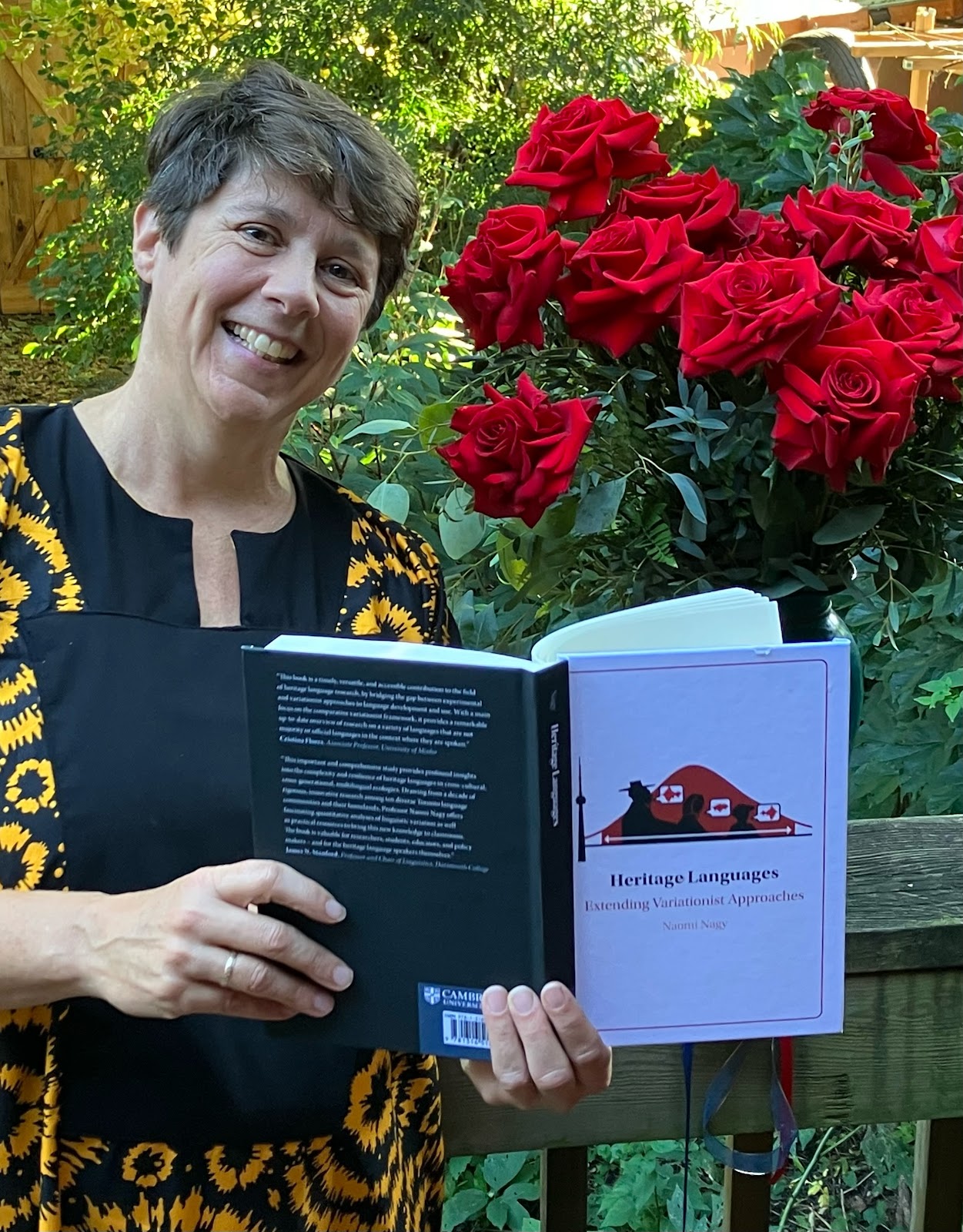
Professor Naomi Nagy (department chair) introduced her new work, Heritage Languages: Extending Variationist Approaches, earlier this semester at the Canadian Language Museum at Glendon College. 

This book is a part of the larger Heritage Language Variation and Change in Toronto project (HLVC), and an accumulation of hard work of linguists at the UofT, and heritage language speakers across the city. 


Professor Nagy at the Book Launch

Read the publication at this link, accessible through University of Toronto libraries.

Congratulations Professor Nagy on your publication and launch! 

Canadian Language Museum
Picture credits: Craig Diegel

August 2, 2024

UofT Linguists Impress at the 2024 CLA Conference


From June 17-19, 2024, UofT Linguists trekked to Carleton University to attend the 2024 Canadian Linguistics Association (CLA) Conference

Will Williams, PhD student, shared this list of talks and posters by UofT people. Bolded names indicate University of Toronto affiliation.

Looking forward to CLA 2025, and the presentation of more incredible presentations such as the ones below!

Posters

Thales Buzan, Cristina Name & Laura Colantoni (Faculty)

Native English Speakers’ Perception of Questions Produced by L1 Brazilian Portuguese and L1 English Speakers

Caroline Mekhaeil (PhD student, UTM)

Could Individual Language Dominance Explain the Transfer to L3 French?

Caroline Mekhaeil presents poster


Samuel Akinbo (Faculty), Tongpan Fwangwar & Michael Bulkaam

Morphophonological Polarity in West Chadic Languages

Rim Dabbous, Marjorie Leduc (MA Alumna), David Ta-Chun Shen & Charles Reiss

Locality in phonology is epiphenomenal

Radu Craioveanu (Alum)

Long and short diphthongs in North Saami

Radu Craioveanu presents poster

Liam McFadden (Undergrad), Avery Ozburn (Faculty) & Samuel Akinbo (Faculty) - Best Poster!

Language mapping for linguists

Liam McFadden presents poster

Talks

Ash Asudeh, Bronwyn Bjorkman, Neil Myler, Daniel Siddiqi & Lisa Sullivan (Alum)

Metasyncretism and secondary exponence in LRFG

Samantha Jackson (incoming Faculty, ex-postdoc) & Derek Denis (Faculty)

Speaking of immigrants: Commentary on the aural employability of (non-)Canadian English

Samira Ghanbarnejadnaeini (MA Alum)

“Woman, Life, Freedom:” A Feminist Critical Discourse Analysis of Gender and Political Activism

Laurestine Bradford (MA Alum)

A Source of Conativity in Tlingit Pluractional Verbs

Angelika Kiss (PhD student), Jianing ZhouJustin Leung (PhD student)

Declarative questions in Shanghainese and Cantonese

Yawovi Godo, Lydia Mei, Andreea Cristina Nicolae & Lyn Tieu (Faculty)

Étude expérimentale des propriétés d’exhaustivité de la disjonction en français : L’interaction de l’exclusivité, du libre choix, et des implicatures ad hoc

Lisa Sullivan (Alum) & Nicole Rosen (Alum)

/e/-/i/ overlap in Manitoba English

Calvin Quick (PhD Student)

Agreement with nominal antecedents in Welsh

Simone Diana Zamarlik (Alumni)

Preposition stranding in a non-preposition-stranding language: The puzzle of optional preposition omission under sluicing in Polish

Crystal Chen (PhD Student), Lyn Tieu (Faculty) & Ana Teresa Pérez-Leroux (Faculty)

Investigating the role of gaze and the semantics of demonstratives in referent identification

Samuel Jambrović (PhD Student), Awarded "Honorable Mention"

Defending predicativism: Lessons from Barbie

Nadia Takhtaganova (PhD Student) & Barend Beekhuizen (Faculty)

Variation in the Morphosemantics of Postnominal Prepositions: The Case of Romance A

Arsalan Kahnemuyipour (Faculty) & Sahar Taghipour (Alumni)

Ezafe in the context of PPs

Justin R. Leung (PhD Student)

I’m like, “Like is not a complementizer, it seems like”

Dionatan Cardozo (Visiting student)

Quantified Phrases in Brazilian Portuguese: Preliminary Experimental Results

Christiana Moser (PhD Student), Bahar Tarakcı, Ercenur Ünal & Myrto Grigoroglou (Faculty)

Multimodal recipient mentions in possession-transfer event descriptions: language-specificity outweighs conceptual peripherality

Patrick Kinchsular (Undergrad)

External Possession in Kinyarwanda: A Tale of Two Applicatives

Annie Chong, Avery Ozburn (Faculty) & Tamam Youssouf

Phonologically-conditioned allomorphy in Oromo plurals

Ana Teresa Pérez-Leroux (Faculty), Laura Colantoni (Faculty), Danielle Thomas (alum) & Crystal Chen (PhD Student)

Gender in Toronto Heritage Spanish

Anissa Baird (PhD Student) & Emily Atkinson (Faculty)

Five- & Eight-Year-Olds’ Interpretation of Ambiguous They

July 23, 2024

Naomi Nagy, Linguistics Chair, Publishes Book about Heritage Language Variation and Change!

book cover
On June 27th, 2024, Department of Linguistics Chair, Naomi Nagy, published her book, Heritage Languages: Extending variationist approaches. [Click link to purchase :-) or get it from UofT's library]. 

In Canada, the term, "heritage language" refers to a language learned in the home by children, if that language is not one of Canada's official languages (French, English). Half the people in Toronto are heritage-language speakers!

This book seeks to dispel stigma surrounding the use of one's heritage language by investigating cross-generational variation and change in conversations with 400+ speakers, in 8 different heritage languages, in Toronto. The findings reveal many similarities between heritage and homeland varieties.

"Introduc[ing] new methodology to help readers understand and apply variationist sociolinguistic approaches to quantitatively analyze spontaneous speech," this novel approach to heritage language research showcases how change in grammar of heritage languages resembles change patterns seen hegemonic, majority languages, contradicting findings of "simplification/attrition patterns in experimental heritage language studies." [quoted from the publicity blurbs]

Comparing patterns not only across languages, but across generations, this research quotes heritage speakers to give voice and pride to the use of their languages. 

Nagy presented some of this research at BAM's Language Research Day, as her talk on Heritage Language Variation and Change (HLVC), which we covered on the blog earlier in July. Other findings are on the project's webpage.

This book promises to be a veritable toolbox for those interested in learning about or researching heritage languages, dedicated to language revitalization.

Currently, the Department Chair is in Italy conducting research also relevant to this pursuit - about the variation in Franco-Provencal language varieties over time and space, and how to connect speakers of different varieties via social media.


The author reports that this book was much more fun to write than her dissertation!

June 24, 2024

UTM Faculty Dr. Samantha Jackson and Derek Denis Publish their Research into Accent-Based Biases in the GTA

Postdoctoral Fellow of Language Studies at UTM, Dr. Samantha Jackson, and Associate Professor of Linguistics, Derek Denis, have recently published their work titled What I say, or how I say it? Ethnic accents and hiring evaluations in the Greater Toronto Area.

Jackson’s work, focusing on sociolinguistics, investigates how immigrants to Canada speaking with an identifiably non-Canadian accent are perceived by prospective employers. She investigates strategies to reduce such workplace discrimination and target other societal problems. 


Denis' interests follow variationist sociolinguistics (language change), and how human language faculty allows for variation both within the individual’s grammar and the larger context of the society in which it exists.


During their study, they recorded 12 women giving scripted 6 answers to interview questions, (3 good, 3 bad) and asked Human Resources students at universities and colleges in the GTA to rank the content of responses, as well as the employability of each voice. They were also asked to determine for which, if any, job interview to recommend these individuals. 


Jackson and Denis analyzed the results using conditional inference tree modeling and random forest analysis.


They found that the accent heard by participants affected their ratings of all these scripted responses, viewing Canadian accents as superior to those of non-Canadians – specifically, the most disadvantaged being Chinese, Nigerian, and German accents. These were least likely to be recommended for customer-facing and, importantly, higher-ranking jobs. 


Presented at online conferences in 2021 and 2022, in Germany and in Vancouver, a full thematic analysis of comments from the full study’s sample will be presented in June at the CLA (Canadian Linguistics Association) Conference, held in Ottawa. Watch out for WHITL’s coverage of that event, coming soon. 


As for this publication, major recommendations from the report include (1) adding language to the Ontario Human Rights Commission’s grounds for discrimination, among others, which can be found in their full published work. It will also be available in the June issue of Language


Though linguistic protection is an idea covered in sections 15 (Equality Rights), and 23 (Minority language and educational rights) of the Canadian Charter, Jackson and Denis’ work puts a spotlight on the need for specific and targeted legislation to protect Canadians with non-Canadian accents in the workplace.


Real change in public policy and legislation which emerges from projects like these are some of the most exciting moments we get to watch as they evolve. Looking forward to seeing this work at the CLA Conference in June.


An important p.s.: Dr. Jackson will join the UofT Department of Linguistics in January 2025. We can't wait!


June 21, 2024

Elaine Gold Receives the Governor General's Meritorious Service Award

Director Elaine Gold at Glendon Hall
Elaine Gold, retired from the Linguistics Department, and head of the Canadian Language Museum (CLM) has been awarded the Governor-General's Meritorious Service Award. Congratulations!!

The co-Chair of the International Network of Language Museums has seen her museum's exhibits touring across the world, including and especially those pertaining to Indigenous languages. 

Director Gold's star-studded career since retirement from our Department includes speaking about Canadian Indigenous Language policies at the Austronesian Languages Revitalization Forum in Taipei, September 2023.

She and the CLM are now collaborating with the Indigenous Languages Research Foundation to translate their booklet, Indigenous Languages in Canada, into Mandarin. 

The CLM also hosted the art exhibit Anthem: Expressions of Canadian Identity during the fall, which will be presented from May to September at the Canadian Embassy's Prince Takamado Gallery in Tokyo. On June 20th, she, her team, and four artists, will attend the exhibition's reception. 

Director Gold giving her presentation in Taipei, September 2023.

Currently on display in the CLM is "Toronto Voices," an exhibit created as part of community outreach, exploring and detailing the identity of young Torontonians through their vocabulary in collaboration with The Spot, a drop-in center in the Jane-Finch area. 

This recognition of Gold's tireless devotion to languages of Canada, and especially of Toronto, is a fantastic credit to her work in both national and international linguistic communities.

We are so inspired by Gold's impact on reconciliation and language revitalization, especially in the field of Indigenous languages and cultures.


March 2, 2023

TULCON16!!!

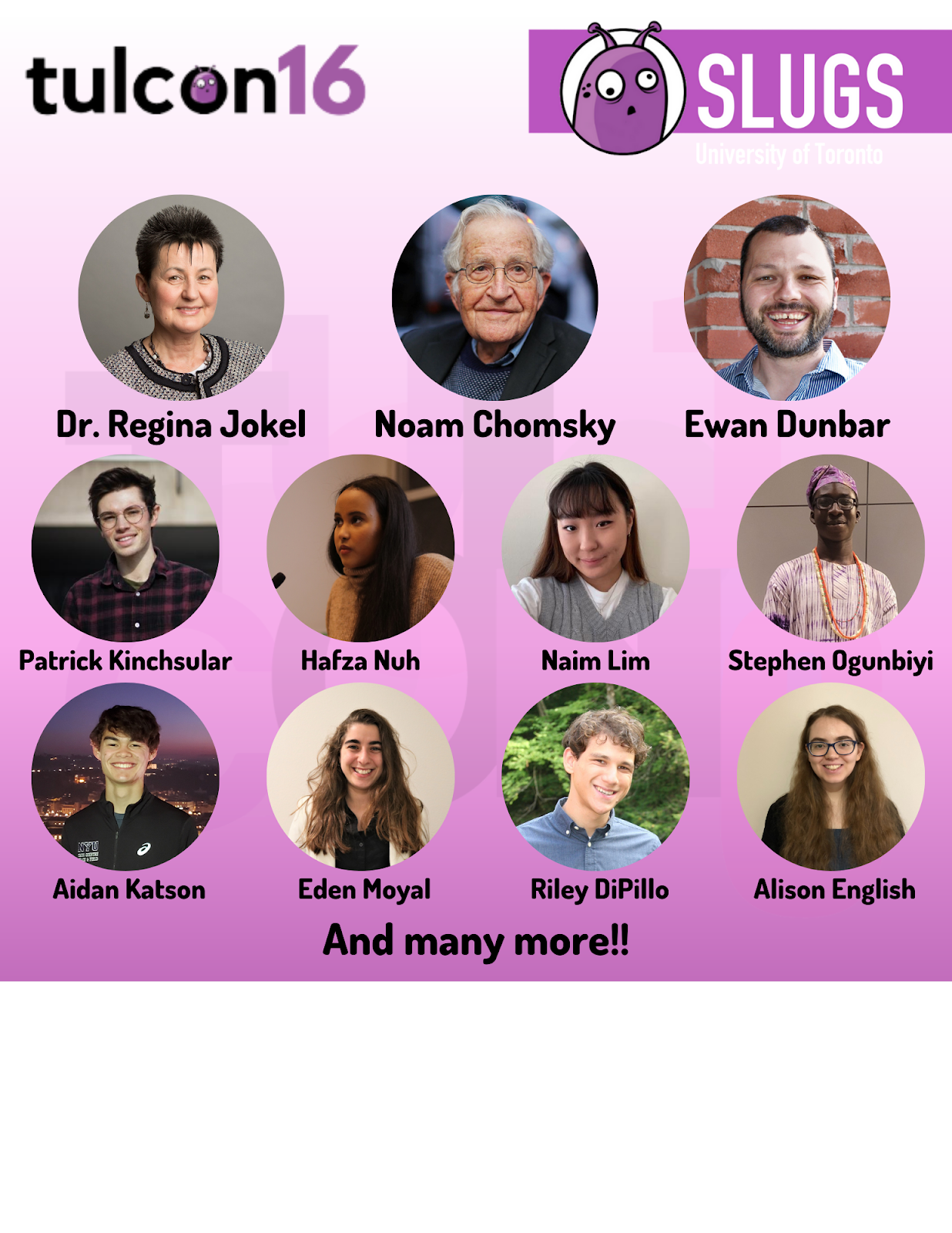
In case you have not heard, SLUGS is hosting TULCON16 this upcoming weekend!! With an incredible line up of keynote speakers, including Noam Chomsky himself), this will be a jam packed weekend of wonderful linguistic work! 

Presentations cover a range of topics from speech disorders to the use of A.I. to theoretical syntax and everything in between! Below you can see the list of all UofT speakers presenting at the conference.Visit the TULCON16 website to get the extensive schedule with abstracts

UofT Presentations: 

- Dr. Regina Jokel (Faculty)  "Language as a diagnostic tool"

- Ewan Dunbar (Department of French)  "Are the Robots as smart as babies now?

- Siyi Fan (Undergrad)  & Shiyang Sun (Undergrad) "A variationist study of first-person-singular subject ellipsis in epistemic verb phrases of Heritage Cantonese" 

- Tony (Juntao) Hu (Undergrad) "Secondary thematic role encoding in require vs. allow verbs"

- Patrick Kinshular (Undergrad) "Semantic constraints in Kirundi phonology"

- Mechelle Wu  (Undergrad) "The citizens of everywhere and nowhere: A pilot study examining the linguistic behaviours of Third-Culture Kids (TCKs)" 

- Naim Lim  (Undergrad) "Acoustic study of word-initial liquids in Korean loanwords for English produced by Korean speakers"

- Hafza Nuh  (Undergrad) "An analysis of English stop consonant perception and production in L1 Somali speakers and comparison with L1 English speakers: A study of /p/ and /b/

- Laura Escobar (Undergrad) "The intonation of statements in the casual spontaneous speech of Tokyo Japanese" 

If you are interesting in attending, please register in advance.  For those who would like to get involved with TULCON, SLUGS is accepting volunteers to help with organization matters throughout the day.

We are SO excited for TULCON and hope you all can make it! 
  

August 30, 2021

UofT Language Research Day!

The University of Toronto will be hosting the first Language Research Day! This will be a one-day meeting where graduate students, postdoctoral researchers and faculty members can share their language-related research.  All researchers from all departments, campuses and affiliated hospitals are welcome! 

Language Research Day will be held virtually on November 12th, 2021. The theme is Language Research in a Virtual Context, which is very fitting for the time!  

Research on ANY aspect/ level of language is welcomed. Note that your research does not need to be relevant to the virtual context, all topics are welcomed! 

For those interested, submit your abstracts (250 word limit) for a poster or oral presentation through EasyChair.  The deadline for submission is September 13th 2021. 

We encourage everyone to attend! This is a great way to learn about the diverse language research happening at UofT.  You can register via Eventbrite by November 5th 2021. 

If you have any questions, feel free to email language.research@utoronto.ca for more information. 

We look forward to seeing the program! 


July 20, 2021

New HLCV Publication - Phonology in Italian

    We are proud to announce that there has been a new publication form the Heritage Language Variation and Change in Toronto (HLVC) Project! The paper looks at phonological variation in Italian. It focuses on apocope in heritage Italian from three generations of heritage Calabrian Italian speakers and compares results to a homeland sample.

Baird, A., A. Cristiano & N. Nagy. Apocope in Heritage Italian. Special issue Social and Psychological Factors in Bilingual Speech Production in Languages. [Abstract]

     On the publication team we have Anissa Baird, Angela Cristiano and Naomi Nagy. The study builds off the findings for Professor Nagy’s own dissertation research:

Nagy, N. 1996. Language contact and language change in the Faetar speech community. University of Pennsylvania PhD dissertation. Philadelphia: IRCS. 

    Anissa Baird is a current MA student in our department and Angela Cristiano is a MA student at the Università di Bologna in Italy. Cristiano will be a visiting student in our department this Fall, and we cannot wait to have her in the department! 

    Baird  started this research as an undergraduate student, working with Rachel Keir, while taking LIN456 here at UofT. They presented their original findings at The Toronto Undergraduate Linguistics Conference (TULCON) in 2019. To read their original findings, see their TULCON abstract.

Photo courtesy of the ITA phonology team  

    Congratulations to Baird, Cristiano and Nagy for their great accomplishment! We love to see how research in the department can be built upon by our ambitious and intelligent students! We recommend reading Nagy’s dissertation (abstract), then Baird and Cristiano's TULCON abstract followed by their new publication to see how their research grew!

May 18, 2021

DiGS and SCiP 2021

Diachronic Generative Syntax (DiGS) 22 is taking place online from May 20 through 22, hosted by the University of Konstanz. Preceding the conference is an accompanying workshop, Syntactic Change in Progress (SCiP).

  • Sali A. Tagliamonte (faculty) is giving one of the keynote talks for SCiP: "Studying syntactic change in (mostly) synchronic data: The view from 20th century Ontario, Canada."
  • Ailís Cournane (Ph.D. 2015, now at New York University) and Sandrine Tailleur (Ph.D. 2012, now at l'Université du Québec à Chicoutimi) have a presentation for DiGS: "Where do maybes come from? The interaction of history and acquisition."
  • Ailís Cournane (Ph.D. 2015, now at New York University) is also part of a DiGS talk with Espen Klævik-Pettersen (University of Agder): "The role of the conservative learner in the rise and fall of verb-second."

May 15, 2021

New paper: Gardner, Denis, Brook, and Tagliamonte (2021)

Matt Hunt Gardner (Ph.D. 2017, now at Katholieke Universiteit Leuven), Derek Denis (faculty), Marisa Brook (faculty), and Sali A. Tagliamonte (faculty) have a paper in English Language and Linguistics, 57(2): "Be like and the Constant Rate Effect: From the bottom to the top of the S-curve."

The be like quotative emerged rapidly around the English-speaking world and has quickly saturated the quotative systems of young speakers in multiple countries. We study be like (and its covariants) in two communities – Toronto, Canada, and York, United Kingdom – in apparent time and at two separate points in real time. We trace the apparent-time trajectory of be like and its covariants from inception to saturation. We take advantage of the prodigious size of our dataset to examine understudied aspects of the linguistic factors that condition quotative variation. Building on earlier suggestions (Cukor-Avila 2002; Durham et al. 2012) that be like might show patterning over time consistent with the Constant Rate Effect (or CRE, Kroch 1989), we argue that the CRE does indeed apply to the rise of be like, but needs to be handled with care. Logistic modelling assumes that the top of the S-curve is located at 100 per cent of a given variable context. In the case of be like, the saturation point is nearer 75–85 per cent, with minor variants retaining small semantic footholds in the system. In conjunction with our analysis, we suggest how to adapt the predictions of the CRE to changes likely to lead to saturation but not categorical use.

May 13, 2021

CASCA 2021

This year's annual meeting of the Canadian Anthropology Society/Société canadienne d'anthropologie (CASCA) is taking place online from May 12 through 15, hosted by the University of Guelph. Several of our departmental members are involved:

  • Vidhya Elango (MA) and Derek Denis (faculty) have a presentation: "Social media and the enregisterment of Multicultural Toronto English."
  • Alejandro Paz (faculty) is a discussant on a panel entitled "(Re)contextualizing linguistic difference: Negotiating identity in new communicative settings."

May 10, 2021

New paper: Franco and Tagliamonte (2021)

Karlien Franco (former postdoc, now at Katholieke Universiteit Leuven) and Sali A. Tagliamonte (faculty) have a paper out in American Speech, 96(2): "Interesting fellow or tough old bird?: Third-person male referents in Ontario."

English has many words to refer to an adult man (e.g., man, guy, dude), and these are undergoing change in the Ontario dialects. This article analyzes the distribution of these and related forms using data collected in Ontario, Canada. In total, 6,788 tokens for 17 communities were extracted and analyzed with a comparative sociolinguistics methodology for social and geographic factors. The results demonstrate a substantive language change in progress with two striking patterns. First, male speakers in Ontario were the leaders of this change in the past. However, as guy gained prominence across the twentieth century, women started using it as frequently as men. Second, these developments are complicated by the complexity of the sociolinguistic landscape. There is a clear urban versus peripheral division across Ontario communities that also involves both population size and distance from the large urban center, Toronto. Further, social network type and other local influences are also important. In sum, variation in third-person singular male referents in Ontario dialects provides new insight into the co-occurrence and evolution of sociolinguistic factors in the process of language change.

May 1, 2021

New paper: Schlegl and Tagliamonte (2021)

Lisa Schlegl (Ph.D.) and Sali A. Tagliamonte (faculty) have a new paper in the Canadian Journal of Linguistics, 66(1): "'How do you get to Tim Hortons?' Direction-giving in Ontario dialects."

In this study, we target the speech act of direction-giving using variationist sociolinguistic methods within a corpus of vernacular speech from six Ontario communities. Not only do we find social and geographical correlates to linguistic choices in direction-giving, but we also establish the influence of the physical layout of the community/place in question. Direction-giving in the urban center of Toronto (Southern Ontario) contrasts with five Northern Ontario communities. Northerners use more relative directions, while Torontonians use more cardinal directions, landmarks, and proper street names – for example, Go east on Bloor to the Manulife Centre. We also find that specific lexical choices (e.g., Take a right versus Make a right) distinguish direction-givers in Northern Ontario from those in Toronto. These differences identify direction-giving as an ideal site for sociolinguistic and dialectological investigation and corroborate previous findings documenting regional variation in Canadian English.

April 6, 2021

Research Groups: Friday, April 9

10:00 AM - 11:30 AM: Language Variation and Change Group
Michael Iannozzi (BA 2014, now at the University of Western Ontario) presenting on his work about heritage Italian and contact with English in southern Ontario.

11:30 AM - 1:00 PM: Phonetics/Phonology Research Group
Angelika Kiss (Ph.D.) and Andrei Munteanu (Ph.D.): "Intonation contours in Russian declarative questions."

Intonation is often used to encode speaker commitment to a proposition. While intonation-contours for genuine questions and assertions have been explored previously, phonetic correlates of declarative questions are understudied, particularly for languages other than English. We present preliminary results from an online production experiment, which elicited 4 utterance types – assertions, genuine questions, confirmative declarative questions, and echo declarative questions – from speakers of Russian. A Principal Component Analysis of the F0 contours reveals that the first two principal components are enough to distinguish assertion from other types of sentences, and questions from CDQs and EDQs, but not CDQs from EDQs. The main factor distinguishing CDQs from EDQs appears to be utterance duration. More impressionistically, true questions are signaled through a peak on the verb, while CDQs and EDQs with a peak on the object. Assertions tend to have a peak on the subject, or not at all.

1:00 PM - 2:00 PM: Syntax Group
Samuel Jambrović (Ph.D., Department of Spanish and Portuguese): "Family names and the morphosyntax of specific reference."

Many languages differ from English in requiring a determiner when referring to kinds.

(1) *(Az) elefántok nagyok. (Hungarian)
(2) *(Los) elefantes son grandes. (Spanish)
'Elephants are big.'

In (1) and (2), only context differentiates between specific reference (the elephants are big) and generic reference (elephants are big). With family names, however, these languages contrast specific and generic reference morphosyntactically. To refer to a specific family, Hungarian uses an associative plural marker (3), while Spanish uses a plural determiner (4).

(3) Nagyék a szomszédaim. (Hungarian)
(4) Los García son mis vecinos. (Spanish)
'The Nagys/Garcías are my neighbours.'

The constructions in (3) and (4) are both exceptional. In Hungarian, names do not directly combine with canonical plural morphology, as indicated by the regularization of family names derived from irregular common nouns (ló 'horse' → lovak 'horses', but 'surname' → Lók 'the Lós'). In Spanish, the plural determiner cannot otherwise combine with morphologically singular elements (*los elefante 'the.pl elephant.sg').

These data suggest two generalizations: 1) names are not compatible with NumP, the locus of individuation; 2) there is special plural morphology that only occurs with names. I propose a distinct nominalizer for names to capture these facts and account for the interpretation that names receive at the syntax-semantics interface.

March 2, 2021

SULC 8


The eighth annual Scarborough Undergraduate Linguistics Conference (SULC 8) is taking place online on Friday, March 5, from 12 PM to 4 PM. The plenary speaker is Derek Denis (faculty), on Multicultural Toronto English. Zoom details are in the image above and on the Facebook page of the Linguistic Student Association at the Scarborough campus.

February 12, 2021

NWAV AP 6

The sixth New Ways of Analyzing Variation, Asia-Pacific conference (NWAV-AP 6) is taking place online from February 17 through 20, hosted by the National University of Singapore.

  • Yoonjung Kang (faculty) and Suyeon Yun (former postdoc, now at Ehwa Womans University) are part of a talk with Sungwoo Han (Inha University): "Vowel length contrasts in Northern dialects of Korean."
  • Naomi Nagy (faculty) is presenting "Pro-drop in Heritage Cantonese and Korean is not influenced by English contact."
  • Kevin Heffernan (Ph.D. 2007, now at Kwansei Gakuin University) and Keiko Nishino (Kwansei Gakuin University) are presenting "Rethinking the stereotype that men explain: Evidence from Japanese public speaking."

January 29, 2021

Naomi at York University next week

Naomi Nagy (faculty) is giving a talk next week for the Centre for Research on Language and Culture Contact at Glendon College, York University: "Cross-generational change in heritage languages in Toronto?" This will be taking place on Wednesday, February 3, from 11 AM to 12 PM. Zoom details can be found at the link.

The Heritage Language Variation and Change project (Nagy 2009, 2011) is based on intergenerational comparisons (i.e. how many generations since the family immigrated to Toronto?) of speakers in language diaspora in Toronto. I will discuss some differences between the results of experimental studies and our variationist sociolinguistic studies based on spontaneous speech. The focus will be on the picture we see of intergenerational differences, as well as differences between homeland versus heritage varieties. In general, greater linguistic stability is illustrated by the variationist approach than experimental methods. The data are from studies of Voice Onset Time (VOT), case marking, and null subject pronoun variation. The languages discussed include Cantonese, Faetar (a Francoprovençal variety spoken in southern Italy), Italian, Korean, Polish, Russian and Ukrainian.

January 27, 2021

Derek at TEDxUofT

Derek Denis (faculty) is giving a talk for TEDxUofT on Friday, January 29: "On the meaning and function of slang in our linguistically diverse city." The event, featuring several speakers, will run from 1:30 PM to 4 PM. Note that registration is free but that you will need a ticket in order to attend: see the bottom of the page.

January 20, 2021

Derek at TEDxUofT

Derek Denis (faculty) is giving a talk about Multicultural Toronto English for an afternoon panel hosted by TEDxUofT on Friday, January 29, from 1:30 PM to 4:00 PM. More details at the link!

December 11, 2020

New paper: Bigelow, Gadanidis, Schlegl, Umbal, and Denis (2020)

Most years, the second issue of Penn Working Papers in Linguistics (PWPL) is a special selection of well-received papers from the previous autumn's New Ways of Analyzing Variation conference. This year, following up from last year's NWAV in Oregon, one of the papers in PWPL 26(2) is about Multicultural Toronto English and represents a collaborative effort by Lauren Bigelow (Ph.D.), Tim Gadanidis (Ph.D.), Lisa Schlegl (Ph.D.), Pocholo Umbal (Ph.D.), and Derek Denis (faculty): "Why are wasteyutes a ting?"

This paper examines lexical enregisterment through TH/DH-stopping in Multicultural Toronto English (MTE), a multiethnolect emergent in the Greater Toronto Area. Sociolinguistic interview data from young MTE speakers reveals an overall ~10% rate of stopping, with teenage males being the primary stoppers. However, despite the presence of stopping in the vernacular of most speakers, certain terms referring to character archetypes - e.g. wasteyutes, mandem - have become sites of enregisterment of TH/DH-stopping in MTE rather than enregisterment of stopping in more frequent words or of stopping itself. We argue that this is because these lexical items implement reflexive tropes, as speakers thought to be stoppers are those who might be labeled wasteyutes or mandem: young, male, suburban, typically non-white, and typically low status. As such, performance of these stereotypical personae fosters indexical linking between sound (TH/DH-stopping) and culturally salient identities (wasteyutes, mandem), cementing enregisterment of these terms in MTE.