Myrto Grigoroglou and her team have much to look forward to as they prepare for the 2024-2025 academic year, and all that it will entail in the many fields of research in which they are conducting continuously impressive work.
August 7, 2024
Linguistics Spotlight: Myrto Grigoroglou
Myrto Grigoroglou and her team have much to look forward to as they prepare for the 2024-2025 academic year, and all that it will entail in the many fields of research in which they are conducting continuously impressive work.
June 21, 2024
Elaine Gold Receives the Governor General's Meritorious Service Award
![]() |
| Director Elaine Gold at Glendon Hall |
Director Gold's star-studded career since retirement from our Department includes speaking about Canadian Indigenous Language policies at the Austronesian Languages Revitalization Forum in Taipei, September 2023.
She and the CLM are now collaborating with the Indigenous Languages Research Foundation to translate their booklet, Indigenous Languages in Canada, into Mandarin.
The CLM also hosted the art exhibit Anthem: Expressions of Canadian Identity during the fall, which will be presented from May to September at the Canadian Embassy's Prince Takamado Gallery in Tokyo. On June 20th, she, her team, and four artists, will attend the exhibition's reception.
| Director Gold giving her presentation in Taipei, September 2023. |
Currently on display in the CLM is "Toronto Voices," an exhibit created as part of community outreach, exploring and detailing the identity of young Torontonians through their vocabulary in collaboration with The Spot, a drop-in center in the Jane-Finch area.
This recognition of Gold's tireless devotion to languages of Canada, and especially of Toronto, is a fantastic credit to her work in both national and international linguistic communities.
We are so inspired by Gold's impact on reconciliation and language revitalization, especially in the field of Indigenous languages and cultures.
June 14, 2024
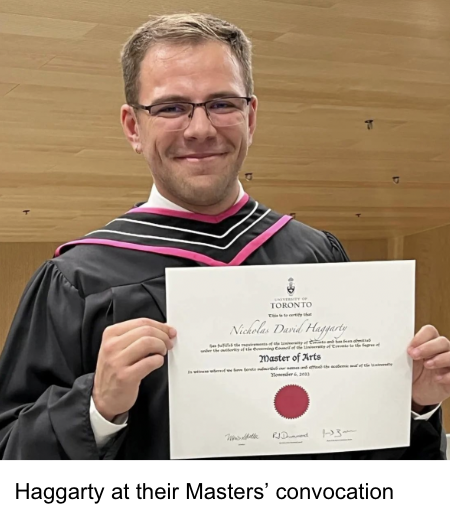
Linguistics Spotlight: Nicholas Haggarty in the Field of Queer Linguistics
Some French words like, “quatre” (four) and “table,” have over time evolved to sound more like “quat-” or “tabl-,” as speakers “dop” that final segment.
Seems minor, right?
In 17th-century France, popular opinion held that people who pronounced words without that final segment were “peasants,” “uneducated.”
Sociolinguists often track such idiosyncrasies and their evolving meanings over time to get an understanding of the impact of language on culture. One such individual is Nicholas Haggarty (they/he), who studied historical perceptions of social class of people who spoke French with that particular identifier.
They made an interesting claim in response: it’s not a social class phenomenon or an indicator of education level, but rather, an identifier of Quebec and Montréal French.
Haggarty just finished their first year as a PhD student studying Sociolinguistics and Queer Linguistics with a background in both French and English. Having assisted on Professor Yoonjung Kang’s “Speech Rate Effects in French Stop Voicing Production and Perception,” Haggarty looks back on their works as constantly striving for an understanding of why people make the sounds they do, and why those sounds are perceived in the ways they are.
Their Master’s thesis studied the stereotypical “gay” voice, and whether there was a science-backed explanation for the phenomenon so commonly referred to in the media. Haggarty examined pitch and tone in a series of archived interviews with queer men of the 80s.
An inspiring individual who views their research as advocacy rooted in education, Haggarty’s work focuses on the stories we tell through not only our language, but the clues revealed by the linguistic forms we use.
What is queer linguistics?
Haggarty describes queer linguistics as relevant today due to societal interests in staying the hetero-normative course. To them, the field brings the queer community into the linguistics field, identifying elements of queerness and queer performance to define how people use language to root themselves in their identity.
An intersecting interest therein, Critical Discourse Analysis investigates parts of speech and what it means when we use them. For example, when we use Internet-slang or community-specific vernacular, are we showing relation or connection to ourselves or our community?
Haggarty’s magnum opus to date is their PhD, using a corpus of interviews with queer individuals in the Toronto area. He will study their oral histories to get an understanding of language that goes beyond phonetic analysis, including the various ways they perceive authenticity in their identity.
The best part about this? The resource will be public.
An unprecedented act of agency and advocacy, this database of oral histories of queer people in Canada is a way of teaching people how queerness is perceived in our corner of North America, and whether the lessons they teach us line up with research done in places like the United States. If not, perhaps there is something to be said about breaking down pervasive stereotypes.
As Haggarty says, “everything we do is a performance,” and their work in the field of queer linguistics seeks to decode its meanings and values.
To all those interested in the emerging field of queer linguistics, and to everyone else who values education and understanding above all else, keep an eye out for this exciting development in Haggarty’s work.
We all have something to learn by listening to each other’s stories and taking them on their own terms.
March 15, 2022
Traditional Ukrainian Song Performed by F-Zero
June 21, 2021
Virtual Pride Concert featuring Jeremy Dutcher
The University of Toronto is holding a Pride concert featuring two Indigenous performers: Jeremy Dutcher and Nenookaasi, both Two-Spirit. The event is co-sponsored by the Sexual and Gender Diversity Office, Hart House, First Nations House, Office of Indigenous Initiatives, and the UTM Indigenous Centre. Note that while the concert will not be recorded, it will be available via livestream on Tuesday, June 22, from 3 PM through 5 PM, and will be followed by a live question-and-answer session.
Dutcher won the 2018 Polaris Music Prize and a 2019 Juno Award for his bilingual debut album, Wolastoqiyik Lintuwakonawa, building on anthropological documentation of music from his community:
Jeremy Dutcher is a classically trained operatic tenor and composer who takes every opportunity to blend his Wolastoq First Nation roots into the music he creates, blending distinct musical aesthetics that shape-shift between classical, traditional, and pop to form something entirely new. Dutcher’s debut release, Wolastoqiyik Lintuwakonawa, involves the rearrangement of early 1900s wax cylinder field recordings from his community. “Many of the songs were lost because our musical tradition was suppressed by the Canadian government. I'm doing this work as there's only about a hundred Wolastoqey speakers left. It's crucial that we're using our language because, if you lose the language, you're losing an entire distinct way of experiencing the world.”
Registration is available here. Students, staff, faculty, librarians, alumni, and friends of the U of T are welcome.
May 4, 2021
Huberta in the U of T Magazine
In the latest issue of the U of T magazine, Huberta Chan (BA 2019) talks about a pivotal moment in her undergraduate education, which had been made possible by the U of T (Hong Kong) Foundation.
Huberta Chan (BA 2019 UC) received a foundation scholarship to study linguistics. She recalls that on the first day of her sociolinguistics class, the professor asked each student to introduce themselves with their name and the languages they spoke. 'The moment I demonstrated how to say hello in Cantonese was the very first time I was aware of feeling proud to be a native Cantonese speaker from Hong Kong," says Chan. "I had never appreciated the fact that I was bilingual."
She says her classmates spoke with similar pride about their own languages and cultures, and she grew interested in learning more about them. "My professor taught us that every language is special because behind each one are the culture and stories unique to the people who speak it," she says. "This is an idea I treasure to this day."
March 2, 2020
Jack on the Sunday Edition
March 8, 2018
Linguistics in the community: Grade 8 school project on constructed languages
September 7, 2017
Corpora in the Classroom
To improve the instructional infrastructure and scaffold undergraduate and graduate class assignments that teach relevant theory and research skills, we have developed a teaching resource called Corpora in the Classroom (https://corpora.chass.utoronto.ca/), on which hundreds of hours of recorded and digitized speech from 9 languages (so far) are archived and meta-data-tagged.
This tool has been used in 7 or 8 sociolingusitics classes over the past 5 years, but we are hoping to expand its utility and use to additional classes/areas. If you'd like to use this tool or contribute data to it, please have a look at the demo pages (https://corpora.chass.utoronto.ca/demo/) and then contact Naomi to discuss. (Sample assignments using this tool for a 1st year course are at http://individual.utoronto.ca/ngn/LIN/courses/TBB199/TBB199.16W_syll.htm, HWs 11 & 13.)
The project has been funded by internal ITIF and CRIF grants, Keren Rice's CRC funds, and SSHRC.
July 12, 2017
Welcome back, Derek!
- His research
- Toronto for research on variation and change
- Being grounded in one institution
- Getting a tenure-stream job
- Involvement at St. George campus
- Supervising and collaborating with graduate students
- If linguistics didn't exist...
1. How would you introduce your research to someone who isn't familiar with linguistics?
All of my research falls under the very large umbrella of trying to understand the what, how, who, and why of language change. I mostly work on Canadian English and primarily use variationist sociolinguistic methods. I'm mostly interested in morphosyntactic and discourse-pragmatic phenomenon such as 'eh' but I've also done sociophonetic research as well.
2. What makes Toronto a compelling place to carry out research on language variation/change?
Toronto is one of the most multicultural and multilingual cities in the world. This is obviously of great benefit for linguists because it means we can almost always find a native speaker of a language locally. It also means that we can study the heritage varieties of these languages outside of a homeland setting, as Naomi has been doing. I’m most interested in understanding the effect that having a population in which more than 50% of people speak a language other than English has on Toronto English. We have a very detailed understanding of ‘old line’, middle class, settler colonial English from Sali’s Toronto English Archive, but there are other things going on in communities that are predominantly composed of first generation Canadians and who predominantly interact with first generation Canadians. In London, Jenny Cheshire, Paul Kerswill and their colleagues have found that in such scenarios a unique kind of multiethnolectal dialect can form. I suspect that we have something like that developing in Toronto and I'd like to try to document it and understand how it came about and where it's going.
3. You've done three degrees at UofT, and now you're back for a job. What are the benefits of being so grounded in one institution? Has it posed any problems or challenges?
The number one benefit of being back at UofT in a faculty position is the amazing students, both graduate students and undergraduate students. I plan to involve students in my research at all stages. I don't think there's anything wrong with doing what I did... everyone is different. I'm exactly where I want to be so my path worked for me. The only challenge I can think of is that I'll have to find something to occupy my Thursday nights since I won't be able to go to pub night anymore!
4. Will having a tenure-stream job change the way that you plan your research, such as the scale or time-frame of research projects that you start?
Having a permanent position and the resources available to tenure-stream faculty will definitely allow me to implement my bigger ideas!
5. Your main appointment is in Mississauga—how will you be involved in St. George?
I’ll be a member of the graduate faculty which will mean I'll occasionally teach graduate courses and can be the supervisor or a committee member on forum papers, GPs, and dissertations. This year I'll be co-coordinating Junior Forum with Susana as well. I plan to be in Sid Smith most Fridays for research group meetings. I’m always happy to talk to whoever about variation, change, sociolinguistics, stats, and really pretty much anything else people in the department are working on or thinking about!
6. For the graduate students reading this, what kind of projects would you be interested in supervising or collaborating on?
Once my project on Toronto multiethnolects gets underway, there should be lots of opportunities for graduate students to be involved in that project. I'd be happy to supervise any project using variationist sociolinguistic methods including projects on languages other than English and understudied varieties of English worldwide. I'm also interested in supervising or co-supervising historical or experimental work. One of my more recent interests is understanding the role of settler colonialism in the development of Englishes around the world including Canadian English and I'd be more than happy to chat with anyone who's thinking about Settler-Indigenous relationships in terms of language (or otherwise).
7. If linguistics didn't exist, what other academic field or career path would you have liked to explore or go into?
When I was 10, I was a huge fan of the Stargate movie, which made me want to be an (crypto-)Egyptologist. In grade 7, I wrote a report on what educational path I’d need to take to achieve that goal. Funnily enough, I ended up following parts of that path in a lot of ways. What I didn’t get into was physical anthropology and archaeology. I think if I didn’t become a linguist and stayed in academia, I’d have gotten into the study of prehistroical population migrations either from the archaeological or genetic side of things. One thing I love about teaching historical linguistics is that I get think about that kind of stuff.
If I wasn’t in academia, I would own and operate a small coffee shop and roastery called svartr --- Old Norse for 'black', like how I take my coffee. That’s always been the back-up plan.
July 3, 2017
Diane Massam's retirement: messages from some former students
Päivi Koskinen (MA 1992, PhD 1998, now at Kwantlen Polytechnic University) - website
The 1990’s was the best decade, UofT Linguistics was the best of the 90’s, syntax project was the best of UofT Linguistics, and there would not have been syntax project without Diane (and Elizabeth). Thank you, Diane, for that fabulous decade! Thank you for starting me on the path the right way for an MA about Finnish passives, and my first generals paper on the lexical semantics of those Finnish inchoative verbs. Thank you for being gracious when you returned from your sabbatical in France and Niue to find that in your absence your PhD student had defected. I was privileged to work with a prof with whom we would flip back and forth between functional projections, kids with chickenpox, Finnish participles, gender bending children, and everything under the sun. Cheers for Friday syntax project meetings, garden parties, and That Santa Claus Parade. May you always have cake and flowers on July 24, your Finnish-Finnish Name Day, and for good measure October 16, your Swedish-Finnish Name Day!
Will Oxford (PhD 2014, now at University of Manitoba) - website
Thanks, Diane, for showing me that Algonquian is more like Austronesian than I ever would have thought! Happy retirement!
Kyumin Kim (PhD 2011, now at Cheongju University) - website
I still remember the moment that I first met Diane when I started my PhD back in 2006. When I entered her office for the first time, she asked what city in Korea I am from. Then she took out a map and asked me to point out and talk about the city and how I grew up etc.. She wanted to know about me first rather than what I was interested in for my PhD. So, this is Diane, which I have loved! Best wishes for a very happy retirement, Diane! Thank you for everything you've done for me directly and indirectly. I have been so fortunate to have you in my (PhD) life. You'll be missed, but wish you all the best for the next phase of your life.
With Love!
Kyumin.
Jila Ghomeshi (MA 1990, PhD 1996, now at University of Manitoba) - website
I defended my doctoral dissertation in 1995 and Diane Massam was my supervisor. She was a relatively new faculty member in the department and I was her first doctoral student. Under her supervision I felt challenged, in the positive sense, to write the best thesis I could. We became friends through the process and have stayed in touch personally and professionally through our collaborative research. While we continue to find areas of mutual interest in syntax to work on, I think what really keeps us working together is how much we laugh. I am happy to have been asked to write something on the occasion of her retirement from U of T though I have had trouble narrowing down what I want to say about her.
There is her unbridled curiosity for all things linguistic and for the details of daily life. There is her remarkable work ethic that has resulted in a steady flow of journal articles, book chapters, edited volumes, and presentations. There is her remarkable record of graduate supervision. And there is her commitment to service in the form of committee work, organizational roles and leadership at all levels. This commitment extends beyond the department at U of T to the Canadian Linguistic Association. All this can be read from her CV so I will write about two qualities that are less tangible but have made far more of an impression on me.
Diane has a gift for combining rigour and openness in her outlook towards everything. As a syntactician, she is a formalist to her core and yet does not let theory constrain the way she looks at data or the phenomena she works on. As a supervisor, she holds her students to an established framework but not so as to hamper their imagination. As a person, she is deeply ethical without being judgmental. In every realm I can think of, she achieves a balance between equally important but seemingly opposite poles. She has an unerring sense of the middle – the space between extremes that looks like common sense. This brings a steadiness to her and those around her.
Equally inspirational for me has been to see her work-life balance – a clichéd term that makes it sound like a skill to be acquired at a workshop or from a self-help book. It is evident to me that Diane’s balance comes out of the love and commitment that she feels towards both her job and her family. Of course, there is a sense of duty at work that has no necessary counterpart at home so they can never be truly equal. But work, for Diane, includes doing syntax and as I’ve watched her ‘do’ syntax over the years I have imagined it is like the way great writers write – because they have to to be happy. Those of us who find the vocation we love almost as much as we love our families experience ‘balance’ as the pain of tearing ourselves away from one for the other. I have watched her do this a million times.
Diane used to say to me that she wants to be ordinary. I found this shocking as she was (and is) a driven person who has achieved most of the conventional benchmarks of success. It is a radical statement in our pursuit-of-excellence culture. I don’t know if this is still what she wants so at the risk of disappointing her I must say she is the most extraordinary person I know. She is a role model for how to be the very best kind of linguist, professor, colleague, friend, and ordinary person.
Monica-Alexandrina Irimia (MA 2005, PhD 2011, now at University of Modena and Reggio Emilia) - ResearchGate
I have been so fortunate and honoured to have Diane as my M.A. and PhD supervisor. I am not sure I will ever be able to express my gratitude for everything Diane has done for me, from my academic formation to crucial advice on personal matters. Diane is the best mentor a student could ever hope for; her talent and insight as a great linguist are only matched by her kindness, understanding, humanity, never ending support, encouragement, generosity, and dedication. It is more than fair to say that it would have been impossible for me to become a linguist without Diane’s contribution. Diane has also set a model of a true scholar which I will always value and emulate.
Monica
Julie Goncharov (PhD 2016, now at Hebrew University of Jerusalem) - website
“There are no former students”, right?
In my heart, there are a lot of words that I can say to Diane and about Diane from the time prior to my becoming her student and during her supervision. But what is more relevant (for me) now is this experience of being her former student. The connection never breaks. And this is not only because of occasional (and so delightful) catching-ups, but also because I recognize how many of my choices are sculpted by Diane. Especially, those choices that pertain to moral judgments and scientific standards.
Here’s one story about respecting others’ scientific territory. I remember Diane once prefixing her talk at the Syntax Group with an acknowledgment that the topic she was going to talk about she had been developing with one of her students. And she added that before taking on the topic again, she emailed the student and asked for permission. Now, when my scientific ship is out there in the ocean, I realize how important this is for a student and an early-career researcher. Surely, the larger your toolbox is and the more experienced you are with using those tools, the faster you can solve a new problem. But to create room for somebody else’s discovery and to respect somebody else’s scientific territory, you need to have wisdom and high standards which make Diane Diane.
Of course, this is only one story from a million! Thank you for everything, Diane!
Arsalan Kahnemuyipour (PhD 2004, now at UofT Mississauga) - research profile
Congratulations on your retirement, Diane!
It is really hard for me to imagine U of T syntax without you. You are the reason I am still doing Syntax today. You are and will always be a role model for me both as a syntactician but also for the balance you always struck between your academic and personal life. Since that phone call you made to Iran in summer 1998 to let me know I have been (kind of ☺) admitted to the grad program until today and forever, you will be my mentor. Yes, that means you cannot get away from me. You can run but you can’t hide!
I wish you a great retirement, Diane. I am sure you and Yves have everything planned and will have a fabulous chapter in your lives. You both deserve it. How do we do Syntax without Diane (and Elizabeth and Alana!) at U of T? Well, I will have to resort to you to find a positive way of approaching the problem. During my graduate years and especially when I was writing my thesis, whenever I came across what looked like an insurmountable block in my research and rushed to your office frantically, your reaction would be: That is a good problem. I guess I have another good problem to deal with!
Thank you so much for being who you are, Diane, and wishing you all the very best once again!
Niina Ning Zhang (PhD 1997, now at National Chung Cheng University, Taiwan) - website
Diane is a deep and sharp scholar, who is also a caring and considerate person, a modest and humble person, and a pleasant and humorous person to talk with. She is both guide and friend of her supervisees. I’m lucky to be one of them.
Patrick Murphy (MA 2014, now in UofT PhD) - website
I'm extremely grateful to Diane for being a wonderful mentor on my MA paper. That experience really solidified my desire to continue with research and do a PhD. My research path ended up going in a different direction after my MA (due to a course in speech perception reigniting an old interest), but ergativity is still very cool and hearing it mentioned never fails to capture my attention. I also appreciate the experiences she gave me as a research assistant (for the Oxford Handbook of Ergativity and her Niuean/English recipe null objects project), and I want to point out that she's in general just a fun person to talk to. Thanks for everything!
June 30, 2017
Alana Johns' retirement: messages from some colleagues and former students
Michelle Yuan (BA 2012, MA 2013, now at MIT) - website
I met Alana in Fall 2009 after enrolling in ABS230—Introduction to Inuktitut, which she co-taught that year with the late Saila Michael. I was in my second year of undergrad and had no idea who Alana was or that I'd end up a linguist in part because of her. Alana has been an amazing advisor and teacher these past eight years, and it has been an honour learning from her. She's also one of the funniest people I've ever met. I'm extremely grateful to have met her, and I think the field of linguistics has been greatly enriched by her work. Happy retirement, Alana!
![]() |
| Michelle and Alana at MA convocation |
Joan Dicker (Labrador School Board) - website
Dear Alana
Congratulations on your retirement
Thankyou for all that you did with our Inuktitut language
Thankyou for being my professor in the Linguistics MUN courses that I took
Thank you for giving me good marks hahaa
Thankyou for giving me the opportunity to attend a language conference with you way out to Flaggstaff Arizona even though the first night we shared a room, you kept me up aaaall night with your snoring lol hahaa
Thankyou for bringing me here to Toronto to take part in this very worthwhile Inuktitut language and linguistics workshop and to join you in your retirement party
Nakummesuak Alana Ai..SilakKijaKattanialikKutit uvlu tamât
Ilitagijait Joan Dicker
![]() |
| Alana and the group from Nunatsiavut at the airport for the Inuktitut Language and Linguistics Workshop |
![]() |
| Joan and Alana at a Canadian Language Museum exhibit |
I’m very lucky to have had Alana as a supervisor. It was her work with Inuktitut speakers that originally got me interested in the language and her bringing me up north at the end of my MA that set me on the course to where I am today. Throughout my MA and my PhD, she was both patient and supportive, always having interesting and insightful questions and comments on my work. I also have fond memories of fieldwork trips with her and other students to both Iqaluit and Baker Lake, as well as a trip to Ulukhaktok that has led to a very fruitful collaboration with an Inuinnaqtun speaker on a dictionary project. From writing letters and reading drafts, to sharing ideas and encouraging me, she was always there for me and her other students.
One particular set of memories that stand out begin with a rainy day in Baker Lake with Alana, Midori, and Conor, when we were invited out ice fishing with a local family. Alana and I had decided to stay in town and work, but we walked down to the shore with Midori and Conor and watched them take a little dingy out to the ice. It was July so the ice was receding and locals were riding their snow machines at full speed to skip over the water between the ice and the shore. As Midori and Conor set off in the cold rain, I distinctly remember a bit of glee on our part that we could go back inside where it was warm and get some more sleep and a hot drink. However, their successful return that night, with two Arctic char in hand, convinced us to join them the next day. We rode by snowmobile over the still mostly frozen lake to a tiny cabin up a hill from the shore. There on the ice, in view of the cabin, but quite a distance away, we fished in pre-drilled holes with fishing jigs made of caribou bone. As Alana rode up the hill to the cabin, leaving Conor and me to fish, I’ll never forget her reminder that arctic wolves would be white and thus blend into the surroundings, so we’d probably never see them coming… Despite her warning, all survived—except a goose the children shot out of the sky, and then proceeded to make honk with chest compressions.
![]() |
| Richard ice-fishing |
![]() |
| Alana ice-fishing |
![]() |
| Taking a picture of Alana taking a picture |
| Alana and colleagues at the Inuktitut Language and Linguistics Workshop (May 30-31, 2017) |
Catharyn Anderson (Special Advisor to the President on Aboriginal Affairs, Memorial University of Newfoundland)
I first knew of Alana before I ever met her in person. When I did my first Linguistics courses at Memorial in 1996/97, I had heard her name as someone great who did work on Inuktitut. As a young Inuk undergraduate student, I was disappointed to learn that she had left Memorial for UofT. However, after I graduated with my BA, I went back home to Nunatsiavut to work with the Cultural Centre in the area of language revitalization, and I would eventually meet and work with Alana. She invited me to collaborate with her on a paper for a conference in Quebec City, which was a great learning experience and opportunity for me. This was the first of many times that we worked together. I know that Alana developed many strong relationships and friendships with people in Nunatsiavut, and I am happy to include myself amongst those. Alana, thank you for the work you did on Inuttitut, for your support of community language projects, and your support of the people doing them. I wish you a very happy retirement, and all the best for the years ahead! Nakummemagialuk, Catharyn
Julien Carrier (current PhD student)
Bettina Spreng (PhD 2012, now at the University of Saskatchewan) - website
What I appreciate about Alana is how approachable she is. I came to Toronto having read her thesis for my MA in Germany while not having much background in Generative Grammar. I was quite intimidated since I had understood maybe half of it.
She made me feel welcome and one minute into our first meeting, she had made me feel completely comfortable. She is incredibly supportive of her students and that is something that I try to be with my students. Her enthusiasm for her work and her trust in her students is something I admire very much. I will always remember what she said after I came back after taking a break from the program to ask her if she would support me finishing after all. She said "I always knew it!" I don't think I ever told her how much that trust meant to me. So, here it is. Thank you, Alana.
March 13, 2017
Graduate research milestones (PhD generals papers, March 2017)
Na-Young Ryu (phonology, psycholinguistics)
In my second generals paper, I investigate how Mandarin learners, whose native language has only a binary laryngeal contrast, are able to acquire the Korean three-way laryngeal contrast in stops and affricates, focusing on their L2 language proficiency levels through two perceptual experiments. The results of experiments reveal that most Mandarin learners do not reach the same level of perception accuracy as native Korean speakers; however, advanced learners perceive the Koran three-way categories more accurately than beginning and intermediate learners. In addition, Mandarin listeners are more successful at perceiving Korean aspirated stop and affricate contrasts compared to fortis and lenis regardless of L2 proficiency. Moreover, lenis is least likely to be differentiated perceptually by Mandarin listeners across all proficiency groups, indicating that they lack attention to vocalic f0, which is the most relevant dimension for native Korean listeners to discriminate lenis from fortis and aspirated consonants.
Emilia Melara (sociolinguistics, pragmatics, morphosyntax)
This paper analyzes naturally-occurring uses of the propositional anaphor variants this, that, and it in the English of three Torontonian speaker groups, each of different ethnic and linguistic backgrounds (Anglo, Cantonese, and Italian), together and separately. The variation is analyzed quantitatively, using the variationist framework (Tagliamonte 2002), to examine the spontaneously-produced speech. It finds that on top of the pragmatic conditions proposed by Gundel et al. (1993), specifically that it is the least likely form to be used unless the referent proposition is the most salient one, there are additional constraints on the choice of anaphor used. The study finds that the primary predictor of anaphor choice is the type of clause that introduces the proposition, such that declarative clauses favour the demonstrative that, non-declaratives it. This is the case for all of the groups that were analyzed. A generation analysis of the Cantonese and Italian speakers shows that salience, as proposed by Gundel et al. (1993) to condition anaphor choice, is not employed by first generation speakers, unlike second generation speakers and the Anglo group as a whole. This suggests that if there are effects of language contact between the English of the speakers of Cantonese and Italian backgrounds, salience may not be a conditioning factor in Cantonese or Italian as it is in Toronto English. I explore what morphosyntactic properties of the anaphoric elements may be responsible for their preference with particular clause types and ask what it is about the pragmatic constraints that first generation speakers in the Cantonese and Italian groups do not pick up on in anaphorically referring to propositions in English.
Erin Hall (language acquisition, syntax/semantics)
My second generals paper was a language acquisition study looking at when children understand the difference between sentences with noun phrase embedding (e.g. The cup on the table is green) and coordination (The cup and the table are green). Previous studies have shown that young children have difficulty with the semantics of embedding in the CP domain, as well as with relative clause comprehension, but the PP type of subordination has not been examined in detail. I designed an iPad-based colouring experiment to test children’s comprehension of coordinated NPs as compared with two types of PP embedding, locative (in/on) and comitative (with). Children ages 3 to 5 were found to consistently understand the different interpretations of coordinates and the locative type of embedding, but they had difficulty with comitative PPs like The dog with the bone is blue; children often coloured both nouns (the dog and the bone) in these cases, treating them like coordinates rather than embedded sentences. These results suggest that children have an understanding of the semantic consequences of PP embedding within the NP as early as age 3, but their comprehension depends on the particular preposition involved. With PPs seem to be particularly challenging, likely due to the polysemy of this preposition and/or its closer semantic relationship to the conjunction and.
Ruth Maddeaux (psycholinguistics, sentence processing)
It has been argued that input from both linguistic and visual channels are combined to construct a conceptual representation of an object or event (Knoeferle & Crocker 2006, Altmann & Kamide 2007, Wolter et al. 2011). The relative salience of objects in the discourse is determined by both linguistic representations and visual perception (Wolter et al. 2011). An area of discourse that this research bears on is the processing of presuppositional information; specifically, is there any processing cost associated with adding information to the common ground through different modalities? I use an eye-tracker to determine where people look when they receive information that they are expected to accommodate, and measure whether the manner in which this information is acquired has an effect on the time it takes to process it. I focus on the presupposition trigger return, as in return the glass to the table. The results suggest that listeners have a weaker representation of an object when it is not mentioned by name. Looks to the target object are more likely in this condition, as a result of needing to strengthen the representation; that is, when it is least linguistically established in the common ground. I conclude that the manner of acquisition does have an effect on listeners’ discourse representation. Information that is received through linguistic means is more strongly established in the discourse than information received through non-linguistic means.
Patrick Murphy (semantics, psycholinguistics, sentence processing)
My second generals paper was an eye-tracking experiment investigating the Canadian English "be done NP" construction, which allows speakers of Canadian English (and a handful of U.S. dialects) to say "I'm done my homework" or "I'm finished my homework" (instead of "I've finished my homework" or "I'm done/finished *with* my homework"). A recent paper (Fruehwald & Myler 2015) argued that this construction involves aspectual adjectives directly taking an NP complement, without silent verbal or prepositional structure intervening. The paper also argued that these aspectual adjectives are similar to aspectual verbs (like "begin", "finish", etc.) in requiring a particular interpretation mechanism (complement coercion or type-shifting) for entity nouns (like "the resume" or "the coffee"—contrast with event nouns like "the interview" or "the party"). Previous studies (in self-paced reading and eye-tracking) have found evidence for complement coercion / type-shifting for aspectual verbs in the form of longer reading times for entity nouns than event nouns after these verbs. My own study had similar results: longer reading times for entity nouns than event nouns in the "be done NP" construction. This supports Fruehwald & Myler's claim that these aspectual adjectives behave similarly to aspectual verbs in requiring complement coercion / type-shifting for entity nouns.
November 18, 2016
Interview with recent hire Jessamyn Schertz
We've also created a new post label called "interview" for this and other interviews in the future.
How would you introduce your research to someone who isn't familiar with linguistics?
Right now, I’m helping to lead the Junior Forum, a professional development course for new graduate students. It’s fun to be involved at the beginning stages of people’s careers. I’ll be teaching grad courses about once a year, and looking forward to serving on thesis/GP/dissertation committees. I’ll also be continuing my involvement with the Phonetics/Phonology and Psycholinguistics groups, as well as research collaborations with my colleagues across the three campuses.
September 26, 2016
RCM highlights Susana & Abdel-Khalig's daughter!
Congratulations to Dalila, Susana and Abdel-Khalig for this stealth media appearance!
September 3, 2016
Sali on intensifiers in The Paris Review
June 2, 2016
LIN398 adventurers in Kapuskasing
Why is LIN398 so worthwhile?
Well, the short answer is because it's fun. The more important reason is because the immense hinterland of Ontario presents a sociolinguistic goldmine of untapped regional variation. The research coming out of my laboratory on Ontario dialects is not only an enterprise of language documentation, it is also leading to innovative contributions to sociolinguistics. LIN398 is an invaluable adjunct to these enterprises. Moreover, it offers the ideal training ground for students. An add-on benefit is the incredibly positive community outreach and engagement that is forged in the process. In the research excursion, we collect oral histories from people born and raised in whatever community we go to and then produce a book and DVD of stories that we return to the library, museum or other community organizations.
Where are you this year?
We are Kapuskasing, Ontario, a small city on the most northerly point of Highway 11. It took us two days to get here. From Toronto, it is 850 kilometers due north. Kap (as it is called by locals) is a minority English-speaking community where two-thirds of the population are francophone. This presents a unique language-contact situation.
Which students are with you this year?
Cedric Ludlow, John Lubanski, Jennifer McNeillie, and Lisa Schlegl.
What are they doing right now?
They are very busy conducting sociolinguistic interviews with people born and raised in the community and asking them questions that bring local culture, lore and language to the surface in narratives of personal experience. So far we have discovered an incredible wealth of traditions, experiences, and many heartwarming tales. As of yesterday morning the students had collected 55 interviews!
April 27, 2016
A surprise guest at MOTH
Visitors descended upon our Mississauga campus from far and wide for MOTH over the weekend of the 15th and 16th - including at least one who wasn't on the program!
March 7, 2016
Department of Linguistics Participant Pool
The participant pool allows undergraduate students to participate in linguistics experiments for course credit. It's administrated in one course per semester – in Fall 2015, LIN228, and in the present semester, LIN229. The course instructor sets up the syllabus such that 2% of the student’s participation grade comes from participating in an experiment. The experiments are run by graduate students and faculty in the linguistics department. The pool is an excellent resource for grad students (and faculty!), because it allows them to test a greater number of participants without needing to have the funding to pay them, and without having to advertise for participants independently.
The pool is also a major benefit to our undergraduate students, who get first-hand experience of how experimental work is done. Feedback from undergrads so far has been very positive and has attracted students interested in learning more about linguistic experimentation.
The participant pool suited to a whole range of experimental research in linguistics. Thus far, individual experiments drawing on the pool have asked participants to discriminate between sounds, to give grammaticality judgments, to wear an eye tracking device while they read sentences, and more.
Researchers who have an experiment to run and are interested in using the pool should get in touch with Ruth Maddeaux (ruth.maddeaux@mail.utoronto.ca) and send her a brief description of their study. Every semester, there will be a deadline sometime around the start of classes by which interested researchers need to have received their ethics approval (including approval to compensate students with course credit, which has to be built into the ethics submission) and their experiment protocol ready. If they have everything in place by that deadline, they are welcome to have their experiment included in the pool! Researchers are highly encouraged to get in touch with Ruth as they’re preparing their ethics submissions, since there is some specific language involving the use of the pool that needs to be included.
If all goes well, Ruth will then post all the available experiments on the Blackboard page for the course that the pool is running in, with links to where the students can sign up for the experiment of their choosing. After that, the researcher will schedule appointments with the students who signed up for their experiment. Once the student’s participation is done, the researcher signs a sheet confirming that the student participated. At the end of the semester, Ruth assigns the 2% extra credit to all the students who participated. As much as possible, the students are divided evenly between the experiments, to make sure all researchers get the same number of participants.
There is a Gmail account – linguisticspool@gmail.com – at which students can contact Ruth (as the pool manager) if they have general questions about the process, or if they run into a problem. Course instructors interested in having the participant pool run in their course should also get in touch with Ruth. The endeavour wouldn’t be possible without them, and it involves very little extra work for them.
There is a bonus advantage to recruiting Toronto students into the participant pool, and that is the enormous variety of linguistic backgrounds in our classrooms! As a linguistics department, this is a valuable resource. In exchange for the benefit of using the pool, researchers are asked to record their participants reading a word-list in their native language. The participants also fill out a short language background questionnaire. At the end of the semester, I upload all the recordings along with the questionnaires into a database. As the semesters go by, we’ll build up quite a big database filled with recordings of our students. They can be used in class projects, for pretty much anything the instructor can think of!
(Thanks very much to Ruth Maddeaux for all the details!)
February 5, 2016
A conversation with Elaine Gold
Elaine Gold is retiring at the end of 2015-2016, marking the end of a long journey at the University of Toronto from undergraduate student to Ph.D. candidate to teacher, researcher, undergraduate coordinator and active outreach organizer. Although Elaine is retiring from the Department of Linguistics, she is actually just changing jobs. Her plan is to devote herself full time to being the Director of the Canadian Language Museum at its new home at Glendon College of York University. I spoke to Elaine on February 1st about this important milestone in her life.