June 15, 2022
Podcast on Computational Linguistics!
June 13, 2022
Associate Professor Keir Moulton!
June 9, 2022
Graduation Tea 🫖🎓🎉
June 8, 2022
Ba-TOM 1!
The First Toronto-Montreal Bantu Colloquium (Ba-TOM) was hosted (IN PERSON!) on our Scarborough Campus from May 27th -28th!
Students from the Winter Semester Field Method courses at the University of Toronto and at McGill's linguistics department presented their final papers at Ba-Tom 1.
![]() |
| Here we have almost all the UofT presenters! |
Check out the program to see how many UofT names you can recognize!
June 7, 2022
Workshop: Semantics of NPs, DPs, and Modality!
On June 9th the Department of Linguistics and the Department of Spanish and Portuguese are co-organizing this workshop:
Semantics of NPs, DPs, and Modality
Thursday June 9, 2022 NFC, Victoria College VC102
Registration: https://uoft.me/semantics
Professor Roberta Pires de Oliveira, a specialist on modality and bare nominals in Brazilian Portuguese, is the invited speaker and will be sharing their work on Semantics, Language Variation and Experiments!
Students working on related topics will also be presenting their work during the workshop! Student Talks include:
- Sophie Harrington: "More than a mood": Uniting structure and interpretation through prominalized complements
- Crystal Chen (PhD Student): That Kind-of demonstrative: A Semantic Analysis of English Demonstratives
- Samuel Jambrović: Names, articles, and unique individuals
- Ohanna Severo: The syntactic properties of bare nouns in a Spanish-Portuguese contact situation
- Gregory Antono (PhD Student), Daphna Heller (Faculty) and Craig Chambers (cross-appointed with the Department of Psychology): Linearizing classifiers, numerals, and nouns in the noun phrase. Does artificial language learning reflect cognitive biases?
Program
10:30 – 11:00 a.m.
Sophie Harrington
"More than a mood": Uniting structure and interpretation through pronominalized complements
11:00 – 12:00 p.m.
Roberta Pires de Oliveira (Universidade Federal de Santa Catarina/CNPq PQ-1C)
Invited talk: Bare arguments and kinds: The case of Brazilian Portuguese
12:00 – 1:30 p.m. Lunch
1:30 – 2:00 p.m.
Crystal Chen
That Kind-of demonstrative: A Semantic Analysis of English Demonstratives
2:00 – 2:30 p.m.
Samuel Jambrović
Names, articles, and unique individuals
2:30 – 2:45 pm Coffee break
2:45 – 3:15 p.m.
Ohanna Severo
Investigating bare nouns in Spanish-Portuguese bilinguals
3:15 – 3:45
Gregory Antono, Daphna Heller, Craig Chambers
Linearizing classifiers, numerals, and nouns in the noun phrase. Does artificial language learning
reflect cognitive biases?
3:45 – 4:00 p.m. Closing remarks
June 6, 2022
Cantonese "lazy pronunciation" gets another round
This may sound a bit familiar, but...
Brian Diep (undergrad), Justin Leung (PhD student) and Naomi Nagy (faculty) are presenting about variation in heritage and homeland Cantonese at another conference this weekend:
第五屆粵語語言學論壇 The Fifth Forum on Cantonese Linguistics (FoCaL-5)
邊啲人[naːn23]啲? (n-/l-) in Cantonese in Hong Kong and Toronto
This will present some further developments since the talk at WICL last weekend.Katrina Kechun Li, Christopher Bryant & Li Nguyen (University of Cambridge)
Tonal aspects of Cantonese-English code-switching in HLVC corpus

Holman Tse (Asst. Professor at St. Catherine University, previously a visiting student in our Department):
Is there cross-linguistic influence of English /u/ on Toronto Cantonese high round vowels?
(Sorry, not good shots of Holman, but here's his slides.)
June 2, 2022
New Publication: Licensing Unergative Objects in Ergative Languages: The View from Polynesian
Rebecca Tollan (University of Delaware) and Diane Massam (Emerita Faculty) have published "Licensing Unergative Objects in Ergative Languages: The View from Polynesian" in Syntax!
They examine how objects of unergative verbs are case licensed when they are present, focusing on a contrast between Samoan and Niuean, two related Polynesian languages. Their comparative analysis highlights the salients of considering unergative constructions when determining the underlying syntax of any given case system.
Tollan, R., & Massam, D. Licensing unergative objects in ergative languages: The view from Polynesian. Syntax.
June 1, 2022
Daphna & Breanna at the 2nd Experiments in Linguistic Meaning Conference!
The 2nd Experiments in Linguistic Meaning (ELM) Conference was hosted by the University of Pennsylvania from May 18-20 2022.
Si On Yoo, Breanna Pratley (former MA student now at UMass) and Daphna Heller (Faculty) presented their work on "Referential domains, priming and the effect of invisible objects". This study examines whether unmentioned earlier objects can also be part of the referential domain and whether earlier and current objects are part of a single referential domain.
For those who did not attend, be sure to check out their abstract!
May 31, 2022
End of Term Party! 🥳
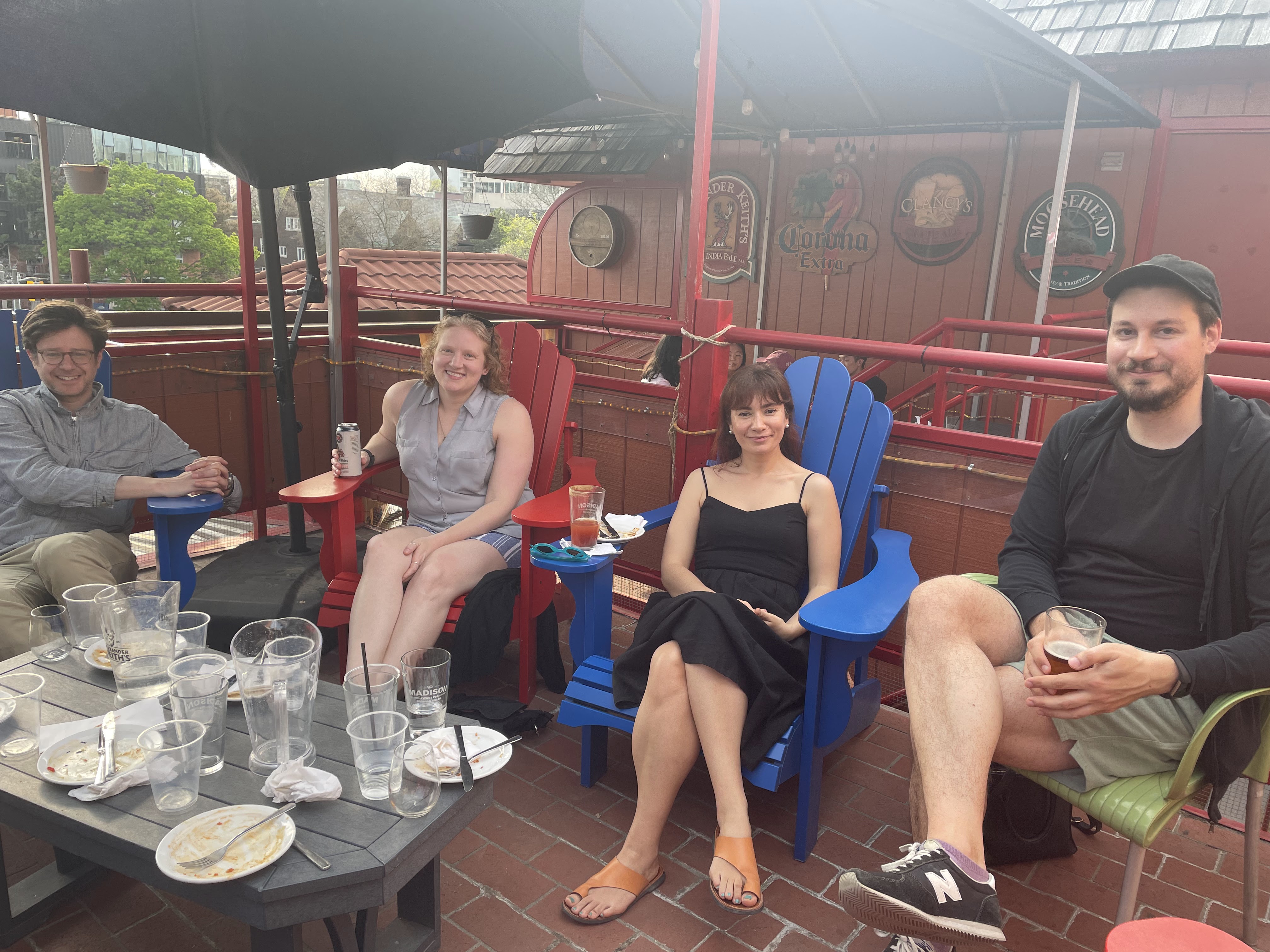
The Department graciously hosted the End of Term Party at the Madison Avenue Pub (a UofT Classic)! The afternoon was full of food, drinks, laughter and LOTS of sunshine! ☀️ 🍻
It was an amazing event and it was wonderful to connect face-to-face!
We would like to thank all the staff who helped to organize the party!
| Nathan Sanders was happy to be there....We promise! |
| Everyone was soaking up the sun ☀️ |
![]() |
| One 1/2 of the group enjoying each other's company |
| The other 1/2 of the group! |
| A SLUGS selfie! |
May 30, 2022
UofT @ CLA Annual Conference!
The Canadian Linguistic Association will be hosting their Annual Conference from June 1st - 4th! It will be held virtually via Zoom and Discord. There will be a strong UofT presence this year! See below for the list of presenters for each day!
June 1st:
- Samuel Akinbo (University of Minnesota) & Avery Ozburn (Faculty). Rounding harmony and loanword epenthesis in Yoruba
- Justin R. Leung (PhD Student). Given the sack, yet promoted: passivizable V-IO-DO constructions in Cantonese
- Pedro Mateo Pedro (Faculty). Acquisition of directionals in Q’anjob’al
- Martin Renard (PhD Student). The Implications of Idiomatic Noun Incorporation Expressions for L2 Kanien’kéha Revitalization
- Julianne Doner (University of Toronto) Deriving Endpoints from Containment Relations in Niuean
- Crystal Chen (PhD Student). That Kind-of Demonstrative: A Semantic Analysis of English Demonstratives
- Nadia Takhtaganova (PhD Student). Post-Verbal PP Complements in Huasteca Nahuatl
- Bruno Andreotti (PhD Student). Modelling Figurative Meaning using Expectations of Normality
- Matthew Patience (PhD Candidate). Predicting difficulty in L2 speech: Moving towards a comprehensive model of L2 perception and production
- Andrew McCandless (PhD Student). Acoustic Analysis of Spanish Vowels in Native Spanish and English Speakers
- Song Jiang (PhD Student). Cue weighting in Mandarin tone perception: A comparison between native speakers and learners of Mandarin
- Omar Gamboa Gonzalez (PhD Candidate). Les nominalisations en -ance en français
- Ohanna Severo (PhD Student). The syntactic properties of bare nouns in a Spanish-Portuguese contact situation
- María Cristina Cuervo (Faculty), Liam Donohue (PhD Student), Nadia Takhtaganova (PhD Student) & Michelle Troberg (Faculty). At the edge of valence
- Tim Gadanidis (PhD Candidate) Linguistic identity construction in restaurant customer service narratives
- Catherine Anderson, Bronwyn Bjorkman, Derek Denis (Faculty), Julianne Doner (University of Toronto), Margaret Grant, Martin Kohlberger, Nathan Sanders (Faculty) & Ai Taniguchi (Faculty). Teaching Introductory Linguistics with Justice: Updating an Open Educational Resource
- Bronwyn M. Bjorkman, Isabelle Boyer, Elizabeth Cowper (Faculty), Daniel Currie Hall, Louise Koren & Dan Siddiqi. Person and gender in pronoun paradigms: A semantic account of a morphological pattern
- Samantha Jackson (Postdoctoral Fellow). What I say or how I say it? Ethnoracial accents and hiring decisions in Toronto
- Rukayat Olawale (University of Toronto) Une étude perceptive de l’influence du contexte pragmatique sur l’expression du vocatif en yoruba
May 27, 2022
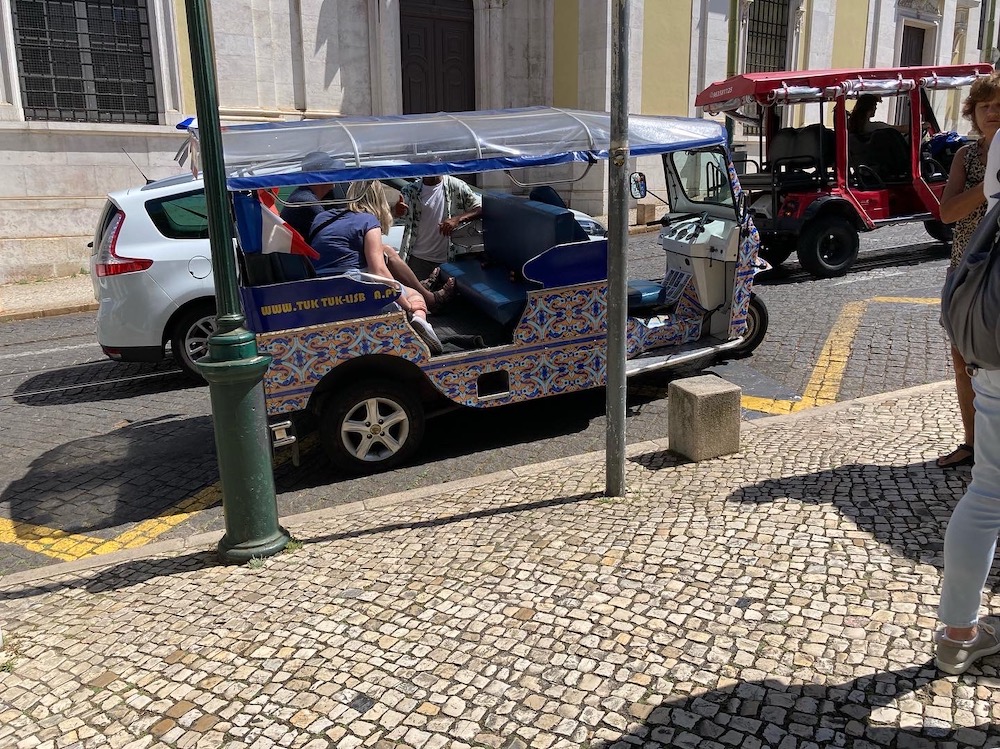
Live conferences are back - Naomi presented in Lisbon
The first Heritage Languages around the World conference brought together practitioners and linguists from sociolinguistics, formal linguistics, psycholinguistics, and language documentation to share knowledge about heritage languages through diverse lenses.
| (L-to-R) Invited speakers Peter Austin, Sílvia Melo-Pfeifer, Jason Rothman, Organizer Ana Lúcia Santos, Invited speaker Naomi Nagy (UofT), Organizers Cristina Flores and Luis Amaral. (Photo by Anabela Rato.) |
Other University of Toronto presenters include Anabela Rato & Vanina Machado (Dept. of Spanish and Portuguese), and Mona El Samaty (OISE).
![]() |
| The Humanities Building, Universidade de Lisboa |
Naomi's talk:
May 26, 2022
The Workshop on Innovations in Cantonese Linguistics!!
The 6th Workshop on Innovations in Cantonese Linguistics (WICL) is a biennial conference that focuses on new advances in Cantonese linguistics, such as innovation in methodologies, tools, and or computing software. This year it will be held virtually by Ohio State University on May 27th - May 28th 2022.
Justin Leung (Graduate Student), Brian Diep (Undergraduate Student) and Naomi Nagy (Faculty) will be presenting their work on " 'Lazy pronunciation' in Toronto Heritage Cantonese: The case of (n-/l-)"! They will be presenting on May 27th. Their abstract can be found below!
The event is free of change but registration is required. We encourage all to attend!
'Lazy pronunciation' in Toronto Heritage Cantonese: The case of (n-/l-)
In Hong Kong Cantonese, there is a group of sound changes in progress colloquially known as 懶音 ‘lazy pronunciation’. A well-known example is the alternation between syllable-initial /n/ and /l/, which is often characterized as a merger of /n/ to /l/ (Zee 1999; To et al. 2015; i.a.), e.g., pronouncing 南 /naːm²¹/ ‘south’ like 藍 /laːm²¹/ ‘blue’. While this merger is sometimes reported to be complete or near-completion (Zee 1999; To et al. 2015), some variation is observed, with age and gender suggested as important factors conditioning variant choice (Ng 2017; Liang 2018), as well as an expectation that heritage speakers may differ from homeland speakers. For example, Cantonese-English bilinguals in Vancouver are found to differentiate /n/ and /l/ in English but merge the two phonemes in Cantonese (Soo et al. 2021). However, little work has teased apart the linguistic and social factors that contribute to this variation. We investigated the factors that contribute to variation and compare the realization of /n-/ and /l-/ in heritage speakers in Toronto and homeland speakers in Hong Kong. If there is influence from English, which differentiates /n/ and /l/, we expect heritage speakers to have less [l] for /n-/ and [n] for /l-/. However, if heritage speakers amplify the change (due to less pressure to conform to a standard, less exposure to homeland speech, or categorical perception as /l/), we would expect them to have greater (perhaps categorical) usage of [l]. We analyzed spontaneous spoken data from sociolinguistic interviews (14 speakers) in Cantonese from the Heritage Language Documentation corpus (Nagy 2011). The corpus includes homeland speakers in Hong Kong and three generations of heritage speakers in Toronto. Tokens of syllables with /n-/ or /l-/ as the onset were extracted and coded impressionistically (and cross-checked) for the variable (n-/l-) and linguistic factors (vowel backness, vowel height, vowel length, tone, previous segment). We also considered the social factors of generation, ethnic orientation and gender of the speakers. The tokens were classified as underlyingly /n-/ or /l-/ based on 19th-century sources (from 粵音資料集叢 https://jyut.net), and these were accordingly analyzed in separate mixed-effects logistic regression models. 504 tokens were extracted (418 /n-/, 86 /l-/) after excluding characters categorically realized as [l]. For the /n-/ tokens, there is more retention of [n] after a previous (coda) nasal, conditioning by the tone and following vowel, as well as significant differences by generation, gender and ethnic orientation. Although generation is significant, there is no monotonic relationship suggesting an advance of the change across heritage generations. In contrast, for the /l-/ tokens, a nasal coda in the preceding syllable significantly favoured realization as [n], and there was no other conditioning. That is, in both datasets, there is a preference to produce [n] after a nasal. The results also confirm one finding in the literature, that /l-/ is less likely to surface as [n] than the other way around, but do not provide any evidence of a different pattern between heritage and homeland speakers.
References
Liang, Y. 2018. 再探討香港粵語聲母 /n-/、/l-/ 不分. Current Research in Chinese Linguistics 97(1): 101–110.
Nagy, N. 2011. A multilingual corpus to explore geographic variation. Rassegna Italiana di Linguistica Applicata 43(1–2): 65–84.
Ng, C. L. C. 2017. Merger of the syllable-initial [n-] and [l-] in Hong Kong Cantonese. Outstanding Academic Papers by Students. http://dspace.cityu.edu.hk/handle/2031/100.
Soo, R., Johnson, K. A., & Babel, M. 2021. Sound change in spontaneous bilingual speech. Proceedings of Interspeech 2021, 421–425.
To, C. K. S., McLeod, S., & Cheung, P. S. P. 2015. Phonetic variations and sound changes in Hong Kong Cantonese. Clinical Linguistics & Phonetics 29(5): 333–353.
Zee, E. 1999. Change and variation in the syllable-initial and syllable-final consonants in Hong Kong Cantonese. Journal of Chinese Linguistics 27(1): 120–167.
May 24, 2022
The Toronto-Ottawa-Montreal Semantics Workshop 2022!!
The Toronto-Ottawa-Montreal Semantics Workshop (TOM 14) will be hosted this year by the Department of Cognitive Science at Carleton University! The workshop will take place on May 28th 2022 on Zoom. The event is free to attend and we encourage all our semanticist to join!
Crystal Chen (PhD Student) and Michela Ippolito (Faculty) will be presenting their work on "Exclamatives Interrogatives"
Dr. Ai Taniguchi (UTM Faculty) will also be presenting at TOM! She will be sharing her work on "Semantics and Pragmatics in a Justice-Centered Introductory Linguistics Textbook: Reflection from Updating an Open Educational Resource"
Publication: Children's Comprehension of NP Embedding by Hall & Pérez-Leroux!
Erin Hall (California State University, San Bernardino) and Ana Teresa Pérez-Leroux (Faculty) have published "Children's Comprehension of NP Embedding" in Glossa: a journal of general linguistics!
They used a colour task to examine children's comprehension of sentences containing complex NPs, comparing PP modifiers to coordinated NPs, where both referents are accessible. They propose that error patterns for comitative prepositions can be explained by the assumption that children's errors align with the direction of systematic language change.
Be sure to read the whole paper to learn more!
Hall, E. & Pérez-Leroux, A. T., (2022) “Children’s comprehension of NP embedding”, Glossa: a journal of general linguistics 7(1). doi: https://doi.org/10.16995/glossa.5816
May 22, 2022
Cherry Blossoms on Campus!
May 15, 2022
CoLang Award Recipient!
Congratulations Martin Renard (PhD Student)! He is one of this year's recipients of the LSA's prestigious fellowship to participate in CoLang! The Linguistic Society of America sponsors The Institute on Collaborative Language Research (aka CoLang), a summer training institute where linguists gain hands-on experiences in the best practices for language documentation, descriptive linguistics and language revitalization.
Martin is a 1st year PhD student and is interested in Indigenous language revitalization and collaborative linguistic research. He has mostly worked on the endangered Northern Iroquoian Language Kanien'kéha (also known as Mohawk).
Congratulations Renard!! We are excited to hear about your experience and are eager to see you put your new skills to work!
May 11, 2022
Naomi Nagy at iCLaVE11 in Vienna while teaching in Paris!
The University of Vienna hosted the 11th International Conference on Language Variation in Europe!
Naomi Nagy (Faculty) presented her work, co-authored with Chiara Celata, on "Lexical Frequency Effects in Italian VOT: Minority vs. Majority language effects"! Nagy was very busy at iCLaVE as she also presented "Prodrop in Six Languages: Very similar and not influenced by English contact", part of a panel of pronombristas.
Be sure to ask Nagy questions regarding her presentations when she returns from France and Portugal!
It was a Zoom conference, so no photos there, but here is Naomi relaxing with partner Craig Diegel and fellow linguists Anna Ghimenton & Giovanni Depau in Grenoble after the conference (photo credit Aléni Depau).
May 10, 2022
UofT presents at Annual Conference on African Linguistics!
The Department of Linguistics at the University of California San Diego hosted the 53rd Annual Conference on African Linguistics in early April (2022). Several UofT linguists attended.
Avery Ozburn (Faculty), Gabriel Palmieri (PhD Student) and Madeline Glover (Undergrad UTM Student) presented their work on ATR Phonetics in Keiyo!
Avery Ozburn (Faculty), Gianna F Giovio Canavesi (Undergrad student at UTM who will be graduating this June) and Samuel Akinbo (University of British Columbia) presented on the Perception of ATR in Dágáárè!
Busy conference for Avery Ozburn! We appreciate all the hard work she and her students put into their work!
May 9, 2022
Guillaume Thomas at WCCFL40!
The Department of Linguistics at Stanford University will be hosting the 40th meeting of the West Coast Conference on Formal Linguistics (WCCFL40)! This conference will take place virtually from May 13th-15th 2022.
Guillaume Thomas (Faculty) is one of the invited speakers! He will be speaking on "Switch-reference, discourse coherence and centering". Abstract is shared below!
Switch-Reference Discourse Coherence and Centering
Switch Reference (SR) is a family of grammatical devices whose primary function is to indicate whether two linked clauses have coreferential pivots, where the pivot is a prominent argument of some sort. In some languages, in addition to their function of reference tracking, SR markers can be used to indicate whether the events or situations described by the linked clauses differ with respect to some parameter, such as time, place or actuality. This phenomenon is known as non-canonical switch-reference. One of the open questions in studies of SR is whether canonical and non-canonical SR are different manifestations of a single process, whether they are facets of a single phenomenon that are triggered by different configurations, or whether they are different phenomena altogether, with independent syntax and semantics. This talk will discuss the relation between canonical and non-canonical SR in Mbyá. Based on an analysis of a corpus of 760 occurrences of SR markers from Mbyá narratives, we argue that canonical and non-canonical SR marking in Mbyá are different manifestations of a single probabilistic process, from which non-canonical uses of SR markers emerge as less likely outcomes than canonical uses.
We are sure WCCFL40 will be an absolute success and we cannot wait to hear about it!
May 7, 2022
Runze Qian at Emory Linguistics Undergraduate Conference!
On April 22nd Emory University's Program in Linguistics hosted the third annual Emory Undergrad Linguistic Conference (EULC3)!
One of our undergraduate students, Runze Qian (Undergrad Student at UTSG), presented his work on "The Application of Turkish Vowel Harmony to English Proper Nouns: An Experimental Phonetic Analysis"! His abstract is below.
Runze Qian will be graduating this June and will be heading to the University of Ottawa to purse his Master's of Linguistics! We are excited to see the amazing work he will do there!
The Application of Turkish Vowel Harmony to English Proper Nouns: An Experimental Phonetic Analysis
Turkish vowel harmony (VH) is a phonological process which dictates that all vowels in non-compounded words of Turkish origin must agree in backness and/or rounding (Kabak 2011). The same rule applies to suffixes that are agglutinated to the word stem. However, there are no rules regarding how VH would apply to suffixes that are attached to words from another language which include phonemes that do not exist in Turkish as shown in example (1) and (2). This project aimed to investigate how native speakers of Turkish who are bilingual in English would apply VH to English proper nouns with vowel phonemes in the word-final position that do not exist in Turkish by conducting acoustic phonetic analyses.
English Gloss Possible Harmony Structures
(1) ‘in/at Los Angeles’ Los Angeles'ta Los Angeles'te
(2) ‘of Boston’ Boston'ın Boston'un
Participants were presented with an elicitation task including five paragraphs written only in English. Each paragraph was designed to have structures that would require the use of a Turkish suffix agglutinated on an English proper noun. An example sentence one of the constructed paragraphs is shown in (3). The participants were asked to do on-site translation of the paragraphs (into Turkish) and their choice of vowels in the agglutinated suffixes were recorded. After finishing translating all paragraphs, participants were asked how they would say each structure in Turkish in isolation to test if the speakers would use different vowels if they were conscious about the structure. The acoustic properties of each vowel were measured and compared with each other. It was found that even with the speakers being bilingual, while pronouncing English proper nouns in a Turkish context, the acoustic qualities of their vowels would shift towards the qualities of Turkish vowels. It is possible for speakers to pronounce the vowels differently while being conscious about the structure, but it is not a universal trend. It was also found that when a suffix is agglutinated, the vowels used to satisfy VH would match with the final vowel of the stem disregarding how the vowel is realized in orthography. This proved evidence for VH being a natural phonological process underlyingly represented in our cognition, rather than a set of grammar rules that need to be remembered.
(3) I am from Adana, but now I live in Los Angeles.
The next steps of the project will be to examine how would heritage speakers and foreign language learners of Turkish use vowels to satisfy VH in such structures, and compare with the data collected from native speakers to see if there are any similarities. Further researches will also examine how do different groups of speakers pronounce the vowels in proper nouns differently and if that can be reflective of their acquisition of the Turkish language.