October 25, 2021

New Publication: Learning Island-Insensitivity from the Input: A Corpus Analysis of Child-and Youth-Directed Text in Norwegian!

Dave Kush (Faculty) and colleagues have published a new article in Glossa!  This new article describes a corpus study that examines youth-directed reading materials to assess what direct evidence Norwegian children receive for filler-gap dependencies in island structures. Kush, Sant and Strætvern consider how different learning models would fare on the acquisition of target generalizations and speculate on how the observed description of filler-gap dependencies reflect the interaction of syntactic, semantic and pragmatic conditions! 

Kush, D. & Sant, C. & Strætkvern, S. B., (2021) “Learning Island-insensitivity from the input: A corpus analysis of child- and youth-directed text in Norwegian”, Glossa: a journal of general linguistics 6(1). doi: https://doi.org/10.16995/glossa.5774


October 22, 2021

SLUGS Academic Seminar!

 Professor Alexei Kochetov is presenting at the SLUGS academic seminar on Monday, October 25th! He will be presenting his work on Kalasha laterals; Phonetic Realizations and Change in Progress! 

For the full abstract please see the SLUGS website! Zoom link and password are also available on the website. 

Hope to see you all there!! 


October 20, 2021

Research Ethics Workshop!

The Junior Forum session on October 26th will be open to all members of the department to discuss research ethics! Suzi Lima (faculty) and Susana Béjar (faculty) will be joining on behalf of the department's Ethics Committee. 

The workshop will feature:

Please refer to the listserv email for more details! 

Congratulations Christopher!

Former MA student Christopher Legerme (now pursuing his PhD at MIT) has won the NWAV student abstract award for his work on Haitian determiners. This work evolved out of his MA Forum paper, which was completed in the summer of 2021 and was supervised by our very own Sali Tagliamonte (Faculty).

We are enormously proud of Christopher and we look forward to his presentation!

The title of his thesis (and NWAV talk) is "Creole on the Cusp: Phonological Variation and Change in Haitian Determiners.

He won this award based on anonymous reviewer comments, which include these (read out at the conference opening):

"super important paper, and the abstract is well-written. We know exactly what has been done and why, and we know the results upon which the interpretations and claims are made."

"Good empirical methods, as long as the nasal/non-nasal distinction can really be coded perceptually. Good engagement with relevant literature. Data on a variety that's well-studied but not with variationist methods."

October 19, 2021

Restarting the Morphology Research Group!

Martin Renard (PhD Student) has brought back the Morphology Research Group alongside Gavin Bembridge (York U)! 

This group is meant to be an informal space to discuss issues related to the field of morphology (based on members' research, work and/or interest).  Members are invited to present and suggest discussion topics for future meetings! 

To participate, please email Martin (martin.renard@mail.utoronto.ca) to sign up for the email list! 

October 14, 2021

Publication: Learning Embedded Verb Placement in Norwegian: Evidence for Early Overgeneralization

Dave Kush (faculty) has co-authored a new publication! Learning Embedded Verb Placement in Norwegian: Evidence for Early Overgeneralization investigates how children acquire generalization of work orders from ambiguous and infrequent input.  Tina Ringstand (co-author) and Kush focus on verb placement in relative and complement clauses in Norwegian. 

Great work Professor Kush! 

Ringstad, T., & Kush, D. (2021). Learning embedded verb placement in Norwegian: Evidence for early overgeneralization. Language Acquisition, 1-22.


October 13, 2021

UofT Linguist Involved with the Jackman Humanities Institute!

Professor Ana Perez-Leroux is a part of the Jackman Humanities Institute Alumni Research Lecture Series! Perez-Leroux video, Telling the Story of Another Vaccine, covers how the people of the Dominican Republic came together to fight against polio. This is a great way to learn about the largest volunteer organization in the DR! Plus, the topic is fitting for the time we are in!


October 12, 2021

North East Linguistics Society 52

Rutgers University will be hosting The North East Linguistics Society 52 this year from October 29th-31st.  PhD student Samuel Jambrović (in the Department of Spanish and Portuguese) is scheduled to present on October 31st! Jambrović will be presenting work on the Evidence for Predicativism in Restrictive Apposition and the Proprial Article. 

This is a presentation you do not want to miss! 

Information regarding registration has yet to come! 

Call for Study Group Volunteers!

SLUGS is once again hosting facilitated study groups for linguistic undergraduate courses! This semester they are holding FSG from LIN228 and LIN232.  There is a call for volunteers to help guide the study groups and answer students questions. If you are interested in volunteering, please fill out the Volunteer Form

This is a great way to give back to the Linguistics Department and help out some eager undergraduate linguists! 

Happy Thanksgiving!

Happy Thanksgiving! The department is thankful to have such amazing faculty members and students! Hope you all enjoy some turkey and pumpkin pie! 


October 6, 2021

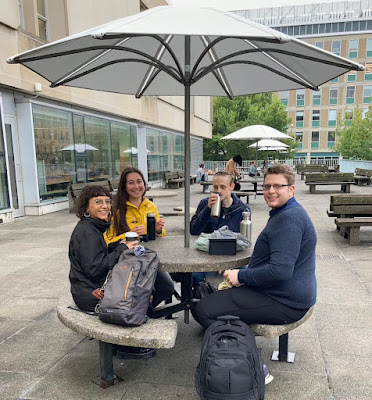
Linguistics students are getting down to work

Neither bad weather nor the restrictions for social distancing and safety keep these students from getting down to serious discussion!

Angela Cristiano, Maya Blumenthal, Ryan MacDonald and Parker Robbins enjoy Sid Smith's East Patio

Angela Cristiano, Maya Blumenthal, Ryan MacDonald and Parker Robbins enjoy Sid Smith's East Patio.

October 5, 2021

Professor Lima + Access and Inclusion Peer Program!


Dr. Suzi Lima (faculty) is currently working with the Access and Inclusion Peer Program here at UofT.  Lima will be in attendance at the Latin American Students and Clubs Welcome on Oct 15! This event provides the opportunity for undergraduate students to interact with the Latin American community here at UTSG! 

For those interested, please register before October 15th! 

Publication - Licensing Null Arguments in Recipes Across Languages


 Professor Diane Massam (faculty) has published an article titled Licensing Null Arguments in Recipes Across Languages.  Massam worked with Ileana Paul to illustrate those null agents and null patients can be possible in recipes within a wide range of topologically and genetically diverse languages. Read their full article to understand the differences in the origins of null agents and null patients! 

Great work Professor Massam! 

PAUL, I., & MASSAM, D. (2021). Licensing null arguments in recipes across languages. Journal of Linguistics, 1-25. doi:10.1017/S0022226721000293

October 1, 2021

UofT @ Moscow HSE Pragmatics Workshop

Angelika Kiss (PhD) and Andrei Munteanu (PhD) will be presenting their joint work on Form-meaning relations in Russian declarative questions at this year's Moscow HSE Pragmatics Workshop. The event will be hosted virtually from Sept 30 - Oct 1 by the International Laboratory for Logic, Language and Formal Philosophy and the School of Linguistics at the HSE University (Moscow).

The workshop programme including abstracts can be found at this link.


September 30, 2021

NWAV 49 (Sociolinguistics conference)

NWAV is the biggest variationist sociolinguistics conference. 

It's coming up, virtually, Oct. 19-24. You can already check out the program at https://www.nwav49.org/

Many UofT students are presenting: Abram, Justin, Kaleigh, Katharina, Lauren, Lisa Schlegl, Pocholo and Vidhya plus Derek, Marisa, Jeremy, Naomi and Sali. You can preview some of these talks at LVC Group on Friday, Oct. 1 at 10am. Ask Kaleigh for the Zoom link. 

NWAV is offering a "group registration" at a reduced rate for classes this year. Please let Naomi (or your sociolinguistics instructor) know if you'd be interested, ASAP. The amount of the reduction depends on how many of you register. Full student rate before Oct. 5 is $32. 

How the conference works this year: Talks will all be pre-recorded by Oct. 10 (and posters by Oct. 18), for you to watch at your leisure (if registered). Then there will be discussion only during the conference days, 9-1 Texas time, so 10-2 in Toronto.

Hope to see many of you there!

UofT @ Sensus 2


The Sensus 2 workshop will be held virtually this year from Oct 1-2 and will be hosted by the University of Massachusetts Amherst.

The following UofT linguists will present:

We're excited to see our linguists out in force this weekend and we wish them all the best.


September 29, 2021

Annual Meeting on Phonology!

 It is that time of year again! The Annual Meeting on Phonology will be taking place virtually from October 1st - 3rd. The UofT Linguistics department is among the organizers and sponsors for the event and you are sure to see some familiar names as chairs and presenters!

From our faculty, we have, Nathan Sanders, Keren Rice, Phil Monahan, Avery Ozburn, Alexei Kochetov, and Ewan Dunbar (Department of French) serving as chairs throughout the event. 

Keep your eyes out for Alumni Christina Bjorndahl's presentation on (Re)conceptualizing Phonological Pedagogy using Evidence-based Practices.

Additionally, the following UofT students, faculty and alumni will be presenting their posters:

Can't wait to hear about the success of this meeting!

September 28, 2021

Colloquium Survey Deadline!

Friendly reminder to those who have not voted yet, there are only two days left to vote in the Colloquium Survey! You will be voting on your preferred UofT-internal colloquium speakers. The survey closes on September 30th so please vote NOW!

September 22, 2021

Congratulations Paul and Piper!

We would like to congratulate Paul Poirier (MA) and his athletic partner Piper Gilles for winning this year's Ice Dance title at the ISU 2021 Autumn Classic International. The full video of their spectacular performance can be found at this link.

September 9, 2021

Interview with Tahohtharátye Joe Brant!

    We had the absolute pleasure of interviewing Tahohtharátye Joe Brant, one of our newest faculty members who is also cross-appointed in the Centre for Indigenous Studies. Keep reading to learn more about him!

What attracted you to UofT?    

UofT is a world-class facility with world-class people. I know Professor Ryan Decaire and the great work that he, and others, do at the Centre for Indigenous Studies and Department of Linguistics. When the opportunity to join UofT came up, it seemed like a really good fit. I get the opportunity to be surrounded by smart, like-minded people who can help in my community's language revitalization journey. 


Do you have any expectations about coming to UofT?   

I have high expectations for my work at UofT. I want to provide the best opportunities for students to learn and support them in reaching their goals. I especially want to inspire students to in Linguistics and Indigenous Studies to support communities and help the next generation of minority and Indigenous language learners. Being at UofT gives me great opportunities to learn with, and from great people.


You were a teacher, a principal, and a vice-principal at an Indigenous institution. What inspired you to work as an educator?   

I was born, raised, and reside on Tyendinaga Mohawk Territory, this will be my first job off the Territory. As I was grew up and went through school, I always wanted to be at home, in my community, to support our children. During my undergrad at the University of Ottawa, I was studying criminology, I thought that this was a good way to help. But, I realized there are ways to reach kids earlier, through the education system. For almost 20 years, I did what I could in education on the territory and now wish to follow another passion, Kanyen'kéha (Mohawk language) revitalization practice and research. I’m now going on a limb, moving to work outside of the Territory, but in this position, I am able to engage with my community and nation's language work. 


What did you enjoy most being an educator working with children / young adults?   


      Children and young adults often don’t get enough credit for how brilliant they are. They have an energy that desire to learn, question, and experience. I enjoy helping students in their learning journey and guiding them through the experience of learning. Normally, around this time of year, I would be at the elementary school, it would just be myself with a few other staff members. The school seemed so eerie without the children. Once the students, families, and teachers enter on the first day, the school would truly come to life. Seeing, hearing, and supporting that energy, the desire to learn and do, was what I enjoy most.    


What drew you into the field of linguistics? What made you go from elementary education to U of T?   

              When I was  growing up, I rarely heard the Kanyen'kéha (Mohawk language) in my family or throughout the community. There are many reasons for the current generational gap in Kanyen'kéha speakers. I started learning Mohawk in elementary school and in the 90s while there was huge surge Mohawk nationhood and sovereignty. I believe one of the greatest things that help perpetuate the vitalization of Mohawk nationhood and sovereignty comes in the normalization and active use of our language. When I was teaching, I strived for culturally inclusive learning and felt like I couldn’t teach this class properly without further knowledge of the language. That’s when I began to learn Kanyen'kéha as an adult. That’s what inspired me learn more about linguistics. I learned the language from amazing people and I have had many great mentors along the way. Now Mohawk is the primary language my family and I speak at home. When raising my children, I wanted to show them how important our language is. It ensures that we have a connection to each other as people and all natural elements of the world. We need to speak our language because language shapes our thoughts and actions. Tahohtarátye is the name, I was given in as a young adult. It translates to, "He comes along in conversation". Your name can be based on birth events, family tradition or as a match of personality or characteristics. Sometimes too, a name fits what you'll do throughout your life. I feel like I keep moving to fulfilling the responsibilities that come with my name.  


What makes learning / researching Indigenous languages unique?   

             There is a correlation between language revitalization, and the health and well-being of a person, community, and nation. There’s great strength in how languages perpetuate the living culture of a people. Learning Indigenous languages is a way forward. A way for people, communities, and nations to reconcile with the past and develop a brighter future. Working with Indigenous languages is more than learning sounds, it is about connecting with our people, our lands, and our ways of knowing and being in this world.   


What challenges do you face when researching Indigenous languages? What do you think can be done to ease these challenges?   

                The biggest challenges in learning comes from acknowledging where we are and making the best choices possible in moving forward.  What's interesting is that institutionalized education was used to take away language and now, we are relying on them to help our people learn. We, in Indigenous language revitalization, need to consider how language is and has been transmitted intergenerationally, for millennia. It’s important to look at the home and family as the base for language vitality. Having access to Indigenous languages is difficult. At home, there was a 60-year gap between first-language speakers of Mohawk. Ultimately, we need greater focus and development of informal language learning opportunities and to have access to hearing, seeing, and doing, in our language.   

             In terms of research, another challenge comes from sharing knowledge and resources. There are amazing people doing important work in many different communities, often accessing such great work is difficult. I feel that we are often quite protective of our resources, knowledge, and experience. Right now, we are in a time crunch. We need to accelerate Mohawk language acquisition, transmission, and learning. We need to come together to find what works and take steps to ensure our language is used for generations to come.


Since you have much experience as an educator, what advice would you give your incoming students? 


Come into class with an open mind, open ears, and an open heart. We need to listen, and read, to understand, not to simply respond. Take in the information and bring it into your world. Ask yourself how the material you are learning impacts you, your family, or your community. Never stop asking questions, but also, put your answers into action. I want my students to know that I also am a learner, I am coming into this new just like how my first-year students.


As the world is re-opening, what are you most looking forward to doing/trying?   

I am a BIG sports fan! Racetracks, golf, and lacrosse are open and hockey will be back soon. I want to go to sporting events. I have always had a love for sports and trying different sports. The love might not have been the sports themselves but the comradery that comes with sports. Even when you’re not playing and you’re just watching, there is just a great environment. I’m hoping everything goes well so we can get back being fans and spectators. 


We'd like to thank Tahohtharáte Joe Brant for taking the time to be interviewed and for sharing his experiences with us. The Department of Linguistics is excited to welcome you and we all wish you the best of luck here at UofT! Say tuned in to check out our other interviews to learn more about our faculty members!