Showing posts with label Brazilian languages. Show all posts

March 14, 2024

Congratulations to Prof. Suzi Lima for her new paper in Language Documentation and Description

Congratulations to Professor Suzi Lima whose new article entitled "On Quotatives and Speech Verbs in Yudja" has recently appeared in the journal Language Documentation and Description. The article examines the argument structure of speech verbs in Yudja, an indigenous language spoken in Brazil.

Here is the abstract:

Much literature has debated the argument structure of speech verbs. For example, Munro (1982) has provided evidence to show that, in many languages, quotations do not pattern like the complements of transitive verbs. In this paper, I analyze the distribution of four speech verbs in Yudja (Juruna branch, Tupi), an Indigenous language spoken in Brazil, and compare them with bona fide transitive verbs. I provide morphosyntactic evidence to argue that direct quotations are not complements of speech verbs based on the distribution of such verbs both in quotative and non-quotative constructions.

Happy reading!

January 20, 2022

Publication: Complex Structures in Brazilian Indigenous Languages

 Suzi Lima (Faculty) and Tonjes Veenstra have published their semantic article to SciELO - Brasil. The research done in  "Complex Structures in Brazilian Indigenous Languages" project helps to advance discussion in theoretical linguistics on various constructions by means of featuring new data or new analyses  of complex structures in languages that have so far been underrepresented in literature. 

Be sure to check out this article to learn more about the semantics of Brazilian Indigenous Languages! 

Lima, S., & Veenstra, T. (2021). Complex structures in Brazilian Indigenous languages. Boletim do Museu Paraense Emílio Goeldi. Ciências Humanas16.


June 6, 2021

CLA-ACL 2021

This year's meeting of the Canadian Linguistic Association/Association canadienne de linguistique is being held online from June 4 through 7, and many University of Toronto linguists of past and present are involved.

  • Laura Colantoni (faculty) and Ana Teresa Pérez-Leroux (faculty) are part of a talk with Yadira Alvarez López (Ph.D., Department of Spanish and Portuguese), Miguel Barreto (BA), Irinia Marinescu (Ph.D. 2012, Department of Spanish and Portuguese), Jierui Yang (BA), and colleague Alejandro Cuza (Purdue University): "The modular interaction hypothesis: When the exponent of gender is an unstressed vowel."
  • Bronwyn M. Bjorkman (former postdoc, now at Queen's University), Elizabeth Cowper (faculty), and Daniel Currie Hall (Ph.D. 2007, now at St. Mary's University), with Louise Koren (Carleton University), Jennice Hinds (Carleton University), and Dan Siddiqi (Carleton University): "Morphological upstaging and markedness."
  • Anabela Rato (faculty, Department of Spanish and Portuguese) and Yasaman Rafat (Ph.D. 2011, Department of Spanish and Portuguese, now at the University of Western Ontario) are part of a talk with Martha Black (University of Western Ontario): "The effect of stimuli repetition on approximant-stop discrimination in Spanish-dominant and English-dominant late bilinguals."
  • Lisa Sullivan (Ph.D.), Erin Vearncombe (faculty, WIT program), and Nathan Sanders (faculty) are giving a pedagogy talk: "Grading grading: Training for consistency, efficiency, and effectiveness in marking linguistics writing."
  • Cristina Cuervo (faculty), Ohanna Severo (Ph.D., Department of Spanish and Portuguese), Sophie Harrington (Ph.D., Department of Spanish and Portuguese), and Samuel Jambrović (Ph.D., Department of Spanish and Portuguese): "Features and forms in L2 Spanish verbal inflection."
  • Songül Gündoğdu (postdoc), Arsalan Kahnemuyipour (faculty), and Marcel den Dikken (Hungarian Academy of Sciences): "Ezafe in the context of CPs in Persian and Kurmanji."
  • Cristina Cuervo (faculty) and Hong-Yan Liu (Ph.D.): "The path of Mandarin Ps: from V to P (and back)."
  • Koorosh Ariyaee (Ph.D.) and Alexei Kochetov (faculty): "Acoustics of Persian uvular lenition."
  • Vidhya Elango (MA) and Derek Denis (faculty): "Fom and friends: Variable BAN-laxing in Multicultural Toronto English."
  • Suzi Lima (faculty): "Relative measures in Brazilian Portuguese."
  • Michelle Troberg (faculty): "Towards a syntactic typology of prepositions in French."
  • Curt Anderson (faculty) has a poster: "Perceivable properties and inference to mental states."
  • Ai Taniguchi (Toronto) is giving a pedagogy talk: "Teaching academic writing via theoretical linguistics: Towards authentic assessments in introductory linguistics classes."
  • Samantha Jackson (postdoc): "Pronoun acquisition in a varilingual context."
  • Zoë McKenzie (Ph.D.): "Restrictions on transitivity in Inuktitut subordinate clauses."
  • Andrew Peters (Ph.D.): "How to adjoin adverbial clauses, and make verb clusters: Lessons from Mongolian converbs."
  • Sahar Taghipour (Ph.D.): "Deriving two types of applicatives: The case of Persian psych predicates."
  • Samuel Jambrović (Ph.D., Department of Spanish and Portuguese): "Obviating lexicalism: A structural account of exocentricity and metaphorical extension."
  • Omar Gamboa Gonzalez (Ph.D., Department of French): "Double aspect des nominalisations du français obtenues par conversion."
  • Andrew McCandless (Ph.D., Department of Spanish and Portuguese) has a poster: "Phonetic training of Spanish /u/ in L2 Spanish learners with L1 Canadian English."
  • Hilary Walton (Ph.D., Department of French): "Does language learning context influence the dynamics of L2 learner groups? An investigation of social identity in Canadian French-as-a-second-language programs."
  • Marjorie Leduc (MA) has a poster: "Icy targets: The case of Karajá."
  • Nicoline Butler (MA) also has a poster: "Sound symbolism in electric, rock, and ground-type Pokémon names."
  • Heather Burnett (former postdoc, now at the Centre national de la recherche scientifique) with Yiming Liang (University of Paris) and Pascal Amsili (Université Sorbonne Nouvelle): "Revisiter l’omission du complémenteur que en français montréalais : Exploration de facteurs cognitifs."
  • Bronwyn M. Bjorkman (former postdoc, now at Queen's University): "Representing and resolving feature conflicts."
  • Ailís Cournane (Ph.D. 2015, now at New York University) and Sandrine Tailleur (Ph.D. 2012, now at l'Université du Québec à Chicoutimi): "Where do maybes come from?"
  • Olga Tararova (Ph.D. 2018, Department of Spanish and Portuguese, now at the University of Western Ontario) is giving a talk with Martha Black (University of Western Ontario): "Multilingual advantage for adult-instructed acquisition of morphosyntax and the effect of processing modality."
  • Monica Irimia (Ph.D. 2012, now at the University of Modena and Reggio Emilia): "DOM co-occurrence restrictions in Romance: Beyond clitic clusters."
  • Monica Irimia (Ph.D. 2012, now at the University of Modena and Reggio Emilia) also hasa poster with Tova Rapoport (Ben-Gurion University of the Negev): "The nature of a predicate: The case of depictives."
  • Bethany MacLeod (Ph.D. 2012, now at Carleton University) and Sabrina M. Di Lonardo Burr (Carleton University): "Imitation of the acoustic realization of Spanish stress: Production and perception."
  • Michael Barrie (Ph.D. 2006, now at Sogang University) and Kang Jungu (Sogang University): "Prosodic spell-out of nominals in Mongolian."
  • Jila Ghomeshi (Ph.D. 1996, now at the University of Manitoba): "T-relatives in Persian."
  • Lyn Tieu (MA 2008, now at Western Sydney University): "Scalar implicatures in French: Children’s production mirrors their comprehension."
  • Recent faculty member Anne-José Villeneuve (now at the University of Alberta), David Rosychuk (University of Alberta), and Davy Bigot (Concordia University): "Langue de ville et langue de soirée: Variation stylistique et maintien des contraintes en français québécois soutenu."
  • Anne-José Villeneuve (University of Alberta) is also part of talk with Tracie Pospisil (University of Alberta), and Kristan Marchak (University of Alberta): "D’où elle est? : Perception dialectale et diversité du français parlé en Albe."
  • Recent visiting student Sander Nederveen (University of British Columbia): "Semantics and morphosyntax of double perfects in Alemannic."
  • For the Pedagogy Roundtable session, we have several participants. Lex Konnelly (Ph.D.), Pocholo Umbal (Ph.D.), and Nathan Sanders are presenting "The Diverse Names Database: A tool for creating more equitable, diverse, and inclusive linguistic example sentences." Sophia Bello (Ph.D., Department of Spanish and Portuguese) is presenting "Effectiveness of interactive digital applications: Assessment of student engagement." Julianne Doner (Ph.D. 2019) is presenting "Lessons from being the Online Support TA in summer 2020."
  • Among those taking part in the career panel for linguistics-related jobs outside academia are Christopher Spahr (Ph.D. 2015, now at Rune Labs) and Carrie Gillon (MA 1999, now working with the Squamish Nation).

June 5, 2021

Congratulations, Guillaume!

Congratulations to Guillaume Thomas (faculty) on receiving tenure! We're just thrilled!

May 7, 2021

SALT 31

Semantics and Linguistic Theory (SALT) 31 is taking place online from May 7 through 9, hosted by Brown University; two alumni are presenting:

  • Julie Goncharov (Ph.D. 2015, now at the University of Tromsø) and Lavi Wolf (Ben-Gurion University of the Negev): "Deriving polarity from granularity."
  • Filipe Hisao Kobayashi (MA graduate, Department of Spanish and Portuguese, now at the Massachusetts Institute of Technology) and Vincent Rouillard (Massachusetts Institute of Technology): "Which singular wh-interrogatives admit plural answers in Brazilian Portuguese?"

November 17, 2020

New paper: Bonfim and Lima (2020)

Anari Bonfim (Museu Nacional/Federal University of Rio de Janeiro) and Suzi Lima (faculty) have a paper out in Linguistic Variation, 20(2): "Count and mass nouns in Patxohã."

This paper describes the count/mass distinction in Patxohã, a revitalized language spoken in Bahia and Minas Gerais, Brazil. We observe that only count nouns can be directly combined with numerals and that only count nouns can co-occur with plural determiners. Furthermore, only count nouns can be combined with size adjectives. As for quantifiers, we observe that at least one quantifier in the language (nitxi) can be combined with count and mass nouns, but trigger different interpretations depending on the noun it is combined with. We also discuss the use of container phrases in counting and measuring contexts.

November 15, 2020

New papers: Lima and Rothstein (2020); Thomas (2020)

The October 2020 issue of Linguistic Variation - number 20(2) - is a special issue devoted to the mass/count distinction in nouns across indigenous languages of Brazil.

Suzi Lima (faculty) and Susan Rothstein (Bar-Ilan University) are co-authors of the introductory paper: "A typology of the mass/count distinction in Brazil and its relevance for mass/count theories."

While much work has been done on the description of the mass/count distinction in different geographical areas, Brazilian Indigenous languages are still highly underrepresented in the field. This paper presents the results of a project that involved researchers describing the mass/count distinction in 15 Brazilian Indigenous languages, based on a questionnaire we prepared in 2016 in order to explore the distribution of bare nouns, plurals, numerals, and quantifiers. Three main observations will be drawn. First, number marking and countability are independent. Second, counting is not restricted to natural atoms. Third, since there seems to be no systematic symmetry in the distribution of plurals, numerals, and quantifiers, we argue that the standard diagnostics for countable versus non-countable nouns are highly language-specific.

Guillaume Thomas (faculty) also has a paper in this issue: "Countability in Mbyá."

This paper investigates the distribution of nouns in Mbyá (Tupi-Guarani), with respect to plural marking, numerals and quantifiers. The study reveals the existence of a robust grammatical distinction between a class of count nouns, which consists mostly of individual denoting nouns, and a class of mass nouns, which consists mostly of substance denoting nouns.

November 2, 2020

Guest speaker: Amalia Skilton (University of Texas at Austin/Max Planck Institute for Psycholinguistics)

As part of her graduate seminar on the semantics of indigenous South American languages, Suzi Lima (faculty) has invited Amalia Skilton (University of Texas at Austin/Max Planck Institute for Psycholinguistics) to give a talk; current departmental members are welcome. A postdoc in linguistic anthropology with the National Science Foundation, she has been making waves for boldly exploring the intersections of language documentation with methodology from adjacent subfields (e.g. variation, acquisition, and psycholinguistics). Her talk, "Understanding deixis in Ticuna: Experimental, observational, and L1 acquisition studies," will be taking place online on Tuesday, November 3, at 4:00 PM. To register, see the first of the two emails from Suzi and fill out the form.

This talk discusses three fieldwork-based studies of the meaning of demonstratives (equivalents to this/that and here/there) in Ticuna, an Indigenous Amazonian language. These studies illustrate the range of methods - from descriptive linguistics, psycholinguistics, and first language acquisition - which researchers can use to analyze semantics and pragmatics in a fieldwork setting. First, I discuss a mixed-methods descriptive study which examined perceptual meanings, or whether Ticuna demonstratives encode information about the speaker's mode of perception of the referent (e.g., whether it is visible). I show how elicitation, semi-experimental methods, and observational recordings of conversation converged to support the same analysis in this line of research. Second, I report on a quantitative study that examined the co-organization of demonstratives and pointing gestures in a video corpus of interviews. This analysis reached substantially different conclusions than either judgment-based or experimental research on the topic, illustrating one way that observational data can complement experimental work. Last, I discuss my continuing research on the L1 acquisition of Ticuna by children aged 1 to 4 years. I show how collecting a large, observational dataset of children's language production allowed me to ask novel questions about the interplay of frequency effects and cognitive/learning biases in the acquisition of demonstratives.

September 23, 2020

New paper: Lima and Martins (2020)

Suzi Lima (faculty) and Adriana Leitão Martins (Federal University of Rio de Janeiro) have a paper out in the Journal of Portuguese Linguistics, 19(1): "Aspectual information of durativity/punctuality impacts the countability of deverbal nouns in Brazilian Portuguese."

This paper explores the countability of deverbal bare singular nouns in Brazilian Portuguese, such as chute ‘kick’ in Maria deu mais chute ‘Maria did more kicking/Maria did more kicks’. More specifically, it investigates whether the aspectual information of a verb impacts the count (cardinal interpretation) or mass (volume/intensity interpretation) interpretation of a bare singular noun. Based on the results of a forced choice task replicating Barner, Wagner, and Snedeker (2008) for English, we show that deverbal bare singulars in Brazilian Portuguese allow count and mass interpretations, depending on the aspectual features of the verbs they are derived from. Punctual events were more likely than durative events to be associated with a cardinal/count response. These results corroborate previous analysis of bare singulars in Brazilian Portuguese, whereby these nouns allow both count and mass interpretations (Pires de Oliveira and Rothstein 2011b).

May 16, 2020

Congratulations, Suzi!

Congratulations to Suzi Lima (faculty), who has been named this year's recipient of the new Early Career Researcher Award from the Canadian Linguistic Association! Their released statement describes Suzi's accomplishments as follows:

Dr. Suzi Lima is an early career researcher who has contributed substantially to language research, demonstrated innovation in research and dissemination, and engaged in practice and policy development in the broader community. Her theoretical focus is the pragmatics and semantics of number and quantity, and she has made contributions to formal semantics, typology, language acquisition, psychology, language documentation and revitalization, and the study of indigenous languages. She has held several research grants and has presented her work at the world's top conferences. She has published many peer-reviewed research works, and has also prepared, with the indigenous communities, a dictionary of verbs (Yudja) and a co-authored pedagogical grammar (Kawaiwete), to be published. She is also in demand as an invited speaker and as an innovative teacher and mentor. Dr. Lima holds a BA and MA from the University of São Paulo (Brazil), and a Ph.D. from the University of Massachusetts. Since her 2014 graduation she has held a postdoctoral fellowship at Harvard University, and Assistant Professorships at Universidade Federal do Rio de Janeiro, and in the Departments of Linguistics, and Spanish and Portuguese at the University of Toronto. In 2019, she began her current position as Assistant Professor in the Department of Linguistics at the University of Toronto. Dr. Lima's research focuses on pragmatics, semantics, typology, language acquisition, and documentation and revitalization. She engages in experimental fieldwork, with a focus on indigenous languages of Brazil, most prominently on Yudja and Kawaiwete. In her dissertation and much of her following work, Dr. Lima has developed ingenious protocols for uncovering the mechanisms by which languages count and measure things and substances, making novel contributions to the semantics and typology of number and quantity. Her work is also innovative in investigating the acquisition of these concepts in under-studied languages, through the study of monolingual and bilingual speakers of indigenous languages and Brazilian Portuguese. She has also collaboratively investigated questions of general cognition, such as how mathematical reasoning relates to cultural practice. Dr. Lima has also been exemplary in the ways she has shared her research with academic and non-academic communities. For example, her collaborative work has resulted in a questionnaire which is a masterpiece in elicitation and experimental design, targeting detailed semantic properties by using methods such as translation, production, comprehension tasks, storyboards, and videos. This questionnaire was applied by specialists who presented their results at a 2017 workshop, now in press as a special volume of Linguistic Variation. One reading book (Kawaiwete songs) was published in 2015 by the Museu do Índio. This ambitious project (coorganized with Susan Rothstein) involved both under-represented scholars and languages, demonstrating Dr. Lima's qualities of leadership. Dr. Lima also reaches out to communities and activists in her work twice funded by United Nations/National Indian Foundation/Indian Museum in Brazil, to document the Kawaiwete language. This work has involved educational workshops for teachers and collaborations with community leaders and researchers, and has resulted in the production of educational materials such as a pedagogical grammar and a dictionary draft. Dr. Lima has also collaborated in creating a database featuring resources for documentation and methods for fieldworkers. Dr. Lima is also an inspiring teacher and mentor, demonstrated in particular by her research excursion program courses where she takes undergraduate students to Brazil for hands-on documentation and fieldwork experience. In summary, Suzi Lima is an extraordinary early career researcher who has already achieved distinction in a range of areas, including theoretical, experimental, and documentation linguistics, while also demonstrating innovation in teaching and community outreach. The Canadian Linguistic Association is delighted to recognize her achievements by awarding Dr. Suzi Lima our inaugural Early Career Researcher Award in 2020.

February 27, 2020

Guest speaker: Jorge Emilio Rosés Labrada (University of Alberta)

Our department is very pleased to welcome Jorge Emilio Rosés Labrada, who is an Assistant Professor in the Department of Linguistics at the University of Alberta. He earned his Ph.D. in 2015 jointly from the University of Western Ontario and l'Université Lumière-Lyon 2, then spent two years as a Banting postdoc at the University of British Columbia. His research focuses on documentation and revitalization of Indigenous languages of the Americas (especially of the Pacific Northwest and the Amazon), often with an emphasis on morphosyntax and/or diachronic perspectives. His talk, "Legacy text collections and their importance for communities, student training, and research", will be taking place at 3:00 PM on Friday, February 28, in SS 560A.

In language documentation, the 'Boasian trilogy' - which has come to be seen as the gold standard - refers to a grammar, a dictionary, and a text collection. Grammars and dictionaries have received substantial attention in the literature over the last 30 years, with many discussions centering on best practices for their creation and on their role in language revitalization and maintenance efforts. Text collections, on the other hand, remain understudied. Yet for many communities, legacy texts - broadly understood here to include narratives, procedural texts, songs, etc. collected in the past - constitute invaluable sources of language and culture. In this talk, I focus on the role that legacy text collections can play in the cultural and linguistic strengthening of communities, in student and community training and capacity building, and in linguistic research. While drawing on multiple examples from my work, the primary focus of the talk will be a case study on the mobilization of such a collection for Makah (Wakashan, Washington State, USA) and the potential applicability of that work to the Canadian context.

February 26, 2020

Applications now open for LIN398

As with last year, Suzi Lima (faculty) is leading a Research Excursion Program (LIN398) course to Brazil to do intensive collaborative fieldwork on multiple endangered indigenous languages of the Amazon region. She and several undergraduates will be travelling to Boa Vista from May 3rd through 15th. If you are an undergraduate student in Arts & Science at the St. George campus and you have an intermediate number of credits, you are eligible. Applications for the course are due on Monday, March 10. For more details, see below or email Suzi.


February 25, 2020

Suzi at York University this week

Suzi Lima (faculty) is giving a talk as part of the Linguistics Lecture Series at York University: "What do we count? A view from Brazilian Indigenous Languages." This will be taking place on Thursday, February 27, from 5:30 to 6:30 PM, in Ross South 552/562. A reception in the department lounge will follow. Everyone is welcome!

In classical theories of countability, the minimal elements in the extension of count nouns are atoms, and the material parts of these atoms are not themselves part of the extension of the nouns (cf. Link 1983, Chierchia 1998, 2010 among many others). According to these theories, grammatical atomicity (what counts as an atom for purposes of counting in language) is strongly associated with natural atomicity (what constitutes as an individual of the kind described by a noun). Against this view, Rothstein (2010) argues that natural atomicity is neither required nor necessary for grammatical counting. Rothstein (2010) argues that atoms can be contextually defined. That is, count nouns like fence, wall and bouquet denote “different sets of atoms depending on the context of interpretation”. For example, what counts as a wall-atom in a particular context (the four wall-sides of a castle that we can consider as ‘a wall’) might not count as a wall-atom in a different context (the north wall of a castle, which we can also name as ‘a wall’). Empirical facts across languages provide ample evidence that discrete individuals are not necessarily countable (see object mass nouns such as furniture in English) and that nouns that denote substances are not necessarily uncountable (cf. Mathieu 2012, Lima 2014 among many others). Such evidence suggests a dissociation between natural and semantic atomicity. Given this debate, the question we intend to address in this talk is: how much does the conceptual content of a noun and natural atomicity influence how units of individuation are specified? Are units of individuation grammaticalized in the semantics of the nouns? Or are units of individuation contextually/pragmatically specified?

December 30, 2019

Report from Amsterdam Colloquium 2019

Suzi Lima (faculty) (centre) with colleagues Maribel Romero (Universität Konstanz)
and Bernhard Schwarz (McGill University).


The 2019 Amsterdam Colloquium took place from December 18 through 20 at the Amsterdam Science Park.
  • Suzi Lima (faculty) gave one of the invited talks for the Workshop on Semantic Universals: "What do we count? A view from Brazilian indigenous languages.
  • Michela Ippolito (faculty) also gave a talk: "Gestures as markers of non-canonical questions."
  • Ailís Cournane (Ph.D. 2015, now at New York University) was part of a talk with Anouk Dieuleveut (University of Maryland), Annemarie van Dooren (University of Maryland), and Valentine Hacquard (University of Maryland): "Learning modal force: Evidence from children's production and input."
  • Ewan Dunbar (MA 2008, now at l'Université Paris Diderot) was part of a talk with Mélissa Berthet (École normale supérieure), Juan Benjumea (Ghent University), Juliette Millet (Université Paris Diderot), Cristiane Cäsar (Pontifícia Universidade Católica de Minas Gerais), and Klaus Zuberbühler (University of St. Andrews): "Animal linguistics and the puzzle of Titi monkeys' alarm sequences."
The 'lightning talks' also included two alumni:
  • Julie Goncharov (Ph.D. 2015, now at the University of Tromsø) and Lavi Wolf (Ben Gurion University of the Negev): "Time matters: The role of temporal boundaries in NPI licensing."
  • Ailís Cournane (Ph.D. 2015, now at New York University) with Maxime Tulling (New York University): "The role of 'fake' past tense in acquiring counterfactuals."

November 21, 2019

Guest speaker: Christine Shea (University of Iowa)


The Department of Spanish and Portuguese is pleased to host an invited talk by Christine Shea, an applied linguist from the University of Iowa who works on phonetic and phonological aspects of L2 learning. Her presentation, "Activation across three lexicons", will be held on Friday, November 29, at 2:00 PM in the Regents Room at the Goldring Centre (GSC 206).

A fundamental challenge of communicating in more than one language is that the speech signal often calls for different interpretations, depending on which language is being spoken. When multilingual listeners hear words in one of their languages, multiple candidates are activated across all their languages. Sublexically, however, differences do exist and can serve to inhibit unwanted activation if they are perceived by the listener. A well-studied example of such sublexical differences is VOT across languages such as Portuguese and Spanish, compared to English. English has long-lag VOT while Spanish and Portuguese have short-lag VOT for the same phonological categories. Another sublexical difference is vowel nasalization. In Portuguese, vowel nasalization can be phonological while in Spanish and English, it is allophonic. Sublexical ambiguities of this type pose an interesting question for multilingual speech processing. Specifically, what happens when a trilingual (e.g., Spanish-Portuguese- English) listener hears input that is ambiguous between two of her languages? Does ambiguous input activate language-specific lexical representations? To answer these questions, we recruited L1 Spanish and L1 Brazilian Portuguese trilingual participants (English was either L2 or L3) living in Uruguay and Brazil. We first determined how listeners identify the multilingual stimuli by means of a categorization task. Subsequently, we determined how listeners classify the same input as belonging to specific languages. Stimuli were bisyllabic nonwords of the form [Ce(N).Ca]. The initial consonant was drawn from a [b-p] voicing continuum (-40ms to 40ms, 10ms intervals) and spliced onto one of three vowels: full nasal vowel (contrastive in Portuguese), nasalized vowel (allophonic in English, Spanish and Portuguese) or oral vowel from each language. For example, the nonword [bẽmpa] with -30 VOT included the nasal vowel and negative VOT characteristic of Portuguese while the nonword [phepa], included VOT of at least 30ms, which phonetically corresponds to English. Participants then completed an auditory form priming task in which they heard the nonword syllables (prime), followed by a real-word (target) from English, Spanish or Portuguese and had to identify the language of the target. Preliminary analysis shows that for phonetically ambiguous primes, RTs were longer and accuracy rates lower compared to non-ambiguous primes. We discuss the relevance of these results for self-organizing models of language selection in multilingual lexical activation.

October 4, 2019

CILLA 9

The 9th Conference on Indigenous Languages of Latin America (CILLA 9) is taking place at the University of Texas at Austin from October 10 through 12.
  • Suzi Lima (faculty) is giving one of the keynote speeches: "A typology of the count/mass distinction in Brazilian languages."

May 20, 2019

REP course in Brazil

Octavia Andrade-Dixon (BA), Greg Antono (BA), Guilherme Teruya (BA), Rildo Dias (faculty, Universidade Estadual de Roraima), Suzi Lima (faculty), Carlos Borges (faculty, Universidade Estadual de Roraima), and Isabella Coutinho (faculty, Universidade Estadual de Roraima)

Suzi Lima (faculty) is currently leading a REP (Research Excursion Program) course, 'Brazilian Indigenous Languages: Documentation, Language Maintenance, and Revitalization', in Boa Vista, Roraima, Brazil. The enrolled undergraduate students are receiving hands-on training in language documentation (working on indigenous languages of Roraima) and collaborative research under the direction of Suzi and colleagues at the Universidade Estadual de Roraima (UERR). Check out their blog to learn more about their adventures!

May 10, 2019

ABRALIN 50

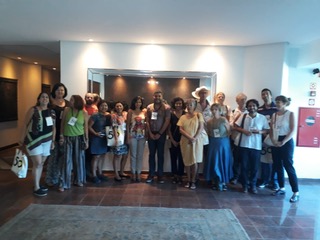
The 50th meeting of the Associação Brasileira de Linguística (ABRALIN 50) took place from May 2 through 9 in Maceió, Brazil. Suzi Lima (faculty) gave a talk: "Oficinas de linguística em comunidades indígenas e pesquisa colaborativa" at the special session 'Languages and peoples threatened: Political impacts of linguistic work' organized by Bruna Franchetto (UFRJ/Museu Nacional). She also co-organized the session 'Complex structures in Brazilian languages' along with Tonjes Veenstra (Zentrum für Allgemeine Sprachwissenschaft). (Photos, video, and captions courtesy of Suzi.)

Participants in the symposium 'Complex structures in Brazilian languages'.

Participants in the symposium 'Languages and peoples threatened: Political impacts of linguistic work'.

Brazilian languages specialists: Kris Stenzel (UFRJ), Ana Vilacy Galucio (Museu Paraense Emílio Goeldi), Suzi Lima (faculty), Mara Santos (UNIFAP), Bruna Franchetto (UFRJ/Museu Nacional), Denny Moore (Museu Paraense Emílio Goeldi), and Luciana Storto (USP).

Suzi celebrated her birthday with her colleagues in Brazil and reports that she had a fabulous time!