Showing posts with label Undergrads. Show all posts

December 6, 2024

Undergraduate Award Recipients 2023-2024

 Please join us in congratulating our Undergraduate Linguistics Award recipients! 


The Jack Chambers Award is awarded to Robin Huo.


The Henry Rogers Memorial Award is awarded to Lucy Meanwell (MA student).


The McNab Scholarship in Linguistics is awarded to Zayd Jose Diz.


The Elaine Gold Award for Undergraduate Achievement in Linguistics is awarded to Benjamin Kobina Eku Sangmuah. 


The Massam/Roberge Scholarship in Linguistics is awarded to Charlie Morocz. 

Please join us in congratulating our winners, Robin, Lucy, Zayd, Benjamin, and Charlie! Well done everyone.

August 2, 2024

UofT Linguists Impress at the 2024 CLA Conference


From June 17-19, 2024, UofT Linguists trekked to Carleton University to attend the 2024 Canadian Linguistics Association (CLA) Conference. 

Will Williams, PhD student, shared this list of talks and posters by UofT people. Bolded names indicate University of Toronto affiliation.

Looking forward to CLA 2025, and the presentation of more incredible presentations such as the ones below!

Posters

Thales Buzan, Cristina Name & Laura Colantoni (Faculty)

Native English Speakers’ Perception of Questions Produced by L1 Brazilian Portuguese and L1 English Speakers

Caroline Mekhaeil (PhD student, UTM)

Could Individual Language Dominance Explain the Transfer to L3 French?

Caroline Mekhaeil presents poster


Samuel Akinbo (Faculty), Tongpan Fwangwar & Michael Bulkaam

Morphophonological Polarity in West Chadic Languages

Rim Dabbous, Marjorie Leduc (MA Alumna), David Ta-Chun Shen & Charles Reiss

Locality in phonology is epiphenomenal

Radu Craioveanu (Alum)

Long and short diphthongs in North Saami

Radu Craioveanu presents poster

Liam McFadden (Undergrad), Avery Ozburn (Faculty) & Samuel Akinbo (Faculty) - Best Poster!

Language mapping for linguists

Liam McFadden presents poster

Talks

Ash Asudeh, Bronwyn Bjorkman, Neil Myler, Daniel Siddiqi & Lisa Sullivan (Alum)

Metasyncretism and secondary exponence in LRFG

Samantha Jackson (incoming Faculty, ex-postdoc) & Derek Denis (Faculty)

Speaking of immigrants: Commentary on the aural employability of (non-)Canadian English

Samira Ghanbarnejadnaeini (MA Alum)

“Woman, Life, Freedom:” A Feminist Critical Discourse Analysis of Gender and Political Activism

Laurestine Bradford (MA Alum)

A Source of Conativity in Tlingit Pluractional Verbs

Angelika Kiss (PhD student), Jianing Zhou, & Justin Leung (PhD student)

Declarative questions in Shanghainese and Cantonese

Yawovi Godo, Lydia Mei, Andreea Cristina Nicolae & Lyn Tieu (Faculty)

Étude expérimentale des propriétés d’exhaustivité de la disjonction en français : L’interaction de l’exclusivité, du libre choix, et des implicatures ad hoc

Lisa Sullivan (Alum) & Nicole Rosen (Alum)

/e/-/i/ overlap in Manitoba English

Calvin Quick (PhD Student)

Agreement with nominal antecedents in Welsh

Simone Diana Zamarlik (Alumni)

Preposition stranding in a non-preposition-stranding language: The puzzle of optional preposition omission under sluicing in Polish

Crystal Chen (PhD Student), Lyn Tieu (Faculty) & Ana Teresa Pérez-Leroux (Faculty)

Investigating the role of gaze and the semantics of demonstratives in referent identification

Samuel Jambrović (PhD Student), Awarded "Honorable Mention"

Defending predicativism: Lessons from Barbie

Nadia Takhtaganova (PhD Student) & Barend Beekhuizen (Faculty)

Variation in the Morphosemantics of Postnominal Prepositions: The Case of Romance A

Arsalan Kahnemuyipour (Faculty) & Sahar Taghipour (Alumni)

Ezafe in the context of PPs

Justin R. Leung (PhD Student)

I’m like, “Like is not a complementizer, it seems like”

Dionatan Cardozo (Visiting student)

Quantified Phrases in Brazilian Portuguese: Preliminary Experimental Results

Christiana Moser (PhD Student), Bahar Tarakcı, Ercenur Ünal & Myrto Grigoroglou (Faculty)

Multimodal recipient mentions in possession-transfer event descriptions: language-specificity outweighs conceptual peripherality

Patrick Kinchsular (Undergrad)

External Possession in Kinyarwanda: A Tale of Two Applicatives

Annie Chong, Avery Ozburn (Faculty) & Tamam Youssouf

Phonologically-conditioned allomorphy in Oromo plurals

Ana Teresa Pérez-Leroux (Faculty), Laura Colantoni (Faculty), Danielle Thomas (alum) & Crystal Chen (PhD Student)

Gender in Toronto Heritage Spanish

Anissa Baird (PhD Student) & Emily Atkinson (Faculty)

Five- & Eight-Year-Olds’ Interpretation of Ambiguous They

June 4, 2024

UofT Linguists at the 55th Annual Conference on African Linguistics

Several members of our UofT community presented talks at the 55th Annual Conference on African Linguistics hosted by McGill University, between May 2nd and May 4th. 

A complete list of UofT attendees and presenters can be found below. 

Liam McFadden, Assistant Professor Samuel Akinbo, PhD Candidate Gregory Antono, Yi-Ting Deng, and Assistant Professor Avery Ozburn presented their work, Mapping African languages. 

His first conference outside of UofT, McFadden is an undergraduate student at UofT, who got to combine his knowledge of linguistics and GIS (Geographic Information System) to navigate through the field of language mapping with the goal of engaging the linguistics community in a project of making better maps. 

McFadden and the team are excited to see the development of their work in future years, and we at the WHITL are excited to see ACAL 56!

UofT Linguistics Department Presence: 

Speakers: 

Laura Griffin, Alexander Angsongna - An Analysis of Tone Delinking in Future Contexts in Central Dàgáárè

Liam McFadden, Samuel Akinbo, Gregory Antono, Yi-Ting Deng, Avery Ozburn - Mapping African languages

Keffyalew Gebregziabher - Polar and Wh-questions in Tigrinya 

Samuel Akinbo, Tongpan Rabo Fwangwar - Grammatical tones in the Derivation of Verbs from Ideophones in Mwaghavul

Atiqa Hachimi, Gareth Smail - Stylized performance of “mock Berber” in a Moroccan Stand-Up comedy talent show

Juvénal Ndayiragije, Patrick Kinchsular - A comparative analysis of transitive expletive constructions in Kirundi and Germanic

Poster:

Avery Ozburn, Gregory Antono, Saba Mirabolghasemi - Community- and context-based approaches to African linguistics: the Language Profiles Project

April 12, 2024

Graduation Lunch & Eclipse


How often do we have 2 such exciting things on the same day? 

On April 8, about 20 of our amazing undergrads joined us for a delicious lunch, a live feed to astronomical experts sharing their wisdom about eclipses, and we all got to see the sun disappear (behind the moon, behind the clouds, whatever...). 

Congratulations to our undergrads completing their Majors, Minor and Specialist POSts in linguistics!!!

Here are some highlights from the day:


the actual eclipse (Nathan's pic)
a cake eclipse -- watch the chocolate pass over the lemon, then disappear (Naomi's pic)


Nathan rocks his solar glasses

Picture-in-picture (Craig's pic)


And, if that's not enough, here's more from The Bulletin Brief <bulletin.brief@utoronto.ca>:

Skies darkened and temperatures dropped as the solar eclipse swept across U of T’s three campuses Monday, bringing community members together to marvel at the celestial spectacle. See how the day unfolded through the lenses of photographers at the university.


April 3, 2024

Congrats Karina!

Congrats to Karina Cheung! 

She presented her research at TULCON and then at Vic's Research Day. For the second, she won the Student Choice Research Award (Voted on by UofT Community) for her paper, "The effects of Heavy-NP Shift on Tagalog Word Order Preferences,"  based on work supervised by Dr. Ivan Bondoc.

March 6, 2024

Linguistics Open House on Feb 26

On Monday Feb 26th we had an open house for all our undergraduates who will soon choose their Programs of Study. Students had the opportunity to chat with faculty, staff and current students about all things Linguistics at U of T. 

Program selection begins March 1st for students, if you have any questions about joining our program please email undergrad.linguistics@utoronto.ca


(Thanks to Kai Herzog-Hara for text and photo credit) 

February 7, 2024

SLUGS hoodies are officially here!!


The Society of Linguistics Undergraduate Students is selling the linguistics hoodies pictured here! For just $45 you can finally rep your linguistics program and support TULCON! 

Hoodies will be sold in-person during SLUGS office hours (Tuesdays 19:00-20:00 or Wednesdays 17:00-18:00) in SS568, or you can reserve your order using the Stripe link (https://buy.stripe.com/5kA4hz9s28aYepGcMM) and pick it up during office hours. 


All proceeds fund TULCON and future SLUGS initiatives!


November 29, 2023

UofT Linguistics @ Fall Campus Day

UofT Linguistics had a wonderful time at Fall Campus Day on Saturday, Nov 18, 2023. Here are photos from the event showing our SLUGS representatives busy discussing linguistics and promoting our undergraduate program to high school students and first year students. Our trivia questions and attractive prizes of samosas, tote bags, buttons, chips and candy drew an impressive crowd!


(Thanks to Kai Herzog-Hara for the report and Photos)

November 20, 2023

Undergraduate Awards 2022-2023

 We are pleased to announce the winners of 5 Undergraduate Awards in Linguistics for 2022-23:

  • The Chambers Award is awarded to Wilson Sy.
  • The McNab Award is awarded to Tony (Juntao) Hu.
  • The Rogers Award is awarded to Patrick Joseph Kinchsular.
  • The Gold Award is awarded to Lucy Meanwell.
  • The Roberge/Massam Award is awarded to Ho Ming Wong.
Congratulations to all these students for their incredible academic achievements!

March 27, 2023

Undergrad Graduation Lunch!! 🎓🍽️🎉

Graduating from university is a significant accomplishment that deserves celebration, and what better way to do so than with a graduation lunch? Recently, the Department of Linguistics hosted a luncheon to honour the hard work and achievements of their undergrads who will be graduating this term! 

In the comfort of the Linguistics Lounge, students and faculty members reflected on their time in the department and chatted about up-and-coming plans! Between the amazing company and the delicious food, the event was a hit!! 


Huge thank you to the staff and faculty members who took the time to organize and attend the lunch! We are very proud of our graduating students and are excited to see what lies ahead for them! 


Can you guess some of the next steps our undergrads will be taking??  


March 2, 2023

TULCON16!!!

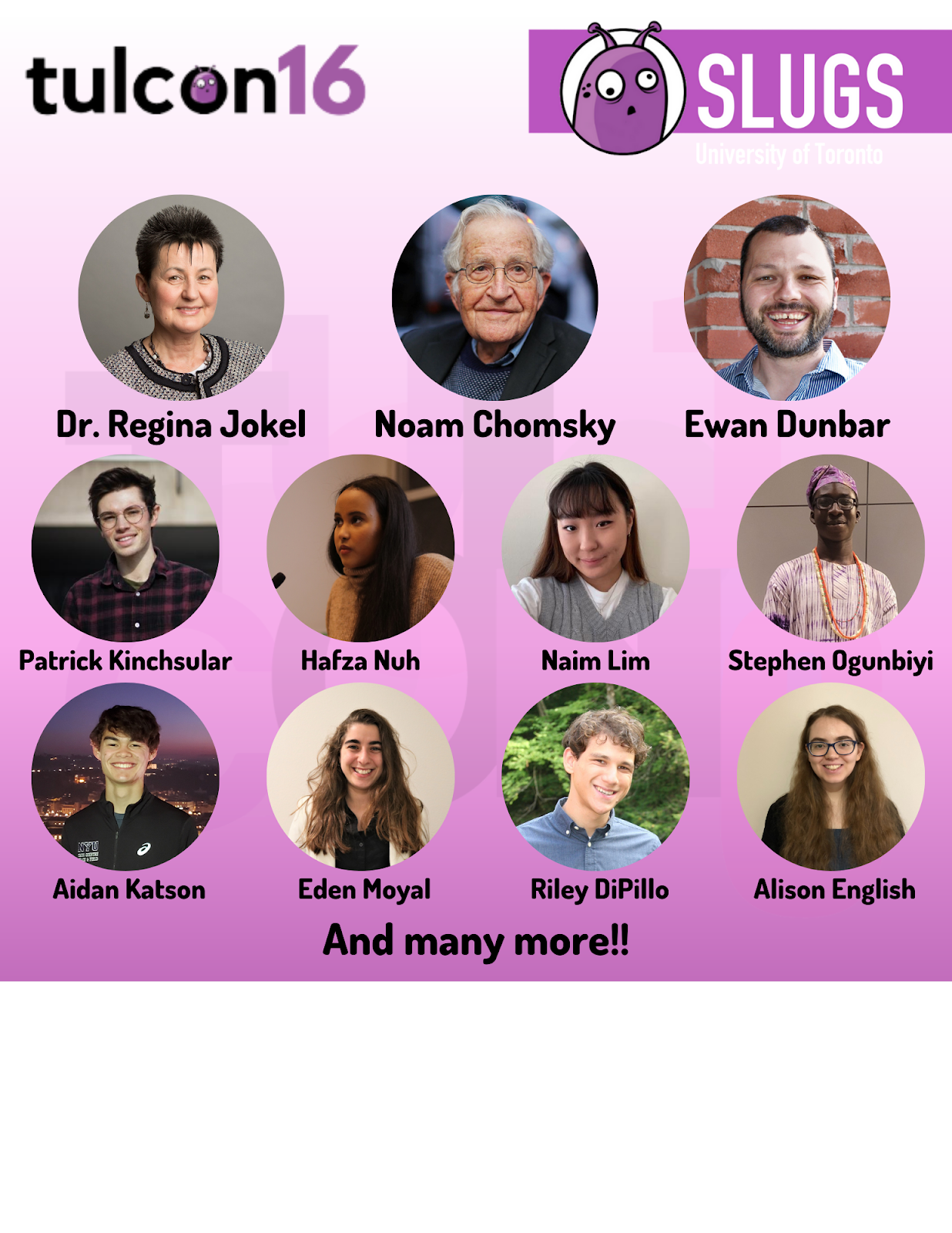
In case you have not heard, SLUGS is hosting TULCON16 this upcoming weekend!! With an incredible line up of keynote speakers, including Noam Chomsky himself), this will be a jam packed weekend of wonderful linguistic work! 

Presentations cover a range of topics from speech disorders to the use of A.I. to theoretical syntax and everything in between! Below you can see the list of all UofT speakers presenting at the conference.Visit the TULCON16 website to get the extensive schedule with abstracts. 

UofT Presentations: 

- Dr. Regina Jokel (Faculty)  "Language as a diagnostic tool"

- Ewan Dunbar (Department of French)  "Are the Robots as smart as babies now?

- Siyi Fan (Undergrad)  & Shiyang Sun (Undergrad) "A variationist study of first-person-singular subject ellipsis in epistemic verb phrases of Heritage Cantonese" 

- Tony (Juntao) Hu (Undergrad) "Secondary thematic role encoding in require vs. allow verbs"

- Patrick Kinshular (Undergrad) "Semantic constraints in Kirundi phonology"

- Mechelle Wu  (Undergrad) "The citizens of everywhere and nowhere: A pilot study examining the linguistic behaviours of Third-Culture Kids (TCKs)" 

- Naim Lim  (Undergrad) "Acoustic study of word-initial liquids in Korean loanwords for English produced by Korean speakers"

- Hafza Nuh  (Undergrad) "An analysis of English stop consonant perception and production in L1 Somali speakers and comparison with L1 English speakers: A study of /p/ and /b/

- Laura Escobar (Undergrad) "The intonation of statements in the casual spontaneous speech of Tokyo Japanese" 

If you are interesting in attending, please register in advance.  For those who would like to get involved with TULCON, SLUGS is accepting volunteers to help with organization matters throughout the day.

We are SO excited for TULCON and hope you all can make it! 
  

June 16, 2022

Undergrad Award Recipient 🎓🎉

Huge congratulations to Gianna Francesca Giovio Canavesi (now UTM undergrad alum) for graduating and receiving two esteemed awards! 

She is the recipient of the UofT Excellence Award for her work on "Production and Perception of Keiyo Vowels,"a research project supervised by Dr. Avery Ozburn. She also received the Outstanding Program Performance Award in Language Studies at UTM! 

Congrats Gianna! Your hard work has paid off and we are excited to see the amazing things you'll accomplish as you pursue your Masters in Speech-Language Pathology! 


June 9, 2022

Graduation Tea 🫖🎓🎉

All undergrad linguists spend years working towards the goal of attending the Graduation Tea! This year, members of the graduating class joined faculty members on Wonder where they reminisced on their undergrad years and chatted about future plans! We are pleased to hear many are continuing their studies in linguistics at various institutions around the world! 

Congrats to all students who are graduating this year! We cannot wait to hear about all the amazing things you'll do in the future! 


May 26, 2022

The Workshop on Innovations in Cantonese Linguistics!!

 The 6th Workshop on Innovations in Cantonese Linguistics (WICL) is a biennial conference that focuses on new advances in Cantonese linguistics, such as innovation in methodologies, tools, and or computing software. This year it will be held virtually by Ohio State University on May 27th - May 28th 2022. 

Justin Leung (Graduate Student),  Brian Diep (Undergraduate Student) and Naomi Nagy (Faculty) will be presenting their work on " 'Lazy pronunciation' in Toronto Heritage Cantonese: The case of (n-/l-)"! They will be presenting on May 27th. Their abstract can be found below! 

The event is free of change but registration is required. We encourage all to attend! 

'Lazy pronunciation' in Toronto Heritage Cantonese: The case of (n-/l-)

In Hong Kong Cantonese, there is a group of sound changes in progress colloquially known as 懶音 ‘lazy pronunciation’. A well-known example is the alternation between syllable-initial /n/ and /l/, which is often characterized as a merger of /n/ to /l/ (Zee 1999; To et al. 2015; i.a.), e.g., pronouncing 南 /naːm²¹/ ‘south’ like 藍 /laːm²¹/ ‘blue’. While this merger is sometimes reported to be complete or near-completion (Zee 1999; To et al. 2015), some variation is observed, with age and gender suggested as important factors conditioning variant choice (Ng 2017; Liang 2018), as well as an expectation that heritage speakers may differ from homeland speakers. For example, Cantonese-English bilinguals in Vancouver are found to differentiate /n/ and /l/ in English but merge the two phonemes in Cantonese (Soo et al. 2021). However, little work has teased apart the linguistic and social factors that contribute to this variation. We investigated the factors that contribute to variation and compare the realization of /n-/ and /l-/ in heritage speakers in Toronto and homeland speakers in Hong Kong. If there is influence from English, which differentiates /n/ and /l/, we expect heritage speakers to have less [l] for /n-/ and [n] for /l-/. However, if heritage speakers amplify the change (due to less pressure to conform to a standard, less exposure to homeland speech, or categorical perception as /l/), we would expect them to have greater (perhaps categorical) usage of [l]. We analyzed spontaneous spoken data from sociolinguistic interviews (14 speakers) in Cantonese from the Heritage Language Documentation corpus (Nagy 2011). The corpus includes homeland speakers in Hong Kong and three generations of heritage speakers in Toronto. Tokens of syllables with /n-/ or /l-/ as the onset were extracted and coded impressionistically (and cross-checked) for the variable (n-/l-) and linguistic factors (vowel backness, vowel height, vowel length, tone, previous segment). We also considered the social factors of generation, ethnic orientation and gender of the speakers. The tokens were classified as underlyingly /n-/ or /l-/ based on 19th-century sources (from 粵音資料集叢 https://jyut.net), and these were accordingly analyzed in separate mixed-effects logistic regression models. 504 tokens were extracted (418 /n-/, 86 /l-/) after excluding characters categorically realized as [l]. For the /n-/ tokens, there is more retention of [n] after a previous (coda) nasal, conditioning by the tone and following vowel, as well as significant differences by generation, gender and ethnic orientation. Although generation is significant, there is no monotonic relationship suggesting an advance of the change across heritage generations. In contrast, for the /l-/ tokens, a nasal coda in the preceding syllable significantly favoured realization as [n], and there was no other conditioning. That is, in both datasets, there is a preference to produce [n] after a nasal. The results also confirm one finding in the literature, that /l-/ is less likely to surface as [n] than the other way around, but do not provide any evidence of a different pattern between heritage and homeland speakers. 

References 

Liang, Y. 2018. 再探討香港粵語聲母 /n-/、/l-/ 不分. Current Research in Chinese Linguistics 97(1): 101–110. 

Nagy, N. 2011. A multilingual corpus to explore geographic variation. Rassegna Italiana di Linguistica Applicata 43(1–2): 65–84. 

Ng, C. L. C. 2017. Merger of the syllable-initial [n-] and [l-] in Hong Kong Cantonese. Outstanding Academic Papers by Students. http://dspace.cityu.edu.hk/handle/2031/100. 

Soo, R., Johnson, K. A., & Babel, M. 2021. Sound change in spontaneous bilingual speech. Proceedings of Interspeech 2021, 421–425. 

To, C. K. S., McLeod, S., & Cheung, P. S. P. 2015. Phonetic variations and sound changes in Hong Kong Cantonese. Clinical Linguistics & Phonetics 29(5): 333–353. 

Zee, E. 1999. Change and variation in the syllable-initial and syllable-final consonants in Hong Kong Cantonese. Journal of Chinese Linguistics 27(1): 120–167.


May 10, 2022

UofT presents at Annual Conference on African Linguistics!

The Department of Linguistics at the University of California San Diego hosted the 53rd Annual Conference on African Linguistics in early April (2022). Several UofT linguists attended.

Avery Ozburn (Faculty), Gabriel Palmieri (PhD Student) and Madeline Glover (Undergrad UTM Student) presented their work on ATR Phonetics in Keiyo! 

Avery Ozburn (Faculty), Gianna F Giovio Canavesi (Undergrad student at UTM who will be graduating this June) and Samuel Akinbo (University of British Columbia) presented on the Perception of ATR in Dágáárè! 

Busy conference for Avery Ozburn! We appreciate all the hard work she and her students put into their work! 


May 7, 2022

Runze Qian at Emory Linguistics Undergraduate Conference!

 On April 22nd Emory University's Program in Linguistics hosted the third annual Emory Undergrad Linguistic Conference (EULC3)! 

One of our undergraduate students, Runze Qian (Undergrad Student at UTSG), presented his work on "The Application of Turkish Vowel Harmony to English Proper Nouns: An Experimental Phonetic Analysis"! His abstract is below.

Runze Qian will be graduating this June and will be heading to the University of Ottawa to purse his Master's of Linguistics! We are excited to see the amazing work he will do there! 


The Application of Turkish Vowel Harmony to English Proper Nouns: An Experimental Phonetic Analysis

    Turkish vowel harmony (VH) is a phonological process which dictates that all vowels in non-compounded words of Turkish origin must agree in backness and/or rounding (Kabak 2011). The same rule applies to suffixes that are agglutinated to the word stem. However, there are no rules regarding how VH would apply to suffixes that are attached to words from another language which include phonemes that do not exist in Turkish as shown in example (1) and (2). This project aimed to investigate how native speakers of Turkish who are bilingual in English would apply VH to English proper nouns with vowel phonemes in the word-final position that do not exist in Turkish by conducting acoustic phonetic analyses.

 English Gloss Possible                       Harmony Structures 

(1) ‘in/at Los Angeles’                        Los Angeles'ta       Los Angeles'te 

(2) ‘of Boston’                                    Boston'ın               Boston'un 

    Participants were presented with an elicitation task including five paragraphs written only in English. Each paragraph was designed to have structures that would require the use of a Turkish suffix agglutinated on an English proper noun. An example sentence one of the constructed paragraphs is shown in (3). The participants were asked to do on-site translation of the paragraphs (into Turkish) and their choice of vowels in the agglutinated suffixes were recorded. After finishing translating all paragraphs, participants were asked how they would say each structure in Turkish in isolation to test if the speakers would use different vowels if they were conscious about the structure. The acoustic properties of each vowel were measured and compared with each other. It was found that even with the speakers being bilingual, while pronouncing English proper nouns in a Turkish context, the acoustic qualities of their vowels would shift towards the qualities of Turkish vowels. It is possible for speakers to pronounce the vowels differently while being conscious about the structure, but it is not a universal trend. It was also found that when a suffix is agglutinated, the vowels used to satisfy VH would match with the final vowel of the stem disregarding how the vowel is realized in orthography. This proved evidence for VH being a natural phonological process underlyingly represented in our cognition, rather than a set of grammar rules that need to be remembered. 

            (3) I am from Adana, but now I live in Los Angeles. 

    The next steps of the project will be to examine how would heritage speakers and foreign language learners of Turkish use vowels to satisfy VH in such structures, and compare with the data collected from native speakers to see if there are any similarities. Further researches will also examine how do different groups of speakers pronounce the vowels in proper nouns differently and if that can be reflective of their acquisition of the Turkish language.

March 29, 2022

Elaine Gold Award Recipient!

We want to give a huge congratulations to the 2021 recipient of the Elaine Gold Award; Robin Huo! 

This award is given in recognition of Outstanding Achievements in the required 200-level Linguistics courses. 

Robin is a third-year student studying linguistics and computer science. He has had an interest in languages and computing since middle school, which has led him to the University of Toronto for its reputation for excellence in both fields. He now hopes to combine these interests through the development or application of computational methods to contribute towards linguistic research.

Congrats on your amazing work Robin! 


February 28, 2022

TULCON!!!

SLUGS will be hosting the fifteenth Toronto Undergraduate Linguistics Conference on March 5th-6th 2022. TULCON will be hosts online via Gathertown. 

Come and see the amazing work of undergrad linguists and hear talks from keynote speakers Marisa Brook (Faculty) and Samuel Jambrović (PhD Student)! Full schedule is now available. 

Please Register before the event!