Showing posts with label Phonetics/Phonology. Show all posts

October 21, 2024

Song Jiang successfully defends Thesis Proposal!


On September 27, 2024, Song Jiang (now PhD candidate) presented his thesis proposal, "Articulatory variability in the articulation and coarticulation of Mandarin rhotic vowels"

His supervisory committee consists of Alexei Kochetov (Supervisor; faculty), Peter Jurgec (faculty), and Tim Bressmann (faculty, SLP).

Congratulations Song on a successful thesis proposal presentation!

August 12, 2024

The heat is on this summer - you need SPF!

The 2024 annual Summer Phonetics - Phonology Forum (SPF) took place on August 7th, and now we know why they call it SPF!

UofT linguists, attendees and presenters alike, gathered for the reception, presentations, and lunch held at the Linguistics Lounge, pictured below.

Session 1, chaired by Professor Alexei Kochetov, saw presentations by both faculty and graduate students.

Louis Careri, Laura Griffin, Youmna Mohamed, Jemi Samuel, Avery Ozburn
Developing a model for community engagement in phonetics and phonology fieldwork
Louis Careri describes p-sided
challenges associated with fieldwork


Laura Griffin's YouTube Shorts Sample, a
language learning resource targeted towards the
younger generation of Mbembe speakers.


New approaches to stress patterns of Oneida 

Professor Yoonjung Kang chaired Session 2, seeing the following presentations:


Jessica Yeung
Where to go from here? Directionality and morphological structure in vowel harmony

Liam McFadden, Shana Rosenberg, Gianna Giovio Canavesi, Avery Ozburn
An artificial language learning experiment on rounding harmony target asymmetries

Lunch was held at Sidney Smith in the Linguistics Lounge.


Session 3, chaired by presenter and Professor Avery Ozburn, showcased two projects.

Jack Mahlmann
Can you hear the silence? Perceptual learning of plain-ejective contrast
 

B. Elan Dresher, namesake and founder of the prize of the same name (see Yanfei above)
Features and contrast: The universal versus the language particular 

Session 4 was chaired by Jessamyn Schertz, Professor of Language Studies at UTM.


Laura Escobar
Gender differences in f0, intonation and particle use in conversation and performative speech in Japanese


Derek Denis, Lauren Bigelow
Speech rhythm, stance, and sociolinguistic identity: Two case studies from Ontario Englishes

Session 5 was chaired by Professor Nathan Sanders, and saw the following presentations, followed by closing remarks.

Alessandro Jaker (Sisseton Wahpeton College)
How natural is tonal phonology? What happens to stress-tone interactions when tones reverse


Laura Griffin
Tonal alternations in Mwaghavul associative constructions


Closing remarks were brief! Thanks to everyone for participating and organizing!

WHITL and the Forum's organizers, Samuel Akinbo, Yoonjung Kang, Alexei Kochetov, Philip Monahan, Avery Ozburn, Nathan Sanders, and Jessamyn Schertz, have much to be proud of, and much to look forward to next year!

July 30, 2024

Song Jiang and Alexei Kochetov Publish on Mandarin rhotics!

Attendees of the 13th International Seminar on Speech Production, ISSP.

Song Jiang (left), PhD candidate at the Uoft Phonetics Lab, and Alexei Kochetov, Professor of Linguistics (right), recently published their work, Variability in the articulation of Beijing Mandarin rhotic vowels. 


Rhotic vowels are modified by the consonant /r/ - think "heard" and "bird".

Noticing that the "contextual and/or inter-speaker variability" of North American English rhotic vowels such as /ɹ/ and [ɚ] was widely documented, and that that of the Mandarin rhotic vowels, such as [ɚ, u˞], was less so, they set out to conduct an "extensive ultrasound investigation" of these rhotic vowels in Beijing Mandarin.

In fact, they were able to indicate a "greater than previously reported variability in the articulation of Beijing Mandarin rhotic vowels" by examining variation in tongue configuration, (retroflex or bunched) vocalic contexts, and reported greater similarity between rhotic vowels to rhotic vowels, than in rhotic and non-rhotic vowels.

This publication was presented as a poster on Wednesday, May 15th at the 13th International Seminar on Speech Production, (ISSP 2024) held this year in Autrans, France.

We are so proud of this momentous accomplishment, and congratulate them on their hard work. 

(All quotes from the paper's abstract, found in the link above.)

July 23, 2024

Naomi Nagy, Linguistics Chair, Publishes Book about Heritage Language Variation and Change!

book cover
On June 27th, 2024, Department of Linguistics Chair, Naomi Nagy, published her book, Heritage Languages: Extending variationist approaches. [Click link to purchase :-) or get it from UofT's library]. 

In Canada, the term, "heritage language" refers to a language learned in the home by children, if that language is not one of Canada's official languages (French, English). Half the people in Toronto are heritage-language speakers!

This book seeks to dispel stigma surrounding the use of one's heritage language by investigating cross-generational variation and change in conversations with 400+ speakers, in 8 different heritage languages, in Toronto. The findings reveal many similarities between heritage and homeland varieties.

"Introduc[ing] new methodology to help readers understand and apply variationist sociolinguistic approaches to quantitatively analyze spontaneous speech," this novel approach to heritage language research showcases how change in grammar of heritage languages resembles change patterns seen hegemonic, majority languages, contradicting findings of "simplification/attrition patterns in experimental heritage language studies." [quoted from the publicity blurbs]

Comparing patterns not only across languages, but across generations, this research quotes heritage speakers to give voice and pride to the use of their languages. 

Nagy presented some of this research at BAM's Language Research Day, as her talk on Heritage Language Variation and Change (HLVC), which we covered on the blog earlier in July. Other findings are on the project's webpage.

This book promises to be a veritable toolbox for those interested in learning about or researching heritage languages, dedicated to language revitalization.

Currently, the Department Chair is in Italy conducting research also relevant to this pursuit - about the variation in Franco-Provencal language varieties over time and space, and how to connect speakers of different varieties via social media.


The author reports that this book was much more fun to write than her dissertation!

July 15, 2024

Arcadian Greek vs. Standard Greek: Dr. Photini Coutsougera Publishes A Dictionary with the Answers


From Dr. Coutsougera: 

"""
Dr. Photini Coutsougera of Mississauga Campus' Language Studies Department has recently published a new book, A Dictionary of Northeastern Arcadian Greek [in Greek] with Patakis Publications, Athens, Greece (2024)/ 320 pages. 

A Look Inside: Letter Αα, p. 66

The Dictionary of Northeastern Arcadian Greek comprises 4.200 entries and 5.120 senses. These entries were primarily collected during field work, over a period of approximately thirteen years, and from existing written sources. 

Subsequently, they were verified one by one  by a group of native speakers of the dialect, aged 80 and over. Each entry contains semantic, phonological, morphological, syntactic and stylistic information. It also contains a plethora of authentic examples in use, synonyms, antonyms, idioms and idiomatic phrases, proverbs, sayings, and verses from local folk poetry. Finally, a 28-page Prologue includes a compact grammar of the dialect, lays out the research methodology employed in the data collection, and defines Arcadian Greek on the basis of linguistic criteria which systematically differentiate it from Standard Greek. 

This book aspires to bring the Peloponnesian varieties of Greek to the fore as they have been conspicuously absent from the literature.

                                                                 """


June 14, 2024

Linguistics Spotlight: Nicholas Haggarty in the Field of Queer Linguistics

Some French words like, “quatre” (four) and “table,” have over time evolved to sound more like “quat-” or “tabl-,” as speakers “dop” that final segment. 


Seems minor, right?


In 17th-century France, popular opinion held that people who pronounced words without that final segment were “peasants,” “uneducated.”


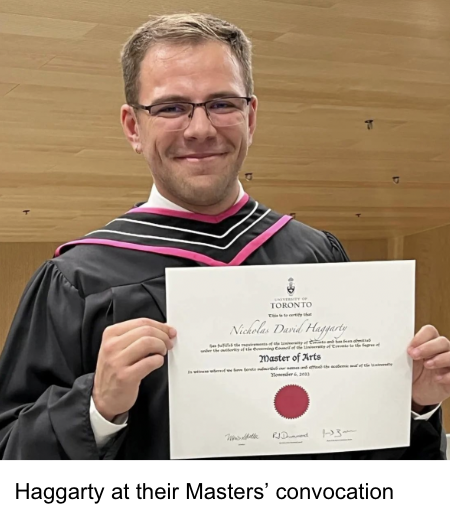
Sociolinguists often track such idiosyncrasies and their evolving meanings over time to get an understanding of the impact of language on culture. One such individual is Nicholas Haggarty (they/he), who studied historical perceptions of social class of people who spoke French with that particular identifier.


They made an interesting claim in response: it’s not a social class phenomenon or an indicator of education level, but rather, an identifier of Quebec and Montréal French.


Haggarty just finished their first year as a PhD student studying Sociolinguistics and Queer Linguistics with a background in both French and English. Having assisted on Professor Yoonjung Kang’s “Speech Rate Effects in French Stop Voicing Production and Perception,” Haggarty looks back on their works as constantly striving for an understanding of why people make the sounds they do, and why those sounds are perceived in the ways they are. 


Their Master’s thesis studied the stereotypical “gay” voice, and whether there was a science-backed explanation for the phenomenon so commonly referred to in the media. Haggarty examined pitch and tone in a series of archived interviews with queer men of the 80s.


An inspiring individual who views their research as advocacy rooted in education, Haggarty’s work focuses on the stories we tell through not only our language, but the clues revealed by the linguistic forms we use. 


What is queer linguistics?

Haggarty describes queer linguistics as relevant today due to societal interests in staying the hetero-normative course. To them, the field brings the queer community into the linguistics field, identifying elements of queerness and queer performance to define how people use language to root themselves in their identity. 


An intersecting interest therein, Critical Discourse Analysis investigates parts of speech and what it means when we use them. For example, when we use Internet-slang or community-specific vernacular, are we showing relation or connection to ourselves or our community?


Haggarty’s magnum opus to date is their PhD, using a corpus of interviews with queer individuals in the Toronto area. He will study their oral histories to get an understanding of language that goes beyond phonetic analysis, including the various ways they perceive authenticity in their identity. 


The best part about this? The resource will be public. 


An unprecedented act of agency and advocacy, this database of oral histories of queer people in Canada is a way of teaching people how queerness is perceived in our corner of North America, and whether the lessons they teach us line up with research done in places like the United States. If not, perhaps there is something to be said about breaking down pervasive stereotypes.


As Haggarty says, “everything we do is a performance,” and their work in the field of queer linguistics seeks to decode its meanings and values. 


To all those interested in the emerging field of queer linguistics, and to everyone else who values education and understanding above all else, keep an eye out for this exciting development in Haggarty’s work.


We all have something to learn by listening to each other’s stories and taking them on their own terms. 


June 4, 2024

UofT Linguists at the 55th Annual Conference on African Linguistics

Several members of our UofT community presented talks at the 55th Annual Conference on African Linguistics hosted by McGill University, between May 2nd and May 4th. 

A complete list of UofT attendees and presenters can be found below. 

Liam McFadden, Assistant Professor Samuel Akinbo, PhD Candidate Gregory Antono, Yi-Ting Deng, and Assistant Professor Avery Ozburn presented their work, Mapping African languages. 

His first conference outside of UofT, McFadden is an undergraduate student at UofT, who got to combine his knowledge of linguistics and GIS (Geographic Information System) to navigate through the field of language mapping with the goal of engaging the linguistics community in a project of making better maps. 

McFadden and the team are excited to see the development of their work in future years, and we at the WHITL are excited to see ACAL 56!

UofT Linguistics Department Presence: 

Speakers: 

Laura Griffin, Alexander Angsongna - An Analysis of Tone Delinking in Future Contexts in Central Dàgáárè

Liam McFadden, Samuel Akinbo, Gregory Antono, Yi-Ting Deng, Avery Ozburn - Mapping African languages

Keffyalew Gebregziabher - Polar and Wh-questions in Tigrinya 

Samuel Akinbo, Tongpan Rabo Fwangwar - Grammatical tones in the Derivation of Verbs from Ideophones in Mwaghavul

Atiqa Hachimi, Gareth Smail - Stylized performance of “mock Berber” in a Moroccan Stand-Up comedy talent show

Juvénal Ndayiragije, Patrick Kinchsular - A comparative analysis of transitive expletive constructions in Kirundi and Germanic

Poster:

Avery Ozburn, Gregory Antono, Saba Mirabolghasemi - Community- and context-based approaches to African linguistics: the Language Profiles Project

May 28, 2024

Phonology-Phonetics Workshop, Montreal-Ottawa-Toronto-Hamilton 2024


McGill Linguistics, on April 19th and 20th, hosted the 2024 [motʰ] Montreal-Ottawa-Toronto-Hamilton Phonology/Phonetics Workshop. 

Connie Ting, a PhD student at McGill University, presented hers and our own Professor

Yoonjung Kang's “Tracking speaker-specific speech rate: habitual vs local influences on

English stop voicing perception."


This work will also be discussed in an upcoming spotlight on another of Professor Kang's

research assistants, PhD student Nicholas Haggarty - keep your eyes open for that!


Additionally, the conference saw:


Joint work by Song Jiang (PhD student) and Alexei Kochetov

A presentation by Elan Dresher (Faculty Emeritus)

Radu Craioveanu (PhD 2023)


We were so proud of all UofT involvement at this conference, and are excited to see where

their work takes them next!  

March 18, 2024

New paper by Prof. Samuel Akinbo in Glossa!

A new paper by Prof. Samuel Akinbo entitled "Iconicity as the motivation for the signification and locality of deictic grammatical tones in Tal" has recently appeared in Glossa. The paper presents evidence in favour of iconicity in the core morphophonological grammar.

Here is the abstract:

We present novel evidence for iconicity in core morphophonological grammar by documenting, describing, and analysing two patterns of tonal alternation in Tal (West Chadic, Nigeria). When a non-proximal deixis modifies a noun in Tal, every tone of the modified noun is lowered. When the nominal modifier is a proximal deixis, the final tone of the modified noun is raised. The tone lowering and raising are considered the effects of non-proximal and proximal linkers, which have the tone features [–Upper, –Raised] and [+Raised] as their respective exponents. The realisation and maximal extension of the non-proximal tone features are considered effects of morpheme-specific featural correspondence constraints. Similarly, the exponent of the proximal linker docking on the final TBU is due to the relative ranking of the proximal-specific correspondence constraints. The association of the tone features [–Upper, –Raised] and [+Raised] with non-proximal and proximal linkers, respectively, is in line with crosslinguistic patterns of magnitude iconicity. Given that the local and long-distance realisations of the proximal and non-proximal featural affixes respectively are perceptually similar to deictic gestures, the locality of the featural affixation is considered a novel pattern of iconicity. To motivate this pattern of iconicity, we extend the notion of perceptual motivation in linguistic theory to include the crossmodal depiction of sensory imagery. Consequently, Tal presents evidence for iconicity as a motivation for morphophonological grammar.

Congratulations Prof. Akinbo! 

February 15, 2024

New book about heritage languages


Cambridge University Press has just produced a fantastic collection of chapters about phonetics and phonology in a wide range of heritage languages. U of T is well-represented:


1 - Front Rounded Vowels of Heritage Korean in Northern China

By Yoonjung Kang, Na-Young Ryu, Jessamyn Schertz (and their co-authors  Sungwoo Han, Suyeon Yun) 


16 - Perception and Production of English and Portuguese Voiceless Stops by Heritage Learners

By Anabela Rato, Vanina Machado. (Dept. of Spanish & Portuguese)


as well as this output from the HLVC Project:


Check out The Phonetics and Phonology of Heritage Languages on the CUP website. 

Huge thanks to Rajiv Rao for his amazing work editing this volume!