Showing posts with label Guest speakers. Show all posts

November 26, 2024

Guest speaker: Isaac L. Bleaman (UC Berkeley)

The Department of Linguistics and the Anne Tanenbaum Centre for Jewish Studies (CJS) hosted a guest talk by Isaac L. Bleaman (Assistant Professor, UC Berkeley) on Friday, November 22, 2024. He delivered a talk entitled, "Social dimensions of variation in Yiddish: Historical perspectives and new insights". He also gave the same talk in Yiddish at CJS two days prior. 

We extend our thanks to the Department of Linguistics Guest Speakers Committee for organizing the event: Samuel Akinbo (faculty), Emily Atkinson (faculty), Tahohtháratye Joe Brant (faculty), and Ivan Bondoc (faculty). 


The abstract of his talk is provided below:

Yiddish contributed significantly to the development of sociolinguistics and language contact, particularly through the pioneering work of Uriel Weinreich and Joshua Fishman. However, very little quantitative variationist research has been conducted on either contemporary or historical varieties of the language. In this talk, I will present my findings on the social significance of variation in New York-based communities that are committed to language maintenance in Yiddish. The results show how differences in communities' maintenance practices and ideologies (e.g., whether to prioritize language dominance; whether to standardize the language) have contributed to inter-community differences in the quantitative patterning of two variables: voice onset time and number agreement. At the end of the talk, I will preview the resources available in the Corpus of Spoken Yiddish in Europe (CSYE), which is now being developed through a National Science Foundation CAREER grant. Among other applications in research and language revitalization, the CSYE will provide the data necessary to address questions related to the social meaning of variation and the direction of language change in the pre-Holocaust period.

The talk was followed by a lively reception at the lounge.


And dinner at Her Father's Cider Bar + Kitchen! In attendance were Isaac L. Bleaman (Guest Speaker) along with Elan Dresher (faculty), Avery Ozburn (faculty), Costanza Vallicelli (PhD Student), Xinyu Liao (PhD Student), and Naomi Nagy (faculty). 

From L-R: Elan, Costanza, Naomi, Xinyu, and Issac. Thanks to Avery for taking this group photo!


September 13, 2023

Welcome Party 2023

Linguists gathered again at the Madison Avenue Pub to celebrate the start of a new school year and the end of the first week. Lots to talk about after the Campus Kick-off Research Fair.


Ewen and Samuel discuss and enjoy the sun.

MA Forum gets their discussions going, too. Calvin, Will R. and Louie face the camera.

 
Naomi and Keir try out speechifying as the incoming Department Chair and Grad Chair.

Guest speaker Thomas Kettig, York U Sociolinguist, shares some of his Hawaiian style, after a great lecture about Hawaiian sociophonetics.

Members of the LVC group gather for a photo (L to R):

Incoming grad chair Keir and outgoing grad chair Arsalan and the  take a moment to relax and enjoy the party.
Suzi, Pedro and Samuel A. advertise great beer for us.


Youp enjoys pub fair.


March 16, 2023

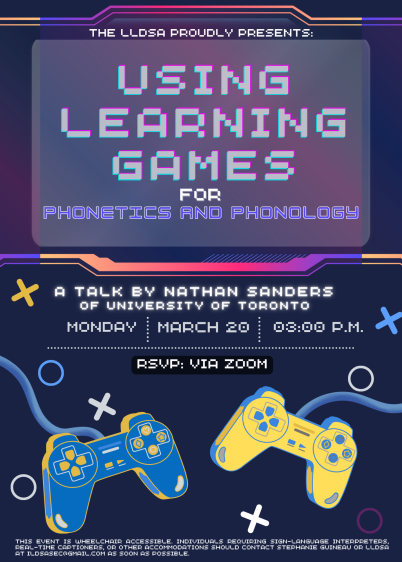
Is Nathan Sanders actually using games to teach linguistics?

Who here took LIN228/229 with Nathan Sanders (Faculty) and LOVED the games he created to help students learn? Who here has no clue what we are talking about but wants to hear more? 

If you said yes, you're in luck as Sanders will be giving an online talk to the Linguistics and Language Development Student Association at San José State University on this very topic! This will be taking place March 20th at 6:00pm EST. Please register to get the Zoom link.

Read over his abstract to understand why this will be such an exciting talk! 🤩


"Using Learning Games for Phonetics and Phonology"

Research shows that students perform better in courses when they take part in active learning, which involves activities or discussions in class that engage them in the process of learning, rather than traditional lectures that require them to passively listen (Hake 1998, Freeman et al. 2014, Michael 2006). However, many instructors may still be reluctant to introduce active learning into their courses for various reasons (Henderson and Dancy 2007, Deslauriers et al. 2019). Educational games have long been known to be useful ways to reap the benefits of active learning, by increasing student engagement, participation, and ultimately, performance (Cruickshank and Telfer 1980, Lepper and Cordova 1992, Sugar and Takacs 1999, Massey et al. 2005, Ritzo and Robinson 2006). Furthermore, games can be easy to implement in the classroom, sometimes requiring little more than pencil and paper or minimal adaptation of existing games, alleviating some of the difficulties instructors have with introducing active learning. Phonetics and phonology are particularly well-suited for adaptation to games, especially matching games, because they involve multidimensional structures allowing for many different ways of dividing up important concepts into meaningful groups of matching elements (the IPA, phonological features, etc.). In this talk, I present a few examples of educational games I have used in my courses for phonetics and phonology content, with discussion of the design principles that underlie the games to help other instructors understand how best to design and adapt their own games.

This talk is based on some of his work done with Danielle Daidone (University of North Carolina Wilmington).  Be sure to check out the full paper as well!


May 27, 2022

Live conferences are back - Naomi presented in Lisbon


The first Heritage Languages around the World conference brought together practitioners and linguists from sociolinguistics, formal linguistics, psycholinguistics, and language documentation to share knowledge about heritage languages through diverse lenses.

(L-to-R) Invited speakers Peter Austin, Sílvia Melo-Pfeifer, Jason Rothman, Organizer Ana Lúcia Santos, Invited speaker Naomi Nagy (UofT), Organizers Cristina Flores and Luis Amaral. (Photo by Anabela Rato.)

Other University of Toronto presenters include Anabela Rato & Vanina Machado (Dept. of Spanish and Portuguese), and Mona El Samaty (OISE).

The Humanities Building, Universidade de Lisboa


Naomi's talk:

“Promoting linguistic and cultural diversity through Heritage Language Sociolinguistics”

Naomi gets into her talk. (Photo by Anabela Rato)


March 24, 2022

Iranian Languages and Linguistics Lecture

We are excited to have PD Dr. Agnes Korn as a third-time speaker in the Iranian Language and Linguistic Lecture Series! 

This lecture took place March 25th at 4:00pm EST. 


March 9, 2022

Upcoming Colloquium: Dr. Rachel Weissler

The next Colloquium will be held on April 1st with guest speaker Rachel Weissler (University of Oregon). Weissler's talk is entitled "What Indicates Race and Emotion in Speech? A Sociolinguistic Experimental Approach to Multidialectal Processing". 

Weissler will also be hosting individual meetings with members of the department from 11:00 am - 1:00 pm on April 1st. This is a great opportunity to chat with her! 

To sign up for an individual meeting, please email Colloquium Committee member Avery Osburn (Faculty) with your availability preferences. 

Abstract
    In order to better understand how American listeners cognitively interact with Black and White voices, I engage theories of language variation and social cognition from the sociolinguistic and psycholinguistic perspectives. I will briefly touch upon my research that investigates how listeners alter their linguistic expectations when hearing Standardized American English (SdAE) and African American English (AAE) through two Electroencephalography (EEG) experiments. I will then focus on the aspect of my research that investigates how individuals process multidialectal linguistic input through emotional prosody and race perception studies. I focus on emotional prosody processing in the pursuit of understanding how identity perception relates to stereotypes, people’s experience with a variety, and results from cognition. African American English (AAE) is the most well-studied minoritized variety of English in the U.S., yet there is still much we do not know about cognitive processing of the variety. Understanding the mechanisms of AAE cognition is critical to building an inclusive model of language. Given the current sociopolitical climate in the United States where linguistic prejudice and discrimination continue to persist, the need to understand the impact of implicit linguistic bias is paramount (Craft, Wright, Weissler, & Queen 2020). In the first study, participants listened to isolated words from an African AAE speaker and an SdAE speaker in happy, neutral, and angry prosodies, and were asked to indicate perceived race and emotion of the speaker. Results showed that SdAE was rated whitest in the happy condition, whereas AAE was rated blackest in neutral and angry conditions. Across the board, however, there was a low base rate for correct identification of race, with a bias for picking the white voice. This choosing of the white voice aligns with hegemonic standards regarding normativity and neutrality, a colorblind effect of “I don’t see race, I don’t hear race.” However, there was an evidenced disconnect between the survey results with participants’ free-write responses, in which by and large they indicated their awareness of what the study was about (i.e., self-reporting that when the voices were “low and aggressive” they went with Black but when “high-pitched and happy,” they went with white). The second study tests listeners with varied experiences with AAE as demonstrated through exposure, familiarity, and usage measures. Participants listened to emotional and racially indexed voices while looking at faces; eye gaze to the matching face was measured. Varied exposure and familiarity did not show a statistically significant relationship with variation in eye gaze. The usage measure was just at the level of significance, suggesting that usage of African American English features can predict participants’ stereotyped looking preferences. This work contributes to further understanding of how social information and stereotypes interface with cognitive processing within a multidialectal frame, and leaves open questions to explore regarding which (if any) parts of the prosodic signal indicate emotion and perception.

February 28, 2022

Iranian Languages and Linguistics Lecture

A lecture, as part of the Iranian Languages and Linguistic Lecture Series, was held Friday, February 25th at 11:00am EST.  Our guest speaker was Professor Mohammad Dabir-Moghaddam from the Allameh Tabataba'i University in Tehran, Iran. 

The title of Dabir-Moghaddam's talk is "Khorasan: An Untapped Linguistic Area of Iran". See the poster below for the abstract! 


February 17, 2022

Colloquium Feb. 18: Learning and the Emergence of (Morpho-)Syntactic Typology.

The department is hosting a colloquium this Friday, February 18th with guest speaker Jennifer Culbertson (University of Edinburgh)! 

Culbertson will be speaking on the topic of Learning and the Emergence of (Morpho-)Syntactic Typology. Abstract is shared below. 

If you are interested in attending, please contact Avery Ozburn (Faculty and Colloquium Committee Member) for the Zoom login information.


Learning and the Emergence of (Morpho-)Syntactic Typology

One of the most controversial hypotheses in linguistics is that individual-level biases in learning shape language typology at the population-level. While this hypothesis has been around a long time, it has often been supported by less than robust empirical evidence. In this talk, I present a number of studies aimed at providing new sources of evidence linking learning to key features of language. In the first part of the talk, I focus on a classic set of "language universals" which describe common word order patterns. One such pattern is word order harmony, the tendency for syntactic heads and dependents to align across phrases within a language. While harmony has long been claimed to have some special cognitive status, there is also compelling evidence that it may be driven by cognition-external processes of language change. I show that harmony is in fact favoured during learning, influencing how adults and children make inferences under noisy learning conditions, and how they extrapolate to new constructions. I then turn to a more complex pattern of word order which has been proposed to derive from constraints on syntactic representations. I report experimental and quantitative corpus-based evidence to suggest an alternative explanation of this pattern, but one nevertheless driven by learning. In the second part of the talk, I discuss the role of learning in shaping morphosynactic patterns like grammatical gender. I argue that the different biases of children and adults during learning work together to constrain how such patterns emerge and change over time. Finally, I discuss the implications of this work for linguistic theories and models of language evolution.

February 3, 2022

Iranian Languages and Linguistics Lecture Series

We are excited to share a collaborative Lecture Series organized by the Elahe Omidyar Mir-Djajali  Institute of Iranian Studies (UofT) and our Linguistics Department! 

Come and enjoy the 5 talks that cover a range of linguistic topics regarding Iranian languages! 

Talks include: 

  • Professor Simin Karimi (University of Arizona) on Investigating the Structure of Iranian Languages: Current Research and Prospects - January 28th 2022
  • Professor Mohammad Dabir-Moghaddam (Allameh Tabataba'i University, Tehran) on Khorasan: An Untapped Linguistic Area of Iran - February 25th 2022 
  • Professor Agnes Korn (CNRS, Centre de Recherche sur le Monde Iranien) on Areal Features in the Languages of South Iran: Focus on Balochi and Baskhardi - March 25th 2022
  • Professor Geoffrey Haig (Universität Bamberg) on Corpus-based Approaches to the Typology of Iranian Languages - April 22nd 2022
  • Professor Erik Anonby and Professor Jaffer Sheyholislami (Carleton University) on Mapping Iranian Languages: Kurdish as a Case Study - May 20th 2022


These events are open to the public, make sure to register to obtain Zoom links! 


January 25, 2022

LSA Meet the Authors Webinar!

The LSA is hosting a "Meet the Authors" webinar and our very own  Katharina Pabst (PhD Candidate) and co-authors will be there to discuss their recent article in Language entitled "Gender Bias in Linguistics Textbooks".

The webinar will take place Friday January 28th, 2022 from 12:00 PM - 1:30 PM EST. Register ASAP as this is not an event you will want to miss!

Virtual Event: Developmental Plasticity and Language Learning

University College is hosting Professor Elissa Newport for an exciting lecture as part of The Neil Graham Lecture series! Professor Newport is a Director at the Center for Brain Plasticity and Recovery, Departments of Neurology, Psychology, and Linguistics at Georgetown University.  

Newport will be speaking on Developmental Plasticity and Language Learning. Specifically discussing how children and adults learn languages when first exposed to them at varying ages, and the outcomes shown when children/adults have strokes to language areas of the brain. 

The event will take place Tuesday, February 1st 2022 from 4:30pm-6:30pm EST. Please RSVP by Thursday, January 27th 2022 to secure your spot! 


March 19, 2021

Paulina Łyskawa at York University this week

This week, Paulina Łyskawa (MA 2015, now at the University of Maryland) is giving a virtual talk for York University. Paulina, a syntactician with an interest in heritage languages and endangered languages, recently completed her Ph.D. under the joint supervision of Masha Polinsky and Omer Preminger. Her talk, "When your grammar is not enough: Agreement with coordinate structures", will be taking place on Zoom on Friday, March 26, from 3 to 4 PM. See the email for a link.

Natural languages reflect the grammatical features of [person], [number] and [gender/noun-class] features (henceforth, phi-features); in many languages, the phi-features of a nominal phrase determine the overt morphophonology of the verb or auxiliary, thus controlling agreement morphology: 

(1) Phi-feature agreement in Polish
Papugi krzyczał-y.
Parrot(3pl.fem) scream.past-3pl.fem
'The parrots were screaming.'

In my work, I investigate the ways natural languages negotiate agreement with coordinate structures, e.g.: 

(2) The cat (3sg) and the dog (3sg) are (3pl) barking loudly.

In a typical coordination structure, involving two nominal conjuncts, each conjunct bears its own independent set of phi-features. This constitutes a surplus of information, as far as the needs of the rest of the clause are concerned, because the verb or auxiliary does not have separate agreement slots to reflect the phi-features of each conjunct. This surplus of phi-features in a coordinate structure needs to be somehow reduced. The question I address here is whether this reduction mechanism is part of the grammar, as is usually assumed, or is instead extra-grammatical. I argue that by situating the feature reduction mechanism outside of the grammar, we have a better handle on the empirical state of affairs (in particular, the preponderance of variability when agreement is controlled by coordination), while maintaining a simpler linguistic theory overall.

March 18, 2021

Research Groups: Friday, March 19

 10:00 AM - 11:30 AM: Cognitive Science of Language Group
1. Guest speaker: Juliette Millet (Université Paris Diderot-Paris 7): "Inductive biases, pretraining and fine-tuning jointly account for brain responses to speech."

Our ability to comprehend speech remains, to date, unrivaled by deep learning models. This feat could result from the brain's ability to fine-tune generic sound representations for speech-specific processes. To test this hypothesis, we compare i) five types of deep neural networks to ii) human brain responses elicited by spoken sentences and recorded in 102 Dutch subjects using functional Magnetic Resonance Imaging (fMRI). Each network was either trained on an acoustics scene classification, a speech-to-text task (based on Bengali, English, or Dutch), or not trained. The similarity between each model and the brain is assessed by correlating their respective activations after an optimal linear projection. The differences in brain-similarity across networks revealed three main results. First, speech representations in the brain can be accounted for by random deep networks. Second, learning to classify acoustic scenes leads deep nets to increase their brain similarity. Third, learning to process phonetically-related speech inputs (i.e., Dutch vs English) leads deep nets to reach higher levels of brain-similarity than learning to process phonetically-distant speech inputs (i.e. Dutch vs Bengali). Together, these results suggest that the human brain fine-tunes its heavily-trained auditory hierarchy to learn to process speech.

2. Julia Watson (MSc., Department of Computer Science), Jai Aggarwal (MSc., Department of Computer Science), and Anna Kapron-King (MSc., Department of Computer Science): "Come together: Integrating perspective taking and perspectival expressions."

Conversational interaction involves integrating the perspectives of multiple interlocutors with varying knowledge and beliefs. An issue that has received little attention in cognitive modeling of pragmatics is how speakers deal with the choice of words like come that are inherently perspectival. How do such lexical perspectival items fit into a speaker's overall integration of conversational perspective? We present new experimental results on production of perspectival words, in which speakers have varying degrees of certainty about their addressee's perspective. We show that the Multiple Perspectives Model closely fits the empirical data, lending support to the hypothesis that use of perspectival words can be naturally accommodated as a type of conversational perspective taking.

1:00 PM - 2:30 PM: Fieldwork Group
Ana Tona Messina (Ph.D.): "A POS tagger for Nahuatl."

Nahuatl is the most widely spoken indigenous language in Mexico; it enjoys the attention of many academics and scholars in the country and abroad; and it has an active community of native researchers and young advocators. Yet, there aren´t many language resources for Nahuatl speakers. In this talk, I will look at the practical issues that stand in the way of progress in this particular case, and I present the first part-of-speech tagger for Nahuatl (still under construction).

March 17, 2021

Guest speaker: J Calder (University of Colorado, Boulder)

Our departmental Equity, Diversity, and Inclusion initiative is very pleased to be hosting a talk by J Calder (University of Colorado, Boulder); they are a faculty member in sociolinguistics working on language, gender and sexuality, marginalization, stylization, and sociophonetics. Their talk, "Moving beyond the white and cisgender speaking subject in variationist research," will be held online from 3:00 PM to 4:30 PM, to be followed by a reception. Note that the talk will be recorded, and that access to the recording will be available on request; for further details, contact Nathan Sanders (faculty).

While the study of gender has largely concerned the practices of white, cisgender speakers in variationist sociolinguistic research, this talk encourages the field to consider a wider range of gendered perspectives, including non-white and non-cisgender ones, in order to facilitate epistemic justice (see also King 2020). An exploration of the realization of /s/ across multiple non-white and non-cisgender communities reveals that gendered linguistic patterns don’t always conform to those found among the white, cisgender subjects prevalent in previous research. In addition, I argue that the social interpretations of these patterns runs the risk of reifying problematic controlling images (Hill Collins 1986) about marginalized populations, if they aren’t grounded and contextualized within local epistemologies. A discussion of the patterns and epistemologies of various non-white and non-cisgender communities illuminates that indexicality is ditransitive - i.e., variables index particular subsets of social meanings for particular populations. In other words, the sociolinguistic epistemologies researchers have gained through studies of the majority population are not always adequate and accurate in explaining the patterns found in underrepresented and understudied communities. Local epistemologies should be considered in variationist analysis to ensure that the way we represent the sociolinguistic motivations behind particular linguistic patterns is epistemically just.

March 15, 2021

Guest speaker for Spanish and Portuguese: Elena Nicoladis (University of Alberta)

The Department of Spanish and Portuguese, along with the Heritage Vowels and Agreement Project, is hosting a virtual talk by Elena Nicoladis, who is a faculty member in psychology at the University of Alberta. She primarily works on bilingual L1 acquisition, especially with respect to morphology and the lexicon, as well as adjacent areas of developmental psychology. Her talk, "Weak vocabulary = lots of gestures? Evidence from bilingual children," will be taking place virtually on Friday, March 19, from 2 PM to 3:30 PM. Registration can be found here.

Bilingual children often have lower scores on vocabulary tests within one language than monolingual children. Their cognitive development is, however, age-appropriate. Given that they have more complex thoughts than their language skills might allow them to convey, might they use gestures to help convey their message? Among monolinguals, gestures can be used to help construct the message a speaker wishes to communicate and access words to go along with that message. In this talk, I review evidence from some of my studies with bilingual children that address that question.

March 14, 2021

Yining Nie at McMaster this week

As part of McMaster University's 2020-21 Cognitive Science of Language lecture series, Yining Nie (MA 2015, now at Humboldt-Universität zu Berlin) will be giving an online talk. After her MA in our department, Yining earned her Ph.D. in 2020 from New York University with a focus on morphosyntax, especially argument structure and event structure. She is now a postdoctoral fellow at Humboldt-Universität zu Berlin, working on cognitive aspects of L1 acquisition. Yining's talk, "Event distinctness and the cross-linguistic expression of causation," will be taking place on Tuesday, March 16, from 10:30 AM to 12 PM. See the email for a Zoom link.

Causative sentences with transparent causative marking are often assumed to encode distinct causing and caused events (e.g. Someone made the plate break), while causatives with no overt marking have non-distinct or overlapping events (e.g. Someone broke the plate). In this talk, I show that transparent causatives differ cross-linguistically in event distinctness, using several syntactic diagnostics. While transparent causatives in language such as English and Japanese encode two distinct events, transparent causatives in many languages such as Tagalog (Malayo-Polynesian; Philippines) encode only one event. I also present evidence of spurious causative marking in both child and adult languages. I conclude that event distinctness does not apply equally across languages, nor in language development.

March 8, 2021

Guest speaker: Lyn Tieu (Western Sydney University)

The Department of French is hosting a talk by Lyn Tieu (BA 2007, MA 2008), who earned her Ph.D. from the University of Connecticut in 2013. She is now a Research Fellow at Western Sydney University and an Honorary Senior Research Fellow at Macquarie University, and works extensively on semantic and morphosyntactic aspects of L1 acquisition. Her talk, "L'étude psycholinguistique des inférences linguistiques" ("The psycholinguistic investigation of linguistic inferences"), is taking place on Thursday, March 11, at 4:00 PM. Note that the language of the talk is French. Guests from departments aside from French are welcome to attend; to register, send an email to the Departmental Secretary, whose address can be found here.

(Language allows us to convey a wealth of information by means of linguistic inferences - the subject of a large number of studies in contemporary academic linguistics. For instance, the sentence 'Marie likes some of her classes' expresses a positive sentiment on Marie's part towards her classes, but can also convey the negative message that she doesn't like all of her classes. The ability to disentangle the many complexities of linguistic meaning and navigate the various inferences ubiquitous in everyday conversation is central to linguistic communication, and we typically use this ability without even having to think about it. But what is the precise nature of this ability, and where does it come from? My research primarily focuses on the nature of linguistic inferences - their representation in the grammar, their acquisition in childhood, and where they might originate in terms of cognition. In this presentation, I will discuss two recent discoveries from my research. First, some inferences emerge earlier than others in early childhood development, which could illuminate the grammatical representation of linguistic inferences. Second, I will show that even nonlinguistic objects such as gestures or sound effects or emoji can yield linguistic inferences, which suggests that the cognitive source of linguistic inferences is more general than has been proposed to date. These two findings demonstrate that, taken together, psycholinguistic methods and formal linguistic theory can bring us to a better understanding of the cognitive architecture underlying linguistic meaning.)

March 7, 2021

Guest speaker: Nico Nassenstein (Johannes Gutenberg Universität Mainz)

This semester's Field Methods class, taught by Suzi Lima (faculty), is very pleased to welcome virtual guest speaker Nico Nassenstein, a faculty member in the Department of Anthropology and African Studies at Johannes Gutenberg Universität Mainz. His talk, "Linguistic change in Lingala: Urban language use and the emergence of new registers", will be taking place on Wednesday, March 10, at 6:00 PM. Please note that registration is required by March 9; see the email from Suzi for details.

Lingala is a Bantu language classified by Maho (2009) as C.30b [lin], which is spoken by approximately 40-45 million speakers (or more), see Meeuwis (2020) for an overview. Over the course of its history, Lingala (and its pidginized predecessor based on Bobangi; Meeuwis 2019) has been subject to interventions and adaptations by colonial agents, missionaries and linguists since the 1890s, and has given rise to a multitude of registers and ideas how and which Lingala represents 'correct' or 'incorrect' varieties (see for instance the list discussed in Sene Mongaba 2013, including Lingala ya basango, literary Lingala, Kinshasa Lingala etc.). Apart from Bangala, Lingala’s closest sister language in the northeastern parts of DR Congo (classified by Maho 2009 as C30a), and the northwestern dialect of Lingala, the variety used in the capital Kinshasa has been treated in most of the available recent studies (Motingea 2006, Meeuwis 2010, 2020). However, Kinshasa Lingala is no homogenous language but varies and is interpreted by different speakers depending upon the context of their interactions. What Sesep (1990) still labelled as Indoubil/Hindubil or the language of Kinshasa’s cowboys (Gondola 2016), is nowadays known as Lingala ya Bayankee or Yanké (van Pelt 2000, Nassenstein 2014) and is slowly changing from a youth language practice and 'street language' to a common medium of communication in urban Kinshasa, developing into an urban contact dialect or urban register (Wiese and Kerswill 2021). As a parallel development, Lingala speakers all around the world make increased use of a public language game or ludling, Langila (Nassenstein 2015), which expresses strong language ideologies of worldliness, global repertoires and 'fashionable' language use – especially across social media such as WhatsApp, Twitter, Facebook and Instagram. In my talk, I trace processes of current linguistic change that are observable in these urban and global language practices based on Lingala and bring them into relation to general patterns of contact and change in Bantu languages. I therefore try to connect early processes of change and compare them with current Kinshasa Lingala and its diverse registers. From a perspective of microvariation, my hypothesis is that despite the linguistic manipulations and agentive language use by urban youth etc. specific morphosyntactic changes in Lingala correspond with those found in other Bantu languages prone to urban diversification and multi-register emergence, e.g. Kiswahili (G.40), Kinyarwanda (JD.60) and Luganda (JE15).

March 5, 2021

Research Groups: Friday, March 5

Please note that this week's meeting of the Syntax Group is cancelled.

10:00 AM - 11:30 AM: Language Variation and Change Group
Guest speaker: Basile Roussel (University of Ottawa): "In search of lost (vernacular) French: A real time look at Acadian French."

11:30 AM - 1:00 PM: Phonetics/Phonology Research Group
Alessandro Jaker
(postdoc) and Phil Howson (Ph.D. 2018, now at the University of Oregon): "An acoustic study of Tetsǫ́t’ıné stress."

March 1, 2021

Guest talk for Spanish and Portuguese: Karen Miller (Pennsylvania State University)

The Department of Spanish and Portuguese and the Heritage Vowels and Agreement Project are hosting a virtual talk by Karen Miller, an Associate Professor of Spanish and Linguistics and the Co-Director of the Center for Language Science at Pennsylvania State University. Her talk, "Children's acquisition of sociolinguistic variation," will be taking place on Friday, March 5, from 2 PM to 3:30 PM. Registration can be found here.

In this talk I will present data on children's acquisition of sociolinguistic variation and present a 4-step developmental pathway for the acquisition of morphosyntactic variation, that I am currently developing with Naomi Shin (University of New Mexico). Although there is abundant evidence that morphosyntactic variation is pervasive among adults, much less is known about how children acquire such variation. The talk will focus primarily on acquisition of variable forms in Spanish-speaking children, including variable clitic placement, /s/ lenition and plural marking, and subject-verb (non)inversion, and acquisition of variable forms in English-speaking children, including the impact of variable agreement marking on the Root Infinitive Stage. I will suggest ways to test our 4-step developmental pathway to the acquisition of variable forms, drawing on corpus data and experimental studies.