
University of Toronto Department of Linguistics Blog
May 26, 2017
U of T News interview with Ailís Cournane
Ailís Cournane (Ph.D. 2015, now at New York University) was interviewed by U of T News, and puppets are included. Check it out! Title: Linguist Ailís Cournane leads the Child Language Lab at New York University

May 24, 2017
Video interview with Sali Tagliamonte on the Ling Space
Here's a great interview with Sali Tagliamonte (faculty):
Video description on YouTube:
Video description on YouTube:
We're really excited to have gotten to interview Sali Tagliamonte at the Linguistic Society of America meeting in January! Dr. Tagliamonte is a full professor at the University of Toronto, and a Fellow of the Royal Society of Canada. She's written a bunch of books and articles about sociolinguistics, and how languages shift and vary over time. You can find out more about her and her work at http://individual.utoronto.ca/tagliam...
In our interview, we discussed the following topics:
- why it's so important to investigate how teens use language, and what facets of adolescent speech she finds most interesting
- what differences we can find in spoken vs. online language use
- the Toronto English Project, and the changes we see in people's language use over the course of their lives
- how language might look in the future
- how to better inform people about how language variation works
- the role of social media in telling people about linguistics, and in language change
... and more! Thanks again to Dr. Tagliamonte for speaking with us.
May 23, 2017
Talk by Norbert Hornstein (Maryland): June 1st, 2017
Professor Norbert Hornstein of the University of Maryland will give a talk in our dept. on June 1 (10am in SS 2111). The title and abstract are below. Everyone is welcome.
http://ling.umd.edu/~hornstein/
http://ling.umd.edu/~hornstein/
Decomposing Merge: The sources of hierarchical recursion
How’s a Minimalist to understand the notion ‘linguistic universal.’ Not in a Greenbergian sense as an evident surface pattern exemplified in all (or most, or many) of the world’s languages. Not in
GB terms as a specification of the structural properties of the Faculty
of Language (FL). Rather, ‘UG’ names those characteristics of FL that
are proprietary to language. MP’s intellectual conceit is that it is
possible to factor the properties of FL into those that are
distinctively linguistic and those that are more cognitively and/or
computationally generic. The idea is that the set of such specifically
linguistic principles (UG) is very small and that in combination with
the cogntively and computationally more generic principles it is
possible to derive the properties of FL.
One
way of implementing the MP research program is to “minimalize” a
candidate theory of UG and attempt the decomposition. As I believe that
GB was a pretty good broad brush stroke guestimate of what FL might look
like, trying to reduce the properties of GB to a more palatable
conceptual account is a good way of pursuing the Minimalist Program.
One
important feature of GB (indeed of all generative theories since the
mid 1950s) is the fact that Gs generate unbounded hierarchically
structured syntactic objects, i.e. the fact of hierarchical recursion.
One success of MP has been to discover what kind of operation achieves
this (Merge) and how we can understand broad properties of Gs as
by-products of this system of recursion.
This
talk argues that endocentricity is a defining characteristic of
syntactic expressions. I understand this to mean that classical X’
theory was roughly correct. In the context of MP, this means that
labeling is a key grammatical operation. I want to argue that it is also
key to understanding how recursion works in natural language grammars.
The approach here contrasts with Chomsky’s recent thinking on the topic
in that it treats labels as important for the derivation and not merely
important for the mapping of derived structures to the CI interface. For
Chomsky, labels titivate hierarchically structured objects generated by
Merge. Here, they are instrumental in allowing the derivation of
hierarchically structured objects at all.
May 18, 2017
Derek Denis and "eh" on CBC Calgary
Derek Denis (Ph.D. 2015, now at the University of Victoria, soon to be back at UofT) has been interviewed by CBC Calgary: "Origins of 'eh': How 2 little letters came to define Canadians"
Derek Denis, a post-doctorate fellow at the University of Victoria's linguistics department, has been studying the history of "eh" for more than five years. In his research, he has found references to the word going back well before Canadian Confederation 150 years ago.
The earliest use of the word Denis found appeared in an Irish play written in 1773. He believes "eh" travelled to Canada along with the influx in immigration. It jumped the pond and was first documented in the Thomas Chandler Haliburton book, The Clockmaker, written in 1836.
May 11, 2017
WCCFL 35 (2017)
The 35th West Coast Conference on Formal Linguistics was recently held at the University of Calgary (program here). Three of the four invited speakers have UofT connections:
Neil Banerjee (UofT BA, now at MIT): Trouble with attitudes and the future
Keir Moulton (UofT BA and MA, now at SFU): A Defence of (C-)Command
Elan Dresher (faculty): Contrastive Hierarchy Theory and the Nature of Features
Also from our department, a talk and a poster:
Rebecca Tollan (Ph.D.) & Will Oxford (Ph.D. 2014, now at the University of Manitoba): Voice-less unergatives: Evidence from Algonquian
Julie Goncharov (Ph.D. 2016, now at Hebrew University of Jerusalem) & Monica Irimia (Ph.D 2011, now at University of Modena and Reggio Emilia): Indexical worlds and modal comparatives
Neil Banerjee (UofT BA, now at MIT): Trouble with attitudes and the future
Keir Moulton (UofT BA and MA, now at SFU): A Defence of (C-)Command
Elan Dresher (faculty): Contrastive Hierarchy Theory and the Nature of Features
Also from our department, a talk and a poster:
Rebecca Tollan (Ph.D.) & Will Oxford (Ph.D. 2014, now at the University of Manitoba): Voice-less unergatives: Evidence from Algonquian
Julie Goncharov (Ph.D. 2016, now at Hebrew University of Jerusalem) & Monica Irimia (Ph.D 2011, now at University of Modena and Reggio Emilia): Indexical worlds and modal comparatives
 | ||
Elan Dresher giving his talk (photo by Darin Flynn, University of Calgary: link)
|

May 10, 2017
Linguistics at UofT Science Rendezvous 2017
Science Rendezvous (an annual all-day nation-wide science festival) is happening on May 13th this year, and our department is participating!
From Inuktitut syllabics to sociolinguistic variables to spectrograms and ultrasounds, our team (Emily Blamire, Vidhya Elango, Ruth Maddeaux, Olivia McManus, and Katharina Pabst, led by faculty member Peter Jurgec) has developed a program to give participants a taste of our field. Check out the website here: https://www.futurelinguist.com/
More information from Peter:
From Inuktitut syllabics to sociolinguistic variables to spectrograms and ultrasounds, our team (Emily Blamire, Vidhya Elango, Ruth Maddeaux, Olivia McManus, and Katharina Pabst, led by faculty member Peter Jurgec) has developed a program to give participants a taste of our field. Check out the website here: https://www.futurelinguist.com/
More information from Peter:
On Saturday, May 13, 2017, for the first time ever, the Linguistics Department at the University of Toronto will be taking part in the 10th annual Science Rendezvous.
Science Rendezvous is an educational outreach event that boasts dozens of exciting exhibits and many fun activities for attendees of all ages. The University of Toronto St George campus will be open to the public throughout the day.
At the Linguistics booth, there will be hands-on activities including ultrasound, spectrogram, a mini-sociolinguistic experiment, an Inuktitut morphology puzzle, immersive videos, wug cookies, and much more! We have an enthusiastic team of linguistics students and volunteers who have worked hard to make all this happen.
You can check out the Linguistic Department’s website for the event at https://www.futurelinguist.com
The University of Toronto Science Rendezvous page with the information about exhibits on campus is here: http://www.sciencerendezvousuoft.ca
The Canada-wide site is at http://www.sciencerendezvous.ca
The event runs from 11 to 4.30, and will take place on and around St George Street between Harbord and College. The Linguistics Booth will be on the main floor of Sidney Smith Hall.
May 9, 2017
Inuktitut Language and Linguistics Workshop: May 30-31, 2017
The department is holding the Inuktitut Language and Linguistics Workshop in honour of Alana Johns on May 30th and 31st, 2017. Information (from the website):
The workshop aims is to promote dialogue between linguists and Inuit community based language specialists, with a special focus on promoting language capacity and linguistic insight through collaboration.
Talks
• Shanley Allen (University of Kaiserslautern)
• Julien Carrier (University of Toronto)
• Laura Colantoni (University of Toronto)
• Richard Compton (Université du Québec à Montréal)
• Zoe McKenzie (University of Toronto)
• Kumiko Murasugi (Carleton University)
• Signe Rix Berthelin (Norwegian University of Science and Technology)
• Marina Sherkina Lieber (Carleton University)
• Bettina Spreng (University of Saskatchewan)
• Michelle Yuan (Massachusetts Institute of Technology)
Panel discussions with Inuit community based language specialists
• Michael Cook (Staff, Inuit Uqausinginnik Taiguusiliuqtiit)
• Joan Dicker (Inuktitut educator, Jens Haven Memorial School)
• Christine Nochasak (Inuktitut Program Specialist, Ilisautiliuvik Curriculum Centre)
• Jeela Palluq-Cloutier (Executive Director, Inuit Uqausinginnik Taiguusiliuqtiit )
• Silpa Suarak Silpa Suarak (Language Program Coordinator, Dept. Culture, Recreation and Tourism, Nunatsiavut Government)
• Sarah Townley (former Director of Curriculum Centre, former head of LITP Adult language program)
Posters
• Shanley Allen (University of Kaiserslautern)
• Andrea Ceolin (University of Pennsylvania), Guido Cordoni (University of York), Cristina Guardiano (University of Modena and Reggio Emilia), Monica Alexandrina Irimia (University of Modena and Reggio Emilia), Shin-Sook Kim (University of York), Giuseppe Longobardi (University of York), Dimitris Michelioudakis (University of York), Nina Radkevich (University of York).
• Julie Doner (U of Toronto)
• Rosa Mantla (Tłı̨chǫ Community Services Board and University of Victoria), Mary Koyina Richardson(Aurora College), Leslie Saxon (University of Victoria)
• Kumiko Murasugi (Carleton University)
• Ilia Nicoll (University of Toronto)
Workshop on assessing oral proficiency in adult second language learning
• Michael Cook (Staff, Inuit Uqausinginnik Taiguusiliuqtiit)
• Jeela Palluq-Cloutier (Executive Director, Inuit Uqausinginnik Taiguusiliuqtiit)
• Abdel-Khalig Ali (University of Toronto)
• M. Cristina Cuervo (University of Toronto)
• Jeremy Green (Six Nations Polytechnic)
The workshop aims is to promote dialogue between linguists and Inuit community based language specialists, with a special focus on promoting language capacity and linguistic insight through collaboration.
Talks
• Shanley Allen (University of Kaiserslautern)
• Julien Carrier (University of Toronto)
• Laura Colantoni (University of Toronto)
• Richard Compton (Université du Québec à Montréal)
• Zoe McKenzie (University of Toronto)
• Kumiko Murasugi (Carleton University)
• Signe Rix Berthelin (Norwegian University of Science and Technology)
• Marina Sherkina Lieber (Carleton University)
• Bettina Spreng (University of Saskatchewan)
• Michelle Yuan (Massachusetts Institute of Technology)
Panel discussions with Inuit community based language specialists
• Michael Cook (Staff, Inuit Uqausinginnik Taiguusiliuqtiit)
• Joan Dicker (Inuktitut educator, Jens Haven Memorial School)
• Christine Nochasak (Inuktitut Program Specialist, Ilisautiliuvik Curriculum Centre)
• Jeela Palluq-Cloutier (Executive Director, Inuit Uqausinginnik Taiguusiliuqtiit )
• Silpa Suarak Silpa Suarak (Language Program Coordinator, Dept. Culture, Recreation and Tourism, Nunatsiavut Government)
• Sarah Townley (former Director of Curriculum Centre, former head of LITP Adult language program)
Posters
• Shanley Allen (University of Kaiserslautern)
• Andrea Ceolin (University of Pennsylvania), Guido Cordoni (University of York), Cristina Guardiano (University of Modena and Reggio Emilia), Monica Alexandrina Irimia (University of Modena and Reggio Emilia), Shin-Sook Kim (University of York), Giuseppe Longobardi (University of York), Dimitris Michelioudakis (University of York), Nina Radkevich (University of York).
• Julie Doner (U of Toronto)
• Rosa Mantla (Tłı̨chǫ Community Services Board and University of Victoria), Mary Koyina Richardson(Aurora College), Leslie Saxon (University of Victoria)
• Kumiko Murasugi (Carleton University)
• Ilia Nicoll (University of Toronto)
Workshop on assessing oral proficiency in adult second language learning
• Michael Cook (Staff, Inuit Uqausinginnik Taiguusiliuqtiit)
• Jeela Palluq-Cloutier (Executive Director, Inuit Uqausinginnik Taiguusiliuqtiit)
• Abdel-Khalig Ali (University of Toronto)
• M. Cristina Cuervo (University of Toronto)
• Jeremy Green (Six Nations Polytechnic)
May 7, 2017
Canadian Linguistic Association 2017
This year's meeting of the Canadian Linguistic Association is being held at Ryerson University here in Toronto from May 27th to May 29th. UofT is extremely well represented; searching the schedule for "U Toronto" gives 46 results (!!), and that's not even including alumni.
I'm dividing this into three sections: current UofT linguistics, UofT linguistics alumni, and other departments at UofT.
Current UofT Linguistics
María Cristina Cuervo (faculty): Optional SE under light causative verbs
Maida Percival (Ph.D.): An ultrasound study of the implosive in Eastern Oromo
Çağrı Bilgin (MA): Accounting for dispreferred null subjects in partial null subject languages
Susana Béjar (faculty) & Arsalan Kahnemuyipour (faculty): Number matching under ellipsis: Assumed identity contexts
Alexei Kochetov (faculty): Long-distance assimilatory effects in English sibilants
Patrick Murphy (Ph.D.): I’m done my homework: Complement coercion with aspectual adjectives
Clarissa Forbes (Ph.D.): Extraction, morphosyntax and wh-agreement in Gitksan
Rebecca Tollan (Ph.D.) & Will Oxford (Ph.D. 2014, now at the University of Manitoba): Distinguishing VoiceP subjects and vP subjects in Algonquian
Ryan Decaire (faculty), Alana Johns (faculty) & Ivona Kučerová (McMaster): On optionality in Mohawk noun incorporation
Emily Blamire (U Toronto): A syntactic analysis of because x in English… because linguistics!
María Cristina Cuervo (faculty) & Sophie Harrington (Spanish & Portuguese): Experiencers, negation, and polarity mood
Darcie Blainey (post-doc): Schwa behaviour in four North American French varieties
Ziwen Tracy Tan (BA) & Naomi Nagy (faculty): VOT in heritage and Hong Kong Cantonese
Bronwyn Bjorkman (former post-doc, now at Queen's) & Peter Jurgec (faculty): Indexation to stems and words predicts long-distance morphophonological effects
Aaron Dinkin (faculty): Changing phonology, stable borders: The low back merger in northern New York
Iryna Osadcha (Ph.D.): Influence of Russian on the stress patterns of the East Sloboda dialect of Ukrainian
Kinza Mahoon (MA): Sluicing in Hindi-Urdu: Additional evidence for top copy availability
Fulang Chen (MA): Chinese truck-drivers in Distributed Morphology
Elizabeth Cowper (faculty) & Daniel Currie Hall (Ph.D. 2007, now at Saint Mary's): First-order person features and the contrastive hierarchy
Erin Hall (Ph.D.) & Ana Perez-Leroux (faculty): The problem with with: Children’s comprehension of PP embedding
Emilia Melara (Ph.D.): What the Russian subjunctive marker tells us but doesn’t say
Dan Milway (Ph.D.): ACC-ing clauses and labels
Arsalan Kahnemuyipour (faculty): Negation is low in Persian: Evidence from nominalization
Ana Teresa Pérez-Leroux (faculty), Yves Roberge (French), and Anna Frolova (French): Complexity in syntax: The case of recursive modification in French L1
Kiranpreet Nara (Ph.D.): Acoustic and electroglottographic study of native and heritage Gujarati speakers
Angelika Kiss (Ph.D.): Since when? as a question about the common ground
Julianne Doner (Ph.D.): Predicate-sensitive EPP
Virgilio Partida-Peñalva (Ph.D.): Stripping in Spanish. Focalized PP remnants
UofT Linguistics Alumni
Richard Compton (Ph.D. 2012, now at UQAM): Left-periphery φ-agreement and A-movement in Inuktitut
Julie Goncharov (Ph.D. 2016, now at Hebrew University of Jerusalem) & Monica Irimia (Ph.D 2011, now at University of Modena and Reggio Emilia): Modal comparatives: A cross-linguistic picture
Daniel Currie Hall (Ph.D. 2007, now at St. Mary's University): The contrastive scope of [±tense] in Laurentian French
Avery Ozburn (MA 2013, now at UBC): Asymmetric re-pairing in Hungarian vowel harmony
Solveiga Armoskaite (Rochester), Liisa Duncan (Ph.D. 2015, now at York) & Päivi Koskinen (MA 1992/Ph.D. 1998, now at Kwantlen Polytechnic University): Refining sound interpretation in Finnish ideophones
Will Oxford (Ph.D. 2014, now at University of Manitoba): Proximate DP, obviative KP: Balancing the morphosyntax and pragmatics of obviation
Bettina Spreng (Ph.D. 2012, now at University of Saskatchewan): The absentive: Time, person, and place deixis
Jila Ghomeshi (Ph.D. 1996, now at University of Manitoba): Ad hoc categories and syntactic juxtaposition
Other UofT Departments
Sophie Harrington (Spanish & Portuguese): I don’t believe it! TP- versus CP-ellipsis in negated Spanish epistemic constructions
Olivia Marasco (Spanish & Portuguese): L2 Spanish initial intonation cues in Y/N questions and statements: The link between perception and production
Suyeon Yun (UTSC French & Linguistics): Perceptual similarity in fricative-initial cluster adaptation
Matthew Patience (Spanish & Portuguese): Hierarchy of articulatory difficulty of Spanish sounds for L1 and L2 Spanish speakers
Anabela Rato (Spanish & Portuguese): Production of English vowels by Portuguese learners: Effect of perceptual training
Caitlin Gaffney (French), Lulu Li (French), and Jeffrey Steele (French): The effect of context on L2 speech perception difficulty: Evidence from learners of French
Olga Tararova (Spanish & Portuguese), Malina Radu (Spanish & Portuguese(, Laura Colantoni (Spanish & Portuguese), Alana Johns (faculty), Gaby Klassen (Spanish & Portuguese), and Matthew Patience (Spanish & Portuguese): Task effects in the production of English sentence-types by native Inuktitut speakers
Stephanie Côté (French): The effects of executive WM, phonological WM, and foreign language anxiety on grammatical gender agreement in L2 French
Katherine Hilary Walton (French): A-t-on besoin des études italiennes ? Une étude des distinctions et des similarités des facteurs qui mènent à l’acquisition du paramètre du sujet nul en italien et en espagnol
Olga Tararova (Spanish & Portuguese): Does the task really matter? The elicitation of negative doubling across four tasks in Chipileño Spanish
Aran Oberle (French): Influence translinguistique dans l’attrition du /l/ sombre chez les anglophones apprenants du français L2 : Effet de l’immersion dans un milieu francophone
Michelle Troberg (UTM) & Patricia Wyslobocka (UTM): Jus: A portrait of a verb particle in Medieval French
Meï-Lan Mamode (French): Acquisition de la prosodie en français langue seconde : Stratégies énonciatives chez les anglophones de niveau avancé
Mihaela Pirvulescu (French), Rena Helms-Park (UTSC), & Maria Claudia Petrescu (Ryerson): Trilingual effects at the microstructure and macrostructure levels in children’s narratives
Erin Pettibone (Spanish & Portuguese), Gabrielle Klassen (Spanish & Portuguese), and Malina Radu (Spanish & Portuguese): Interpreting ellipsis in L2 Spanish
Aurélie Takam (French): Connaissances morphologiques et développement lexical chez les enfants d’âge préscolaire en milieu multilingue
I'm dividing this into three sections: current UofT linguistics, UofT linguistics alumni, and other departments at UofT.
Current UofT Linguistics
María Cristina Cuervo (faculty): Optional SE under light causative verbs
Maida Percival (Ph.D.): An ultrasound study of the implosive in Eastern Oromo
Çağrı Bilgin (MA): Accounting for dispreferred null subjects in partial null subject languages
Susana Béjar (faculty) & Arsalan Kahnemuyipour (faculty): Number matching under ellipsis: Assumed identity contexts
Alexei Kochetov (faculty): Long-distance assimilatory effects in English sibilants
Patrick Murphy (Ph.D.): I’m done my homework: Complement coercion with aspectual adjectives
Clarissa Forbes (Ph.D.): Extraction, morphosyntax and wh-agreement in Gitksan
Rebecca Tollan (Ph.D.) & Will Oxford (Ph.D. 2014, now at the University of Manitoba): Distinguishing VoiceP subjects and vP subjects in Algonquian
Ryan Decaire (faculty), Alana Johns (faculty) & Ivona Kučerová (McMaster): On optionality in Mohawk noun incorporation
Emily Blamire (U Toronto): A syntactic analysis of because x in English… because linguistics!
María Cristina Cuervo (faculty) & Sophie Harrington (Spanish & Portuguese): Experiencers, negation, and polarity mood
Darcie Blainey (post-doc): Schwa behaviour in four North American French varieties
Ziwen Tracy Tan (BA) & Naomi Nagy (faculty): VOT in heritage and Hong Kong Cantonese
Bronwyn Bjorkman (former post-doc, now at Queen's) & Peter Jurgec (faculty): Indexation to stems and words predicts long-distance morphophonological effects
Aaron Dinkin (faculty): Changing phonology, stable borders: The low back merger in northern New York
Iryna Osadcha (Ph.D.): Influence of Russian on the stress patterns of the East Sloboda dialect of Ukrainian
Kinza Mahoon (MA): Sluicing in Hindi-Urdu: Additional evidence for top copy availability
Fulang Chen (MA): Chinese truck-drivers in Distributed Morphology
Elizabeth Cowper (faculty) & Daniel Currie Hall (Ph.D. 2007, now at Saint Mary's): First-order person features and the contrastive hierarchy
Erin Hall (Ph.D.) & Ana Perez-Leroux (faculty): The problem with with: Children’s comprehension of PP embedding
Emilia Melara (Ph.D.): What the Russian subjunctive marker tells us but doesn’t say
Dan Milway (Ph.D.): ACC-ing clauses and labels
Arsalan Kahnemuyipour (faculty): Negation is low in Persian: Evidence from nominalization
Ana Teresa Pérez-Leroux (faculty), Yves Roberge (French), and Anna Frolova (French): Complexity in syntax: The case of recursive modification in French L1
Kiranpreet Nara (Ph.D.): Acoustic and electroglottographic study of native and heritage Gujarati speakers
Angelika Kiss (Ph.D.): Since when? as a question about the common ground
Julianne Doner (Ph.D.): Predicate-sensitive EPP
Virgilio Partida-Peñalva (Ph.D.): Stripping in Spanish. Focalized PP remnants
UofT Linguistics Alumni
Richard Compton (Ph.D. 2012, now at UQAM): Left-periphery φ-agreement and A-movement in Inuktitut
Julie Goncharov (Ph.D. 2016, now at Hebrew University of Jerusalem) & Monica Irimia (Ph.D 2011, now at University of Modena and Reggio Emilia): Modal comparatives: A cross-linguistic picture
Daniel Currie Hall (Ph.D. 2007, now at St. Mary's University): The contrastive scope of [±tense] in Laurentian French
Avery Ozburn (MA 2013, now at UBC): Asymmetric re-pairing in Hungarian vowel harmony
Solveiga Armoskaite (Rochester), Liisa Duncan (Ph.D. 2015, now at York) & Päivi Koskinen (MA 1992/Ph.D. 1998, now at Kwantlen Polytechnic University): Refining sound interpretation in Finnish ideophones
Will Oxford (Ph.D. 2014, now at University of Manitoba): Proximate DP, obviative KP: Balancing the morphosyntax and pragmatics of obviation
Bettina Spreng (Ph.D. 2012, now at University of Saskatchewan): The absentive: Time, person, and place deixis
Jila Ghomeshi (Ph.D. 1996, now at University of Manitoba): Ad hoc categories and syntactic juxtaposition
Other UofT Departments
Sophie Harrington (Spanish & Portuguese): I don’t believe it! TP- versus CP-ellipsis in negated Spanish epistemic constructions
Olivia Marasco (Spanish & Portuguese): L2 Spanish initial intonation cues in Y/N questions and statements: The link between perception and production
Suyeon Yun (UTSC French & Linguistics): Perceptual similarity in fricative-initial cluster adaptation
Matthew Patience (Spanish & Portuguese): Hierarchy of articulatory difficulty of Spanish sounds for L1 and L2 Spanish speakers
Anabela Rato (Spanish & Portuguese): Production of English vowels by Portuguese learners: Effect of perceptual training
Caitlin Gaffney (French), Lulu Li (French), and Jeffrey Steele (French): The effect of context on L2 speech perception difficulty: Evidence from learners of French
Olga Tararova (Spanish & Portuguese), Malina Radu (Spanish & Portuguese(, Laura Colantoni (Spanish & Portuguese), Alana Johns (faculty), Gaby Klassen (Spanish & Portuguese), and Matthew Patience (Spanish & Portuguese): Task effects in the production of English sentence-types by native Inuktitut speakers
Stephanie Côté (French): The effects of executive WM, phonological WM, and foreign language anxiety on grammatical gender agreement in L2 French
Katherine Hilary Walton (French): A-t-on besoin des études italiennes ? Une étude des distinctions et des similarités des facteurs qui mènent à l’acquisition du paramètre du sujet nul en italien et en espagnol
Olga Tararova (Spanish & Portuguese): Does the task really matter? The elicitation of negative doubling across four tasks in Chipileño Spanish
Aran Oberle (French): Influence translinguistique dans l’attrition du /l/ sombre chez les anglophones apprenants du français L2 : Effet de l’immersion dans un milieu francophone
Michelle Troberg (UTM) & Patricia Wyslobocka (UTM): Jus: A portrait of a verb particle in Medieval French
Meï-Lan Mamode (French): Acquisition de la prosodie en français langue seconde : Stratégies énonciatives chez les anglophones de niveau avancé
Mihaela Pirvulescu (French), Rena Helms-Park (UTSC), & Maria Claudia Petrescu (Ryerson): Trilingual effects at the microstructure and macrostructure levels in children’s narratives
Erin Pettibone (Spanish & Portuguese), Gabrielle Klassen (Spanish & Portuguese), and Malina Radu (Spanish & Portuguese): Interpreting ellipsis in L2 Spanish
Aurélie Takam (French): Connaissances morphologiques et développement lexical chez les enfants d’âge préscolaire en milieu multilingue
May 5, 2017
Linguistics Event #2 for Canada 150 - Photos
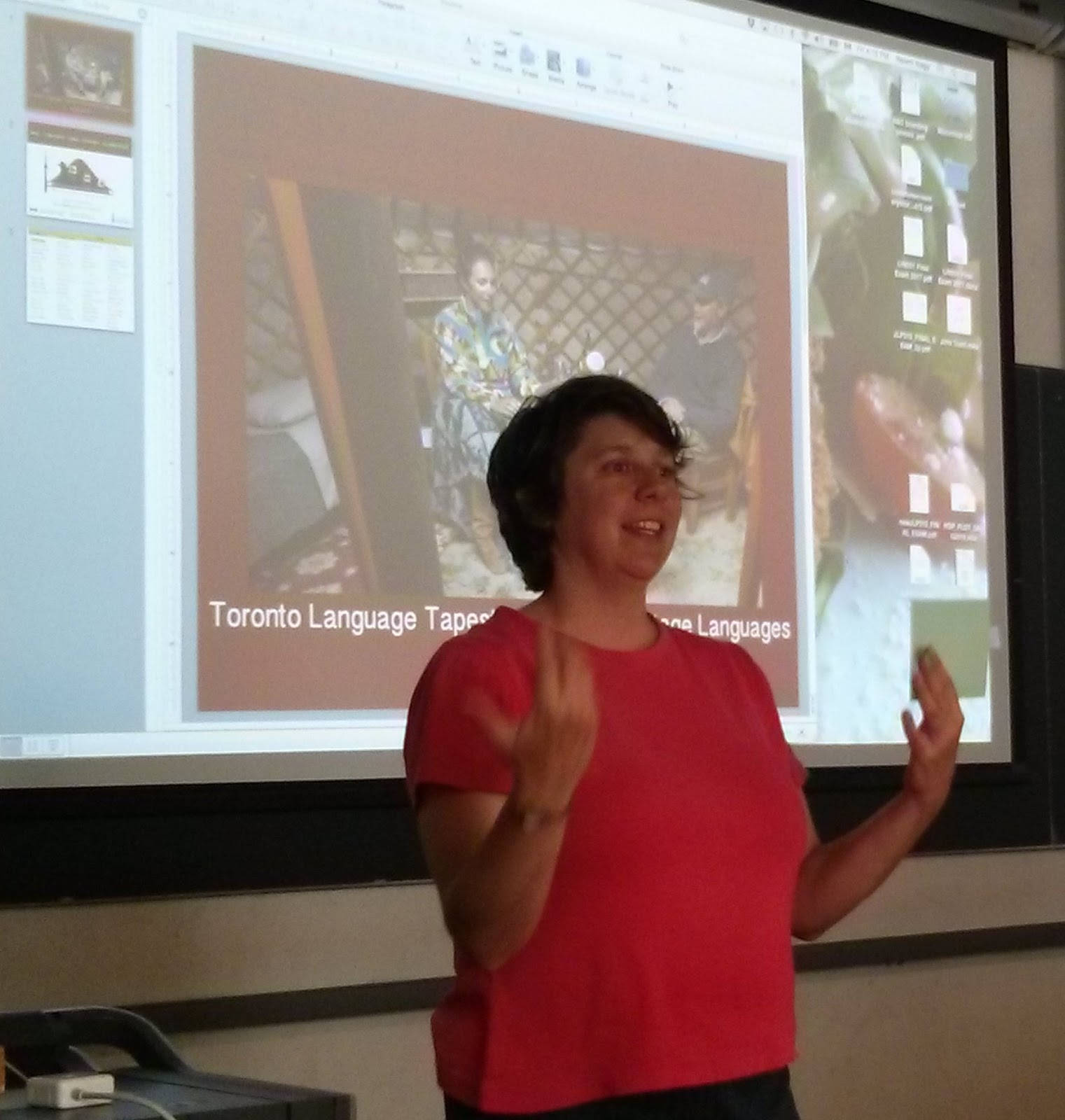
The department held its second (of three) linguistics events for Canada 150 on April 28th, 2017: "Toronto Language Tapestry: Exploring Heritage Languages". It was organized by Naomi Nagy, with organizational assistance was provided by: Katharina Pabst, Savannah Meslin, Darcie Blainey, Frederick Gietz, Robert Prazeres, Elaine Gold and Diane Massam.
Here are some pictures (from the event website).
Here are some pictures (from the event website).
 |
| Welcome to all! |
 |
| Lots to discuss. |
 |
| Rachel and Phil get started. |
 |
| Rapt audience. |
 |
| Rachel grows up bilingual. |
 |
| Phil grows up monolingual. |
 |
| Phil and graphs. |
 |
| Tracy explains VOT. |
 |
| Joanne shows stats. |
 |
| Richard and Pélagie listen. |
 |
| Paulina justifies HLVC method. |
 |
| Darcie and Paulina listen. |
 |
| Coffee break! (Brea, Savannah, Robert, Katharina, Shayna, Emily B). |
 |
| Jeff & Joanne. |
May 2, 2017
Leslie Saxon on 40 years of fieldwork
Leslie Saxon (MA 1979, now at the University of Victoria) writes to us reflecting on her fieldwork experiences as a student in our department, which started her on a long and productive career with linguistics and Aboriginal languages in particular.
Today [May 1st, 2017] is the 40th anniversary of my first research trip to the NWT as Keren’s Rice’s research assistant. I am a linguistics prof now because of that time with Keren and colleagues in Yellowknife, Fort Good Hope, Colville Lake, Norman Wells, Delı̨nę (then Fort Franklin), and Behchokǫ̀ (then Rae-Edzo). Thank you to Keren, Elizabeth, Jack, and all of the amazing staff and students of the U of T Linguistics department when I was there, and to all of the many language specialists in the NWT who went out of their way to support my learning of Dene languages and linguistics.Thanks for this Leslie, and if anyone else has thoughts or memories from the department back in the day, please send them! (utlinguistics [at] gmail [dot] com)
April 28, 2017
Ryan DeCaire in UofT Magazine
Ryan DeCaire, assistant professor in the Centre for Indigenous Studies and Department of Linguistics, was profiled on language revitalization in UofT Magazine. See the article here: "Lost Words: Dozens of Indigenous languages in Canada are in danger of disappearing. What will it take to save them?"
April 27, 2017
Alex Motut: new coordinator of the WIT program
Alex Motut (Ph.D.) has been hired by UofT for a one-year position as an Assistant Professor (Teaching Stream) in the area of Writing Instruction, where she will be the coordinator of the WIT program. She's taking this position after being involved with WIT as the Lead Writing TA for our department (not to mention her other pedagogical experience being involved in e.g. the Teaching Assistants' Training Program, etc.).
WIT (Writing Instruction for TAs) is an initiative within the Faculty of Arts and Science with the goal of ensuring that, in addition to learning the material of a course, students develop their writing skills so they can properly express their knowledge of the material. (This is tailored toward each field, so that students in Chemistry learn how to write lab reports, etc.) As the name suggests, WIT focuses on the role of teaching assistants in improving students' writing skills.
Congrats, Alex!
WIT (Writing Instruction for TAs) is an initiative within the Faculty of Arts and Science with the goal of ensuring that, in addition to learning the material of a course, students develop their writing skills so they can properly express their knowledge of the material. (This is tailored toward each field, so that students in Chemistry learn how to write lab reports, etc.) As the name suggests, WIT focuses on the role of teaching assistants in improving students' writing skills.
Congrats, Alex!
April 26, 2017
Reminder: Linguistics Event #2 for Canada 150 (Fri, April 28, 2017)
This Friday afternoon (Apr. 28) we offer
Toronto Language Tapestry: Exploring Heritage Languages.
It’s the second of a 3-part series featuring languages spoken in and around
Toronto, sponsored by the Department of Linguistics and Canada’s
Sesquicentennial Initiatives Fund, University
of Toronto.
Friday, April 28, 2017, 12pm-5pm
Woodsworth College, Room 126, 119 St. George Street
Cocktail reception in the LIN lounge after.
Article in
The Varsity:
http://thevarsity.ca/2017/04/25/from-toronto-to-tronna/
April 25, 2017
Pictures from TOM 10 (2017)
Thanks to Guillaume Thomas for these pictures from the dinner party from the 10th Toronto Ottawa Montreal workshop in semantics (TOM10), recently held here at UofT.


April 24, 2017
Read Between the Signs: 150 Years of Language in Toronto (Canadian Language Museum exhibit opening)
150 Years of Language in Toronto
When:
Wednesday May 3, 2017
6pm - 8pm
Where:
Canadian Language Museum
Glendon Gallery, Glendon College
2275 Bayview Avenue
Toronto M4N 3M6
April 22, 2017
Fieldwork Group guest speaker: Dagmar Jung (University of Zurich) - April 26, 2017
This talk in Fieldwork Group is set for Wednesday, April 26th (2017) at 3pm in Sidney Smith 1084. A reception is being held after.
Transcription as family affair – representing variation in the Dene language acquisition study
Dagmar Jung, University of Zurich
The Dene Sųlıné language acquisition study (DESLAS) started in 2015 in Northern Saskatchewan (Canada) to document children’s language learning (between 2 and 4 years of age). The longitudinal study aims to have at least 4 children 4 hours per month recorded. The recordings are usually done by the mother or a relative of the child at home. We aim at a natural setting, i.e. oftentimes the family will set up the camera in the evening in the living room with several family members present.
Due to difficulties in the field we had to start and stop with different families several times, leading to a much larger corpus than initially envisioned. In order to transcribe the recordings (as of January 2017 446 sessions with about 380 hours of recordings) without access to previous linguistic documentation of this variety, some of the families that record also started to transcribe using ELAN. The transcription process started to reveal a wealth of speaker knowledge regarding intra-generational as well as inter-generational language varieties. The question of the depth of their representation in ELAN/Toolbox is still being tested. In this talk I will present data discussed by the transcribers that lead to representational problems for the linguist.
Dagmar Jung, University of Zurich
The Dene Sųlıné language acquisition study (DESLAS) started in 2015 in Northern Saskatchewan (Canada) to document children’s language learning (between 2 and 4 years of age). The longitudinal study aims to have at least 4 children 4 hours per month recorded. The recordings are usually done by the mother or a relative of the child at home. We aim at a natural setting, i.e. oftentimes the family will set up the camera in the evening in the living room with several family members present.
Due to difficulties in the field we had to start and stop with different families several times, leading to a much larger corpus than initially envisioned. In order to transcribe the recordings (as of January 2017 446 sessions with about 380 hours of recordings) without access to previous linguistic documentation of this variety, some of the families that record also started to transcribe using ELAN. The transcription process started to reveal a wealth of speaker knowledge regarding intra-generational as well as inter-generational language varieties. The question of the depth of their representation in ELAN/Toolbox is still being tested. In this talk I will present data discussed by the transcribers that lead to representational problems for the linguist.
April 21, 2017
TOM 2017 at UofT
The 10th Toronto Ottawa Montreal workshop in semantics (TOM10) is being held here at the University of Toronto on April 22nd, 2017. See the website here. Talks and posters from UofT:
Frederick Gietz (Ph.D.): Aspectual particles and conversational implicature
Angelika Kiss (Ph.D.): Since when-questions operating on the common ground
Filipe Kobayashi (Dept. of Spanish and Portuguese): On the interpretation of modal auxiliaries below progressive aspect
Michela Ippolito (faculty), Angelika Kiss (Ph.D.), and Tomohiro Yokoyama (Ph.D.): The Semantics of Object Marking in Kinyarwanda
Frederick Gietz (Ph.D.): Aspectual particles and conversational implicature
Angelika Kiss (Ph.D.): Since when-questions operating on the common ground
Filipe Kobayashi (Dept. of Spanish and Portuguese): On the interpretation of modal auxiliaries below progressive aspect
Michela Ippolito (faculty), Angelika Kiss (Ph.D.), and Tomohiro Yokoyama (Ph.D.): The Semantics of Object Marking in Kinyarwanda
April 20, 2017
Jack Chambers on the Maple Leafs in the Washington Post
With the Washington Capitals currently playing the Leafs in the first round of the 2017 Stanley Cup Finals, some people at the Washington Post were wondering why the Maple Leafs aren't the Maple Leaves. Jack Chambers filled them in: The less-than-thrilling reason the Toronto Maple Leafs are not the Maple Leaves
April 19, 2017
Report from visiting scholar Sarah Loriato
Sarah Loriato, who visited us from the University of Bergamo, Italy, has given us a few words on her time here, which she called a "wonderful experience".
From 26 February until 25 March 2017, the Linguistic Department allowed me to perform my research under the supervision of Professor Naomi Nagy, who coordinates the Heritage Language Variation and Change Project (HLVC). Besides learning how to design and carry out my research project in the sociolinguistic subfield of quantitative variation, I attended LIN1256 – the Language Contact, Corpora & Analysis course and participated in many events that took place in the Department of Linguistics during this time. It was an honor to have visited the Department of Linguistics under the supervision of Professor Nagy and be surrounded by such a variety of highly intellectual and interesting individuals. In a month I learned more than I could ever have imagined about heritage languages and quantitative analysis of sociolinguistics data and I greatly appreciate the opportunity that was offered to me.
April 17, 2017
Becky Tollan running an experiment in Niue
Becky Tollan is running an experimental study on processing of questions in the Niue language. Here she is on Niue Island with Lynsey Talagi.


Subscribe to:
Posts (Atom)