Thursday, June 23 - 11:00 AM to 1:00 PM in SS1086
Syntax/Semantics Group
Lauren Eby Clemens (SUNY Albany): "Phonological phrasing in Rutooro and the problem of relative clauses."

University of Toronto Department of Linguistics Blog
June 20, 2016

June 19, 2016
Sociolinguistics Symposium 21
The 21st Sociolinguistics Symposium is taking place at the Universidad de Murcia in Spain from June 15 to 18.
Naomi Nagy (faculty) is presenting "Contact effects and attitude in Toronto's heritage languages."
Emilie LeBlanc (MA 2014, now at York University) is presenting "C'est right addictive, comme super addicting: Diachronic changes in the use of intensifiers in Chiac."
Former visiting scholar Véronique Lacoste (University of Freiburg) and colleague Mirjam Eiswirth (University of Edinburgh) are presenting "English among Haitians in Toronto: Phonetic variation in an expanding community."
June 12, 2016
CRC-Sponsored Summer Phonetics/Phonology Workshop
The annual CRC-Sponsored Summer Phonetics/Phonology Workshop hosted by our department will be taking place on Thursday, June 16, from 8:45 AM to 5:00 PM, in Wordsworth College room 121. The program comprises talks by departmental members of every sort from undergraduate to faculty to alumni, and is as follows:
9:00 AM - 9:30 AM
Peter Jurgec (faculty): "Coronal alternations in Slovenian."
9:30 AM - 10:00 AM
Joanna Chociej (Ph.D.): "Are all grammaticality judgments created equal?"
10:00 AM - 10:30 AM
Paul Arsenault (Ph.D. 2012, now at Tyndale University College): "Retroflexion in South Asia: Typological patterns and areal distributions."
10:30 AM - 10:45 AM
Break
10:45 AM - 11:15 AM
Ross Krekoski (Ph.D.): "Complexity and reanalysis in Chinese tonal systems."
11:15 AM - 11:45 AM
Yoonjung Kang (faculty): "Paradigm uniformity in Heritage Korean."
11:45 AM - 12:15 PM
Keren Rice (faculty) "Why inconsistent allophony: Pressure for paradigm uniformity in Fort Good Hope Dene."
12:15 PM - 1:45 PM
Lunch in the department lounge
1:45 - 2:15 PM
Mary Aksim (MA): "Perceiving the Canadian Vowel Shift: The L effect."
2:15 PM - 2:45 PM
Darcie Blainey (postdoc): "A phonetic sketch of Louisiana French schwa."
2:45 PM - 3:15 PM
Gloria Mellesmoen (MA): "Are BAGELS in the BAG? /ei/ in British Columbia English."
3:15 PM - 3:30 PM
Break
3:30 PM - 4:00 PM
Gabriel So (BA): "Consonant harmony in Harmonic Serialism."
4:00 PM - 4:30 PM
Heather Yawney (Ph.D.): "Irregular stress on the right foot to be faithful: The case of Turkish adverbials with -en."
4:30 PM - 5:00 PM
B. Elan Dresher (faculty) and Aditi Lahiri (University of Oxford): "Latinate suffi xes and the directionality of English stress."
Thanks to the organizing committee - Peter Avery (Ph.D. 1996, now at York University), Peter Jurgec (faculty), Alexei Kochetov (faculty), Keren Rice (faculty), and Jessamyn Schertz (postdoc) - for all of their hard work!
June 11, 2016
Research Groups: June 13-17
Tuesday, June 14 - 12:00 PM to 1:00 PM in SS 2116
Psycholinguistics Group
Cassandra Chapman (McMaster University): Presentation on recent research involving eye-movements and reconstruction effects in 'how many' questions.
Thursday, June 16 - 11:00 AM to 1:00 PM in SS1086
Syntax/Semantics Group
Margot Vivanco (Universidad Complutense de Madrid): "Ø-marked Spanish anticausatives and the scalar nature of change of state events."
June 8, 2016
24th Manchester Phonology Meeting
The 24th Manchester Phonology Meeting took place between May 26 and 28. U of T graduates in particular were prominently featured!
Christina Bjorndahl (MA 2008, now at Cornell University):
"The typology of voiced spirants and the emergence of [sonorant]."
B. Elan Dresher (faculty) and colleague Aditi Lahiri (Oxford University):
"Latinate suffixes and the directionality of English stress."
William J. Idsardi (BA 1988, now at the University of Maryland):
"Categorization, evidence, and phonology."
Sara Mackenzie (Ph.D. 2009, now at Memorial University of Newfoundland) and colleague Joe Argentino (Memorial University of Newfoundland):
"Parallel patterns between language games and serial music."
Sharon Rose (BA 1990, now at the University of California, San Diego):
"How phonology and typology are shaped: Lessons from fieldwork."
June 6, 2016
Research Groups: Week of June 6-10
Thursday, June 9 - 11:00 AM - 1:00 PM in SS 1086
Syntax/Semantics Group
Tomohiro Yokoyama (Ph.D.): "Featural account for the ordering of object markers in Kinyarwanda."
Syntax/Semantics Group
Tomohiro Yokoyama (Ph.D.): "Featural account for the ordering of object markers in Kinyarwanda."
June 4, 2016
Report from CLA-ACL

The 2016 meeting of the Canadian Linguistic Association/Association canadienne de linguistique was held in Calgary from May 28 to 30. Above are some of the many attendees with links to our department: Bettina Spreng (Ph.D. 2012, now at the University of Saskatchewan), Richard Compton (Ph.D. 2012, now at l'Université du Québec à Montréal), Nicole Rosen (Ph.D. 2007, now at the University of Manitoba), Patrick Murphy (Ph.D.), Carrie Dyck (Ph.D. 1995, now at Memorial University of Newfoundland), Elaine Gold (faculty), and Diane Massam (faculty).
June 3, 2016
Report from Complexity in Acquisition Workshop

June 2, 2016
LIN398 adventurers in Kapuskasing
Every year, faculty member Sali A. Tagliamonte applies for funding for a LIN398 course in order to take undergraduate students on a research excursion trip to Northern Ontario and teach the methods and practises of fieldwork in variationist sociolinguistics. This year's field trip is well underway, and the students have been hard at work!
Why is LIN398 so worthwhile?
Well, the short answer is because it's fun. The more important reason is because the immense hinterland of Ontario presents a sociolinguistic goldmine of untapped regional variation. The research coming out of my laboratory on Ontario dialects is not only an enterprise of language documentation, it is also leading to innovative contributions to sociolinguistics. LIN398 is an invaluable adjunct to these enterprises. Moreover, it offers the ideal training ground for students. An add-on benefit is the incredibly positive community outreach and engagement that is forged in the process. In the research excursion, we collect oral histories from people born and raised in whatever community we go to and then produce a book and DVD of stories that we return to the library, museum or other community organizations.
Where are you this year?
We are Kapuskasing, Ontario, a small city on the most northerly point of Highway 11. It took us two days to get here. From Toronto, it is 850 kilometers due north. Kap (as it is called by locals) is a minority English-speaking community where two-thirds of the population are francophone. This presents a unique language-contact situation.

Which students are with you this year?
Cedric Ludlow, John Lubanski, Jennifer McNeillie, and Lisa Schlegl.

What are they doing right now?
They are very busy conducting sociolinguistic interviews with people born and raised in the community and asking them questions that bring local culture, lore and language to the surface in narratives of personal experience. So far we have discovered an incredible wealth of traditions, experiences, and many heartwarming tales. As of yesterday morning the students had collected 55 interviews!
May 28, 2016
Report from DiPVaC 3 and CVC 9
Discourse-Pragmatic Variation and Change 3 (May 4-6) and Change and Variation in Canada (May 7-8) both took place at the University of Ottawa this month.
Sali A. Tagliamonte (faculty) and Bridget Jankowski (Ph.D. 2013) helped kick off DiPVaC 3 with a look at the uses of there and here as non-locative deictic markers in Northern Ontario - a characteristic feature of the region.

Derek Denis (Ph.D. 2015, now at the University of Victoria) presented joint work with Alexandra D'Arcy (Ph.D. 2005, now at the University of Victoria) and Martina Wiltschko (University of British Columbia) on how to break down the multiple functions of utterance-final particles from the perspective of microsyntax.
Sali and Bridget returned to the stage to present on particles of the left periphery of the clause in Canadian English.

Former visiting student Claire Childs (Newcastle University) gave a presentation on effects of different kinds of interviewers on how negative tags are produced in dialects of British English.
Claire's talk ultimately won the Best Student Paper award of the conference. Well done, Claire! Also, MA student Mary Aksim won the book draw.

DiPVaC 3 was also notable for being likely the first linguistics conference at which a certain Canadian game-show host put in an appearance.

Change and Variation in Canada began the day after DiPVaC 3 and also featured a number of linguists associated with our department.
Marisa Brook (Ph.D.) presented on two linked levels of morphosyntactic change affecting subordinate clauses after perception verbs in Canadian and British English.
Ruth Maddeaux (Ph.D.), Paulina Lyskawa (MA 2015, now at the University of Maryland), Emilia Melara (Ph.D.), and Naomi Nagy (faculty) gave a presentation about whether code-switching is correlated with contact effects between English in Toronto and heritage Polish spoken by immigrants and their descendants.
Lex Konnelly (MA) presented on uses of discourse like in the queer community of Toronto and the role of small versus medium sample sizes.
Brianne Süss (MA) presented about uses of 'eh?' in rural parts of Ontario west of Ottawa, where the form enjoys a higher degree of popularity as in the nearest large cities.
Shayna Gardiner (Ph.D.) gave a presentation of a meta-analysis of studies in the journal Language Variation and Change, probing whether cases of stable variation require a continuous factor to be essentially holding them in place.
Mary Aksim (MA) presented an analysis of -s versus -th third-person-present verbal inflection in Early Modern English as represented by three female letter-writers of the time.
Incoming Ph.D. student Katharina Pabst (University of Buffalo) and faculty member Sali A. Tagliamonte, presented results of a project undertaken with Sali's class from the 2015 Linguistic Society of America Institute in Chicago, on words for 'very good' (cool, awesome, excellent, wonderful, splendid, superb, etc.) in Ontario English.


The last talk of CVC 9 was by Sali and Ruth, on 'small' and 'little' and their synonyms in various Northern Ontario communities.

And with that, five days of intense LVC-ing came to an end. Special thanks to the organizers of the conferences for even more hard work than usual!
Sali A. Tagliamonte (faculty) and Bridget Jankowski (Ph.D. 2013) helped kick off DiPVaC 3 with a look at the uses of there and here as non-locative deictic markers in Northern Ontario - a characteristic feature of the region.

(Photo by Nathalie Dion.)
Derek Denis (Ph.D. 2015, now at the University of Victoria) presented joint work with Alexandra D'Arcy (Ph.D. 2005, now at the University of Victoria) and Martina Wiltschko (University of British Columbia) on how to break down the multiple functions of utterance-final particles from the perspective of microsyntax.
Sali and Bridget returned to the stage to present on particles of the left periphery of the clause in Canadian English.

(Photo by Marisa Brook.)
Former visiting student Claire Childs (Newcastle University) gave a presentation on effects of different kinds of interviewers on how negative tags are produced in dialects of British English.
Claire's talk ultimately won the Best Student Paper award of the conference. Well done, Claire! Also, MA student Mary Aksim won the book draw.

Brianne Süss (MA), Mary Aksim (MA), Ruth Maddeaux (Ph.D.), Marisa Brook (Ph.D.), and Shayna Gardiner. (Ph.D.) (Photo by Sali A. Tagliamonte.)
DiPVaC 3 was also notable for being likely the first linguistics conference at which a certain Canadian game-show host put in an appearance.

Derek Denis (Ph.D. 2015, now at the University of Victoria) and Ruth Maddeaux (Ph.D.) provide a hint.
Change and Variation in Canada began the day after DiPVaC 3 and also featured a number of linguists associated with our department.
Ruth Maddeaux (Ph.D.), Paulina Lyskawa (MA 2015, now at the University of Maryland), Emilia Melara (Ph.D.), and Naomi Nagy (faculty) gave a presentation about whether code-switching is correlated with contact effects between English in Toronto and heritage Polish spoken by immigrants and their descendants.
Lex Konnelly (MA) presented on uses of discourse like in the queer community of Toronto and the role of small versus medium sample sizes.
Brianne Süss (MA) presented about uses of 'eh?' in rural parts of Ontario west of Ottawa, where the form enjoys a higher degree of popularity as in the nearest large cities.
Shayna Gardiner (Ph.D.) gave a presentation of a meta-analysis of studies in the journal Language Variation and Change, probing whether cases of stable variation require a continuous factor to be essentially holding them in place.
Mary Aksim (MA) presented an analysis of -s versus -th third-person-present verbal inflection in Early Modern English as represented by three female letter-writers of the time.

Katharina and Sali's talk. (Photo by Nathalie Dion.)
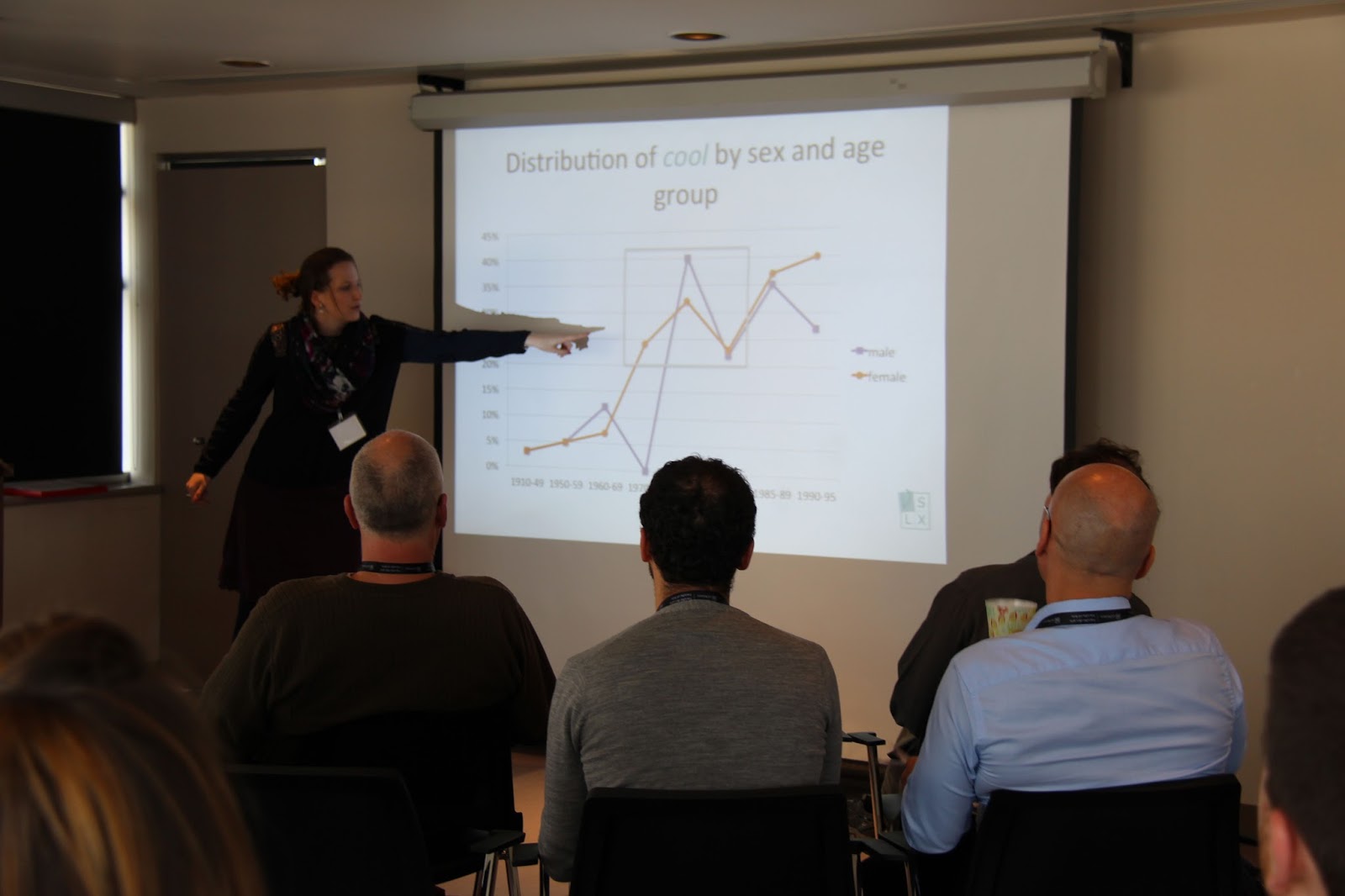
Katharina describes a 'cool' pattern. (Photo by Nathalie Dion.)

(Photo by Nathalie Dion.)
And with that, five days of intense LVC-ing came to an end. Special thanks to the organizers of the conferences for even more hard work than usual!
May 27, 2016
Elizabeth Cowper and Christina Kramer on CanadaAM
Faculty members Elizabeth Cowper (Linguistics) and Christina Kramer (Slavic Languages and Literatures), along with Michael Albano (a resident stage director of opera at the U of T) were interviewed this week on CTV's CanadaAM about the job of reading students' names at convocation, the challenge of trying to get pronunciations correct, and 'Convocation Bootcamp' (founded by Elizabeth), which trains name readers in advance.
May 25, 2016
2016 Dresher Phonology Prize and Cowper Syntax Prize
We are very pleased to announce the winners of our annual graduate student term-paper awards: the Elizabeth Cowper Syntax Prize and the B. Elan Dresher Phonology Prize. These are awarded to the authors of outstanding papers in the graduate syntax and phonology courses.
Elizabeth Cowper Syntax Prize: Shay Hucklebridge (MA)
B. Elan Dresher Phonology Prize: Maida Percival (Ph.D.)
Congratulations to Shay and Maida for their excellent work. We would like to thank all those who have helped to make these prizes available.
Elizabeth Cowper Syntax Prize: Shay Hucklebridge (MA)
B. Elan Dresher Phonology Prize: Maida Percival (Ph.D.)
Congratulations to Shay and Maida for their excellent work. We would like to thank all those who have helped to make these prizes available.
May 24, 2016
CLA-ACL 2016
The 2016 meeting of the Canadian Linguistic Association/Association canadienne de linguistique is taking place in Calgary, Alberta from May 28 to 30 as part of this year's Congress of the Humanities and Social Sciences. Presenters associated with our department are:
Neil Banerjee (BA):
"Of monsters and modals."
Laura Colantoni (faculty), Alexei Kochetov (faculty), and Jeffrey Steele (faculty, French):
"Ongoing L1-based influence in the L2 acquisition of the phonology and phonetics of English word-final nasals."
Elizabeth Cowper (faculty)
"The nature of finiteness."
Hong-Yan Liu (MA)
"Also introducing arguments: The Mandarin ba construction."
Patrick Murphy (Ph.D.), Philip Monahan (faculty), and Meg Grant (faculty)
"Affrication patterns and perceptual tendencies in Canadian and European French."
Erin Pettibone (Ph.D., Spanish and Portuguese), Gabrielle Klassen (Ph.D., Spanish and Portuguese), and Ana Teresa Pérez-Leroux (faculty)
"Bilingual effects in recursive noun phrases."
French Ph.D. student Melanie Elliott:
"Direct and indirect object omission in the Spanish of bilingual Spanish-French children."
Keir Moulton (MA 2002, now at Simon Fraser University) with colleagues Elizabeth Bogal-Allbritten (Simon Fraser University) and Junko Shimoyama (McGill University)
"Stay inside: The interpretation of internally-headed relative clauses in Navajo."
Keir Moulton (MA 2002, now at Simon Fraser University) with Nino Grillo (Humboldt-Universität zu Berlin)
"Exceptional agreement in Italian pseudo-relatives."
Avery Ozburn (MA 2014, now at the University of British Columbia):
"Investigating the motivations of sibilant harmony: Coarticulation and speech errors."
Glyne Piggott (Ph.D. 1974, now at McGill University), with colleagues Lisa Travis (McGill) and Heather Newell (Université de Québec à Montréal):
"Linking syntax to phonology in possession."
Nicole Rosen (Ph.D. 2007, now at the University of Manitoba) with colleague Lanlan Li (University of Manitoba):
"Ethnicity and rurality in the Prairies: The case of /æ/."
Bettina Spreng (Ph.D. 2012, now at the University of Saskatchewan):
"am-Progressives in Swabian: Some evidence for pseudo-noun-incorporation."
Former student Elizabeth Ritter (Ben Gurion University/University of Calgary) and colleague Martina Wiltschko (University of British Columbia):
"Humanness as an alternative to case-licensing."
Daniel Currie Hall (Ph.D. 2007, now at St. Mary's University):
"Phonological identity is phonological identity."
Ewa Czaykowska-Higgins (MA 1984, now at the University of Victoria) with UVic colleague Sonya Bird:
"Salish consonant clusters: Phonetic evidence for syllable parsing?"
Also, three Ph.D. students from the Department of Spanish and Portuguese are presenting posters:
Erin Pettibone:
"The acquisition of multiple adjective order in second language (L2) Spanish."
Malina Radu:
"Conditioned variability in the realization of Romanian rhotics."
Olga Tararova:
"The transfer of negative doubling in a bilingual community, Chipilo, Mexico."
May 23, 2016
Alana Johns in Nain
Alana Johns (faculty) has recently returned from a field trip to Nain, Nunatsiavut, where she has been working to set up a team of community researchers on the Sinâni Project (funded by SSHRC). The project's goal is to collect and transcribe a great deal of Inuttitut stories/conversations. These materials will be used for linguistic analysis and community heritage purposes.
During her time in Nain, Alana was interviewed on the radio (link to mp3) about the Sinâni Project. She also sends along the following pictures and captions:


During her time in Nain, Alana was interviewed on the radio (link to mp3) about the Sinâni Project. She also sends along the following pictures and captions:

"This is a photo from the installation of the new President of Nunatsiavut Johannes Lampe.
This took place in Nain May 4, 2016. I was lucky to be there so I could attend this occasion."
This took place in Nain May 4, 2016. I was lucky to be there so I could attend this occasion."

"The only means of transportation in town on May 4 was still skidoos, but by the time I left on May 16 people were
using vehicles and skidoos were not possible on the town roads, though they were still used to go out on the land."
using vehicles and skidoos were not possible on the town roads, though they were still used to go out on the land."
May 22, 2016
Spring Reunion lecture by Elaine Gold
The Friends of Linguistics at the University of Toronto (flʌut) and Spring Reunion 2016 are co-hosting a lecture by faculty member Elaine Gold: "Bringing linguistics to the public: The Canadian Language Museum." This will be taking place on Wednesday, May 25, from 7 to 9 PM, in the department lounge.
Elaine founded the Canadian Language Museum in 2011 aiming to reach the Canadian public through short, portable exhibits on languages in Canada. Thus far, the Museum has created and curated five such travelling exhibits, as follows:
Canadian English, Eh? (2012)
Speaking the Inuit Way (2013)
Le français au Canada (2014)
Cree: The People’s Language (2015)
A Tapestry of Voices: Celebrating Canada’s Languages (2016)
Elaine will be discussing her work and the role of the Museum and its future directions. The presentation will be followed by a period of informal discussion and then a reception. Students, alumni, faculty, and friends are all welcome!
May 21, 2016
Workshop on Complexity in Learnability and Development
The Complexity and Recursion group is hosting a workshop with the theme of Complexity in Learnability and Development, supported by a SSHRCC grant to faculty members Ana-Teresa Pérez-Leroux and Yves Roberge. The workshop will be taking place in University College room 140 on Wednesday, May 25, from 9 AM (coffee) to 5 PM.
Ana-Teresa will be giving the opening remarks at 9:30 AM. Other projects being presented as talks are as follows:
Erin Pettibone (Ph.D., Spanish and Portuguese), Gabrielle Klassen (Ph.D., Spanish and Portuguese), and Ana-Teresa Pérez-Leroux (faculty):
"Bilingual effects in recursive noun phrases."
Gabrielle Klassen (Ph.D., Spanish and Portuguese), Erin Hall (Ph.D.), Ana-Teresa Pérez-Leroux (faculty), and colleague Anny P. Castilla-Earls (University of Houston)
"Children's use of relative clauses in recursive and non-recursive modification."
Kazuya Bamba (Ph.D.), Midori Hayashi (Ph.D. 2011), Manami Hirayama (Ph.D. 2009, now at Ritsumeikan University), and Ana-Teresa Pérez-Leroux (faculty):
"On the development of complexity in Japanese nominal recursion."
May 20, 2016
Acoustical Society of America 2016
The 2016 meeting of the Acoustical Society of America is being held from May 23 to 27 in Salt Lake City, Utah.
Several department members will be presenting posters:
Alexei Kochetov (faculty):
"The acoustics of strengthened glides in Kirundi."
Alexei Kochetov (faculty) and colleague N. Sreedevi (All India Institute of Speech and Hearing):
"Manner-specific tongue shape differences in the production of Kannada coronal consonants."
Kiranpreet Nara (Ph.D.):
"Acoustic analysis of Punjabi stress and tone (Doabi dialect)."
Maida Percival (Ph.D.):
"Affricate contrasts in Déline Slavey."
Luke West (MA 2015, now at UCLA):
"Pitch specification of minor syllables in Sgaw Karen."
May 19, 2016
Marshall Chasin and Jann Arden team up for hearing-loss awareness
In conjunction with Speech and Hearing Awareness Month, faculty audiologist Marshall Chasin recently sat down with Canadian singer-songwriter Jann Arden and Breakfast Television to talk about the importance of monitoring oneself for hearing loss and following up.
A video of their interview can be found on the Breakfast Television page. There is additional footage on Arden's Facebook page of her undergoing a hearing test.
A video of their interview can be found on the Breakfast Television page. There is additional footage on Arden's Facebook page of her undergoing a hearing test.
May 18, 2016
Research Groups: Week of May 16-20
Thursday, May 19 - 11:00 AM to 1:00 PM in SS 1086
Syntax/Semantics Group
Two practise talks for CLA-ACL: Neil Banerjee (BA) and Nicholas Welch (postdoc).
Friday, May 20 - 2:00 PM to 3:00 PM in SS 560A
Semantics/Pragmatics Group
Rory Harder (Department of Philosophy): "Deontic modals: Inference patterns and understanding."
Here are two desiderata that a theory of meaning for deontic modals should meet: (1) given that P entails Q , it does not follow that Ought(P) entails Ought(Q); and (2) if, in a given context c, a speaker who is semantically competent with the term Ought can make a sincere judgment that Ought(P), a theory of meaning for Ought should not rule out the truth-hood of Ought(P) in c. The first is called non-upward monotonicity, and the second semantic neutrality. It is surprising to me that no theory of meaning for deontic modals has been presented in the literature that meets both of them. In this paper, I first summarize some results that show that the semantics from Kratzer (1981) and Lassiter (2011) fail to meet at least one of the desiderata. I then present some novel results in this vein. A couple recent theories, from Cariani (2013) and Fusco (2015), designed specifically to meet constraints like (1), fail to meet (2). And a couple recent neutral theories, from Carr (2015) and Charlow (forthcoming), designed specifically to meet (2), fail to meet (1), and also, thereby, fail to fully meet (2) as well. In conclusion, I make some general suggestions for how an adequate semantics for deontic modals could be constructed.
May 17, 2016
Guest speakers: Jason Rothman (University of Reading) and Elena Valenzuela (University of Ottawa)
The Jackman Humanities Institute is hosting two talks on Friday the 20th from 1 to 3 PM in room 100 of the Jackman Humanities Building (170 St. George Street). The talks are being co-sponsored by a JHI working group dedicated to the topic of multilingualism in Canada and by the Department of Language Studies at our Mississauga campus.
Jason Rothman (University of Reading):
“On the sources of differences in heritage language bilinguals: Why different is not incomplete.”
In this talk, I will first introduce the audience to and problematize both the concept of what a heritage language bilingual is and the literature that has studied their competence outcomes in adulthood over the past two decades. Heritage speakers are native – often child L1 or 2L1 – speakers of a minority 'home' language who (usually) become dominant speakers starting at school-age in the external societal majority language of the national community in which they grow up and are educated. Typically, heritage speakers show interesting differences in their knowledge and performance in the heritage language as compared to age-matched monolinguals. Often, such differences have been labelled as instances of incomplete acquisition (e.g. Montrul 2008) or attrition (Polinsky 2011). Under both accounts, although for different reasons, heritage language bilingual differences are viewed as some type of deficiency. I will propose that many differences, alternatively, could have only developed the way we see them in heritage grammars for reasons related to qualitative differences in the input heritage speakers receive (e.g. Rothman 2007; Pires and Rothman 2009; Pascual y Cabo and Rothman 2012). In doing so, I will link a process of cross-generational attrition to (some) outcomes in heritage language development. I conclude by suggesting that many aspects argued to be incompletely acquired in heritage language grammars are in fact complete, but unavoidably different.
Elena Valenzuela (University of Ottawa):
“Attachment strategies in code-switched relative clauses.”
It has been argued that monolinguals and bilinguals differ in how they resolve ambiguities in relative clause attachment. Sentences (1) and (2) contain a complex NP of the type “NP of NP” followed by a relative clause (RC). Cuetos and Mitchell (1988) were the first to note that sentences as in (1) and (2) are parsed differently depending on the language:
(1) She kissed the brother (NP1) of the poet (NP2) that was on the balcony.
(2) Ella besó al hermano (NP1) del poeta (NP2) que estaba en el balcón.
In English (1), the poet is on the balcony; in the same sentence in Spanish (2), it is the brother who is on the balcony.
Languages can be grouped according to the parsing strategy for monolinguals: high attachment (Spanish, French, Greek, Italian, Japanese, etc.) and low attachment (English, Arabic, Brazilian Portuguese, Romanian, etc.). Dussias and Sagarra (2007) found that Spanish-dominant bilinguals with limited exposure to English preferred high attachment in both languages, while bilinguals with extensive exposure to English preferred low attachment in both English and Spanish.
Using eye-tracking, this research examines parsing strategies in code-switched sentences to address the following research questions:
i. Does language dominance play a role in parsing strategies?
ii. Does direction of the language code-switch affect processing?
iii. Does the direction of the language code-switch affect processing differently based on individual’s language dominance?
Three groups of bilinguals (Spanish Heritage speakers, L2 Spanish, and L1 Spanish) were tested on their parsing strategies of Spanish/English code-switched ambiguous relative clauses. Results show that the two English dominant groups, both the L2 Spanish and the early bilinguals, had slower reading times in Spanish across the board. In contrast, the L1 Spanish group had similar reading times in both languages, which may indicate that, as in Dussias and Sagarra (2007), language exposure plays an important role. Results will be discussed in terms of processing costs and language dominance.
Subscribe to:
Posts (Atom)